Which EV charger suits your driving routine?
The right EV charger depends on how far you drive, how long the car is parked and whether your home’s electricity supply can support the charging speed. For most drivers, a 7kW home charger is suitable for overnight charging; higher-power or smart options only make sense when your car, supply and driving routine justify them.
For most drivers, a smart 7kW home charger is the sensible choice. It suits cars that spend several hours parked at home and gives you more useful charging than a standard domestic socket. A faster charger only earns its place when you regularly return with a low battery, have limited parking time and your car and electricity supply can accept the extra power.
Start with how your car is actually used. A daily commuter who leaves home with a full battery and returns with plenty of charge may not need the fastest available unit. A car used for long journeys, school runs, business travel or several trips each day may benefit from a larger charging capacity. If the car sits on the drive overnight, charging speed is often less important than reliable scheduling and a suitable installation.
- Occasional driving: a standard socket or a basic home charger may cover your needs, although a dedicated charger is safer and more convenient for regular charging.
- Regular commuting: a smart 7kW charger normally provides a practical balance between charging time, installation requirements and everyday use.
- High mileage: a higher-powered unit may be worth considering if the car supports it and you often need to add a large amount of charge between journeys.
- More than one electric vehicle: load management or charger sharing can be more useful than simply choosing the highest-rated charger.
The car sets one limit. A charger may be rated for more power than the vehicle can receive through its onboard AC charging system. In that case, a higher-rated unit does not make that particular car charge faster. The vehicle, the charger and the property’s electrical supply all need to be considered together.
Your parking pattern sets another limit. A charger on a driveway gives you more flexibility than one at the far end of a garden, where a longer cable route may affect the installation. If the car is parked away from the house during the day, scheduled charging may be less useful than a higher charging rate. If it remains at home overnight, a smart charger can spread charging across the time you have available.
Smart controls matter when charging costs vary. A smart charger can schedule charging for a chosen period rather than starting as soon as the car is connected. This can help you use a time-of-use electricity tariff or avoid charging during a period when other heavy appliances are running. The charger still needs to match the tariff, the vehicle and the way you want to use them. We can discuss the control features during the survey rather than treating them as a reason to choose a particular model.
Solar panels change the question slightly. If you generate electricity at home, you may want the charger to use surplus solar generation rather than drawing all its power from the grid. That depends on the solar inverter, the charger controls and how much surplus generation is available while the car is connected. A home battery can also affect the order in which electricity is used. We look at the existing system before recommending how the charger should interact with it.
A 7kW charger is not suitable for every property without checks. Older homes may have a consumer unit that needs upgrading, an electrical supply with limited capacity or a cable route that is difficult to protect. Rural properties can also have long distances between the parking space and the main building. We check the incoming supply, earthing arrangement, consumer unit, cable route and proposed mounting position before quoting.
A 22kW charger needs more than a bigger charger unit. The vehicle must be able to accept three-phase AC charging, and the property must have a suitable three-phase supply. Many homes have a single-phase supply, so a 22kW charger may not be possible or useful there. We confirm the available supply and the car’s charging specification before recommending this route.
A load-managed charger can help when the supply is constrained. Your home may already be using power for an electric shower, cooker, immersion heater, heat pump or battery system. A load-management device can reduce the charger’s output temporarily when demand rises, then allow charging to continue when capacity becomes available. That can be more practical than increasing the property’s supply, but it depends on the equipment and the available capacity.
The cable route affects both cost and disruption. A short run across an accessible wall is usually simpler than a route to a detached garage, outbuilding or parking area beyond a garden. Trenching, drilling through thick walls, protecting external cable and making good afterwards all need to be considered. We explain the route in the quotation, including any consumer unit or earthing work needed before installation starts.
Safety features are part of choosing the charger. The installation needs its own protected circuit, suitable residual-current protection and a safe method of isolating the equipment. Where the parking space is outside, the charger and cable route must be suitable for the location. We install the electrical work to the relevant requirements and provide the paperwork needed for the completed installation.
Our recommendation should fit the next few years, not only the current car. If you expect to change vehicles, add solar panels or install a battery, tell us during the survey. A charger that works well now may need different controls or capacity later. We can separate what is needed for safe charging today from optional work that only makes sense as part of a wider upgrade.
Our NICEIC- and ECA-registered electricians assess the charger, the vehicle, the supply and the parking arrangement as one installation. You receive a written quotation before work starts, with the recommended charger rating, cable route and any electrical changes set out clearly. That gives you a charger matched to the way you drive, rather than paying for a specification your car or property cannot use.
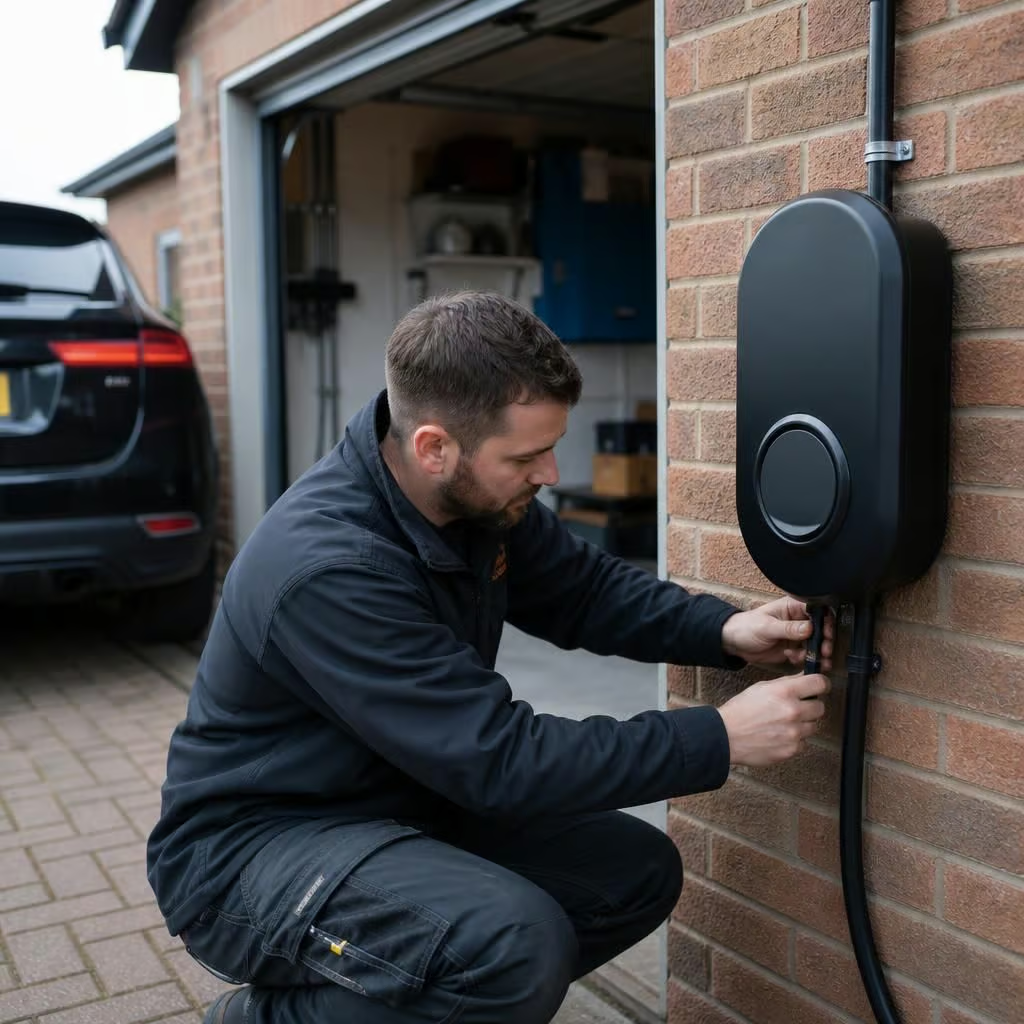
If you plug in at home most nights, a tethered charger keeps the cable ready on the unit. That saves you from taking a separate charging lead from the boot each time. We check that the cable can reach the car without crossing a walkway or becoming a trip hazard.
An untethered charger leaves the unit neater when it is not in use, which can suit a shared driveway or a home where the charger is visible from the road. You keep the charging lead in the car and connect it when needed. We can recommend the more practical arrangement after considering where you park, who uses the charger and how often the cable will be handled.