How often should portable appliances be PAT tested?
There is no legally fixed interval for PAT testing portable appliances; the right frequency depends on the appliance, how often it is used, its environment and the risk of damage. Carry out regular visual checks and arrange formal inspection or testing when your risk assessment shows it is needed, rather than relying on an automatic annual schedule.
There is no legally fixed PAT testing interval. The appropriate frequency depends on the risk presented by each appliance and its surroundings. A phone charger in a clean office does not need the same attention as a power tool used on a building site.
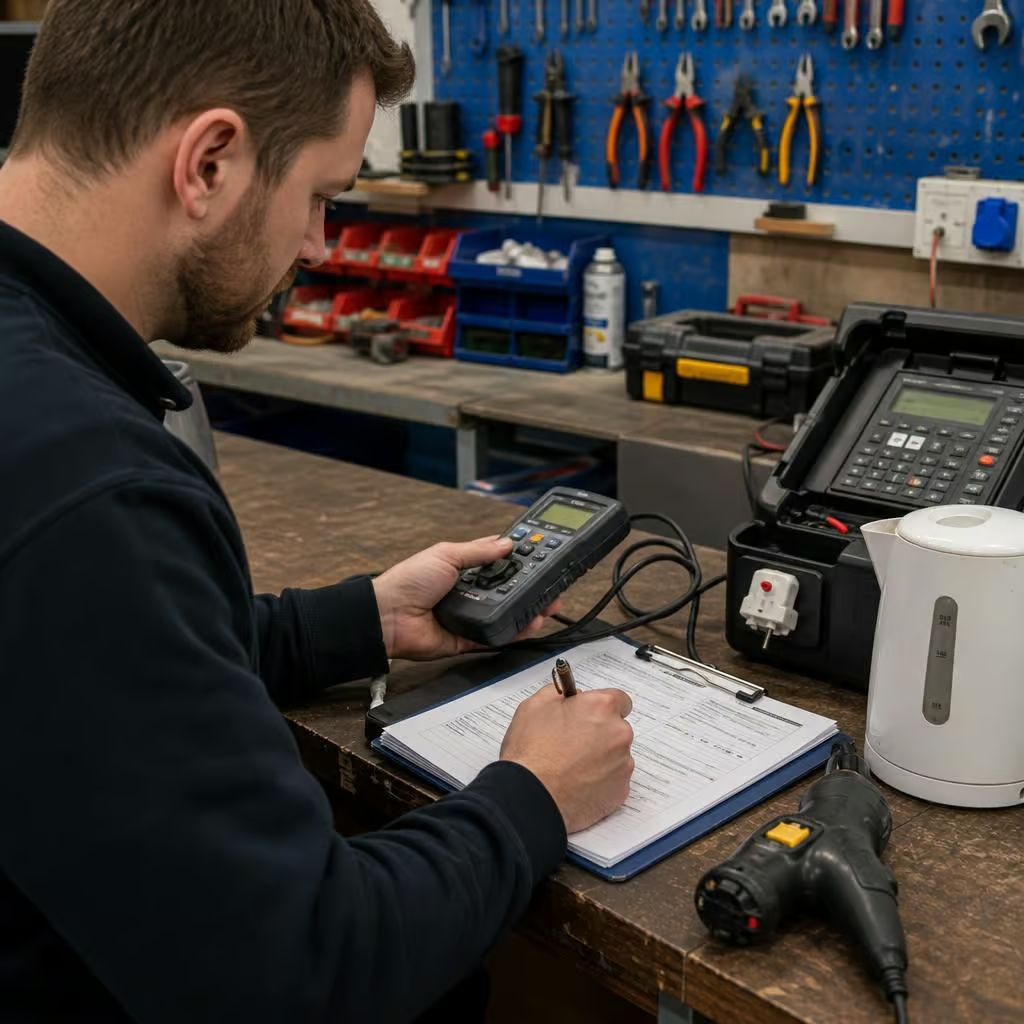
PAT testing is also not a single test that applies identically to every item. We normally combine a visual inspection with electrical tests where the appliance, its construction and the environment make those tests appropriate. That gives you a more useful maintenance record than applying one automatic date to every appliance.
What determines the testing interval?
- How the appliance is used: equipment that is plugged in, unplugged or moved regularly is more likely to suffer damage.
- Where it is used: dust, moisture, heat, chemicals and outdoor conditions can shorten the safe working life of plugs, cables and casings.
- Who uses it: equipment handled by trained staff may receive more careful treatment than equipment used by the general public, children or visitors.
- The consequences of failure: an appliance used in a higher-risk workplace may need closer attention than one used for a low-risk office task.
- The appliance’s construction: Class I equipment relies on an earth connection, while Class II equipment has additional insulation. The suitable checks differ between them.
- The condition and history of the equipment: repeated faults, repairs, heavy use or previous damage are reasons to review the interval.
These points should be considered together. A rarely used appliance can still be unsafe if its cable has been crushed or its plug has been exposed to damp. An appliance in regular use may remain low risk if staff inspect it properly and the environment is controlled.
How often should visual checks take place?
Users should look at equipment before use where the risk justifies it. They can check for cracked cases, loose parts, damaged cables, bent pins, scorch marks, contamination and signs that the appliance has overheated. They should also stop using anything that gives an electric shock, smells of burning or operates unusually.
These user checks do not replace a formal inspection. They provide an early warning between planned inspections and help prevent a minor defect becoming a larger electrical risk. Staff need to know what to look for and how to report defective equipment. We can help set out a simple process that suits the premises.
When is formal PAT testing appropriate?
A formal inspection and test is sensible when the working environment creates a realistic risk of damage, when equipment is moved frequently or when the condition of appliances cannot be monitored reliably by users. Construction, agricultural, workshop, catering and outdoor equipment generally needs more attention than equipment in a clean, dry office.
Lower-risk offices may need a less frequent programme, particularly where appliances stay in place and users carry out regular checks. The interval still needs recording and reviewing rather than being assumed indefinitely. We assess the equipment and its use before recommending a programme.
There is no requirement to test every appliance every year simply because it has a plug. An annual schedule may be appropriate for some premises, but excessive testing can add cost without improving safety if the risk does not justify it. Testing too infrequently can leave damaged equipment in service. The useful interval is the one supported by the risk assessment and the condition of the equipment.
Do landlords have to PAT test every year?
Landlords do not have a universal legal requirement to PAT test every portable appliance at a set interval. They do have responsibilities to keep electrical equipment supplied with a rental property safe. The right approach depends on the appliances provided, the property’s use and the inspection arrangements in place.
At a change of tenancy, a landlord should not rely on the age of an appliance or a previous label. We can inspect the supplied equipment, identify visible damage and test items where appropriate. A record then shows what was checked and which items were removed or failed. The landlord should also give tenants clear instructions to report damage and avoid using unsafe equipment.
Portable appliances belonging to a tenant are not normally part of the landlord’s supplied inventory. A landlord may still need to consider them if the tenancy arrangement or property risk makes that relevant. We can define the scope before attending so the inspection record is clear.
What happens after a failed test?
A failed result does not always mean the appliance must be thrown away. The defect may be a damaged plug, a loose connection, a failed earth, damaged insulation or a problem within the appliance itself. We identify the reason for the failure and label or record the item so nobody puts it back into service by mistake.
Where a repair is practical, the appliance should be repaired by someone competent and tested again before it returns to use. If the defect is serious or the repair is uneconomic, removing the appliance is safer. We do not treat a label as a substitute for dealing with the fault.
How should the interval be reviewed?
The testing schedule should change when the circumstances change. Review it after a move to different premises, a change in working methods, the introduction of new equipment or a pattern of repeated failures. A near miss, electric shock or damaged cable is also a reason to reconsider the existing controls.
We record the appliance identification, location, inspection date, test result and any action needed. A register makes it easier to see recurring problems and identify items due for attention. It also helps a landlord, employer or property manager show that equipment is being managed rather than tested without a clear purpose.
Our NICEIC-registered electrical team can assess the appliances, recommend an interval based on their actual use and provide the test records and labels needed for your files. The result is a testing programme linked to risk, not an arbitrary date applied to every item.
A PAT test records the appliance’s condition on the inspection date. It does not make the item safe until a future date. A cable can be crushed, a plug can become loose or a casing can crack afterwards.
If equipment is moved, shared or used in a harsher area, the original interval may no longer be suitable. We review the schedule when the way an appliance is used changes, rather than treating the date on its label as a guarantee.