
Can a boiler be repaired without replacing it?
Often, yes. We diagnose the fault first and repair the boiler where a safe, available replacement part makes sense; if it is unsafe, repeatedly failing or uneconomical to repair, we’ll explain why replacement may be the better choice.
A boiler does not need replacing simply because it has stopped working. Many faults affect a single part, such as the ignition, pump, fan, thermostat, valve or electrical connection. Replacing that part can restore the system without removing the boiler itself.
The sensible choice depends on the fault, the boiler’s condition and the likely cost of keeping it in service. A repair may be appropriate when the boiler is otherwise sound and replacement parts are available. Replacement becomes more practical when several parts are failing, the heat exchanger or main circuit board has developed a serious fault, or the boiler has become unreliable.
Common faults that can be repaired
- A failed thermostat or programmer can prevent the heating from responding, even though the boiler itself is working.
- A worn pump can stop hot water circulating through the radiators.
- A faulty fan, air-pressure switch or ignition component can prevent a gas boiler from lighting safely.
- A blocked condensate pipe can stop a condensing boiler from operating.
- A leaking valve, seal or connection may be repairable if the surrounding components remain in good condition.
- A damaged electrical connection or fuse can cause a boiler fault without requiring a new boiler.
A fault code helps identify the area of the problem, but it does not always identify the failed component. We test the boiler and its controls rather than replacing parts based on the code alone. That avoids paying for a component that was not causing the fault.
When repair may not be the right choice
An older boiler can still be repairable, but age matters when parts are obsolete or several components show wear. A repair that restores operation today may not represent good value if another major part is likely to fail soon. We explain that risk before you decide, rather than presenting every repair as worthwhile.
Replacement is more likely to make sense when the boiler has repeated breakdowns, has suffered internal corrosion, or needs an expensive primary component. A boiler that has been unsafe to operate must not be kept running while you consider the options. We isolate it where necessary, explain the reason, and set out the available next step.
What we look at before recommending anything
- The fault history and any error codes.
- The condition of the boiler casing, flue, pipework and connections.
- Whether the replacement part is available and suitable.
- Signs of leaks, corrosion, overheating or unsafe combustion.
- How well the boiler is heating the home and hot water.
- The likely cost of the repair compared with the boiler’s remaining serviceable life.
Your heating system may also reveal a problem that is not inside the boiler. Low pressure, trapped air, restricted flow, poor circulation or a faulty control can all make a working boiler appear to have failed. We check the connected system so the same fault does not return after a boiler repair.
For a gas boiler, work must be carried out by a Gas Safe registered engineer. If the property is heated by oil, an OFTEC-registered engineer is the appropriate person to inspect and repair the appliance. That matters particularly in older or off-gas-grid homes, where the boiler, oil tank, fuel line and controls need to work together.
Repair or replacement in an older home
Older properties often have heating systems that have been altered over time. A boiler fault may expose undersized pipework, ageing radiators, poor circulation or controls that no longer match the system. Replacing the boiler alone will not correct every system problem, so we distinguish between the appliance fault and wider heating issues.
If a replacement is the better route, we explain what else needs changing before work starts. That may include the flue, condensate route, controls, valves or sections of pipework. You receive a written quotation, so the scope and charges are clear before you commit.
A repair is usually less disruptive than replacing the boiler, but it is not automatically the cheapest long-term decision. A replacement involves more work initially, yet may avoid repeated repair costs when the existing appliance is approaching the end of its useful service. The right decision comes from comparing the condition of the whole system, not just the price of one part.
Do not remove the boiler or order a replacement based only on a fault code. Note the code if the display shows one, check that the power supply is on, and avoid repeatedly resetting the appliance. If you smell gas, see signs of overheating or suspect carbon monoxide, leave the area and contact the appropriate emergency service. We can then assess whether a repair is safe and sensible.
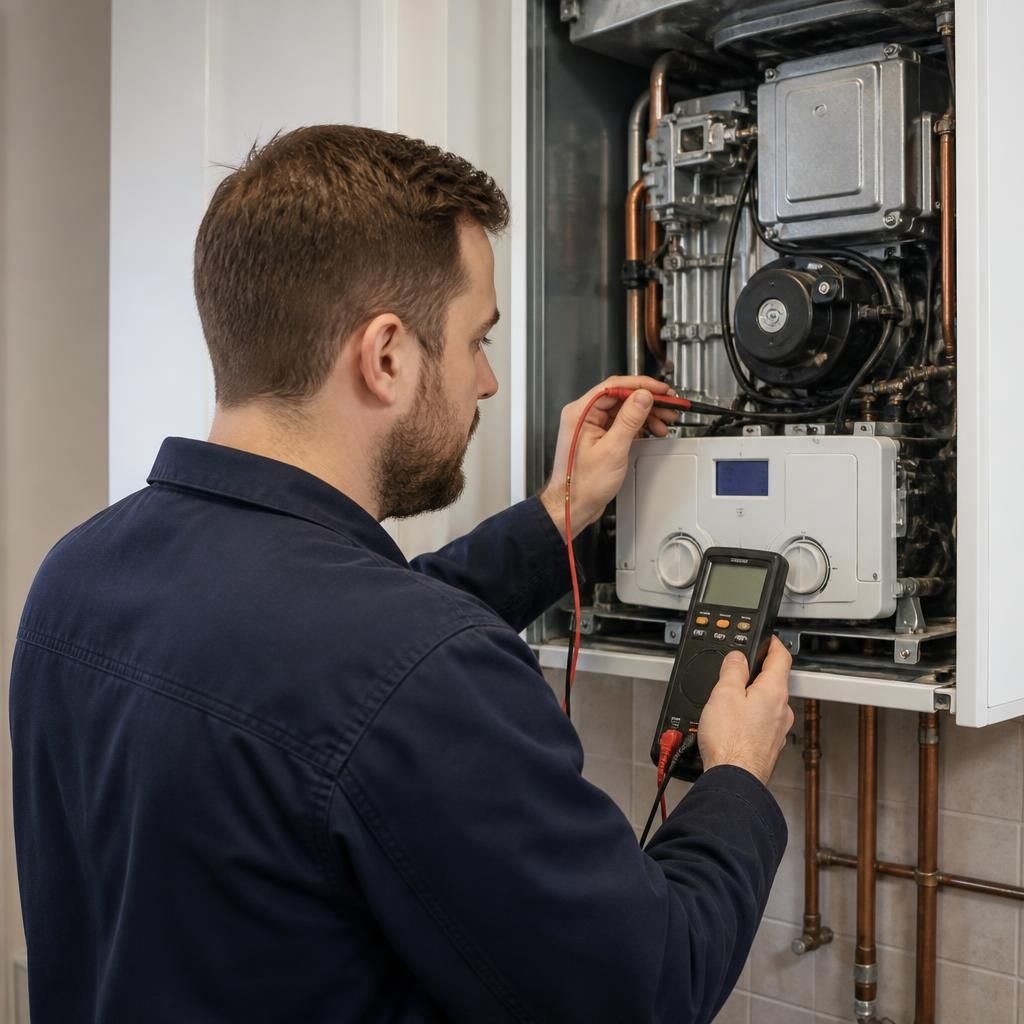
The price of a boiler repair is not just the cost of a replacement part. We also need to identify the underlying fault, access the component safely and test the boiler afterwards. A cheap part will not represent good value if it does not correct the cause of the breakdown.
If the repair involves an older or less common boiler, we check that the replacement part is suitable before recommending it. We then explain the likely cost and the remaining risks in plain terms, so you can compare repair with replacement rather than committing to work on the spot.