
Can a bidirectional charger work with my existing solar panels?
Often, yes, but compatibility depends on your car, bidirectional charger, solar inverter and home wiring. We check how your existing panels connect, then confirm whether they can work together directly or whether the inverter or control equipment needs changing.
The panels themselves are rarely the limiting factor. The important points are the existing solar inverter, the proposed charger’s method of connecting to the system, and whether the car supports bidirectional charging. If those parts work together, the panels may continue operating without replacement.
What happens to the solar electricity? Your panels generate direct current, which the solar inverter normally converts into alternating current for use in the home. A bidirectional charger may connect on the alternating-current side, allowing it to charge the car from surplus solar and send electricity back to the house later. This arrangement is often called AC coupling.
Some systems use a DC connection instead. That can reduce the number of conversion stages, but it usually needs equipment designed to work together from the outset. An existing solar installation may not be suitable for a direct DC connection, even when the panels are working properly. We identify the arrangement before deciding whether any part can be retained.
The vehicle is just as important as the panels. A car must have bidirectional charging hardware and software enabled by its manufacturer. A normal EV charger can put electricity into the car, but it cannot automatically send electricity back to the house. A compatible car may still support only certain chargers, operating modes or control systems.
We check the vehicle’s approved charging requirements alongside the existing PV equipment. This avoids fitting a charger that can communicate with the solar system but cannot exchange energy with the particular car. Software updates or manufacturer approval may also be needed before vehicle-to-home operation can start.
Your existing inverter may determine the installation route.
- If the inverter can communicate with the charger and manage the energy flows, it may remain in place.
- If it cannot communicate with the new equipment, an AC-coupled arrangement may be possible, subject to the home’s electrical capacity.
- If the inverter is old, failing or incompatible with the proposed control system, replacement may be more practical than adding another device around it.
- If the system already has a home battery, we check whether the battery inverter and energy-management controls can work with both the PV array and the vehicle.
Replacing an inverter does not automatically mean replacing the panels. The panel array, cabling, mounting system and generation meter can often be assessed separately. The decision depends on the equipment’s condition, its electrical ratings, its monitoring arrangements and any restrictions attached to the original installation.
Solar surplus is not available all the time. The car can charge from the panels when generation exceeds the home’s demand, but the available power changes with daylight, weather and household use. A system may therefore need to combine solar generation with electricity from the grid, depending on the charging setting and the amount of energy required.
The charger can also be set to avoid exporting electricity when the car is full or when the home is already using the available generation. We look at the existing export limit and the site’s import capacity rather than assuming that the panel output is the same as the charger’s maximum rating.
A power cut needs a separate check. A bidirectional charger does not automatically keep the house running when the grid fails. The system must safely disconnect from the grid and provide an approved backup supply. That may require additional switching, dedicated circuits and controls, and some vehicles or chargers do not support this function.
Vehicle-to-home operation can also be restricted during a fault if the charger cannot confirm that the electrical supply is safe. We treat backup operation as a separate design requirement, not as an automatic benefit of connecting a car to solar panels.
The existing consumer unit and supply matter too. We check the proposed charger rating, cable route, earthing arrangement, protective devices, main fuse and the way the solar system is already connected. Older properties may need changes to the consumer unit or distribution board before the new equipment can be added safely. Rural properties with long cable runs or unusual supplies need the same assessment.
The network operator may also need to approve the additional generation or export capacity. We identify that requirement during the design and allow for the relevant application and notification work. The answer can change if the property has single-phase or three-phase power, an existing battery, a restricted export setting or a previous connection agreement.
Existing payment arrangements should be checked before changes are made. If the solar installation is covered by a legacy generation or export agreement, altering the inverter or system controls could affect its terms. We review the available paperwork and explain where the arrangement needs checking with the scheme administrator or energy supplier before work begins.
For a new or materially altered renewable installation, the certification and export arrangements also need to match the equipment that is actually fitted. MCS certification is relevant where a new installation needs to qualify for the Smart Export Guarantee or where a grant application depends on certified work. We explain what applies to the proposed changes rather than treating an existing PV system as automatically eligible.
Our assessment normally covers:
- the panel layout, inverter model and installation records;
- the car’s bidirectional charging capability and required communication method;
- any existing battery, generation meter, monitoring platform and export limit;
- the consumer unit, cable route, earthing and available electrical capacity;
- whether the system should use AC coupling, DC coupling or replacement equipment;
- the required network notification, certification and control settings; and
- whether backup power is needed, and which circuits would be included.
After that assessment, we set out which parts of the solar installation can stay, which need adapting and which would need replacement. You receive a written quotation before work starts, so the cost reflects the actual equipment and electrical changes rather than a standard charger installation.
A suitable existing solar system can make vehicle-to-home charging practical, but compatibility must be proved between the panels, inverter, charger, car and home’s electrical supply. The right answer may be a straightforward addition, an inverter change or a wider redesign. We explain that difference before you commit to the installation.
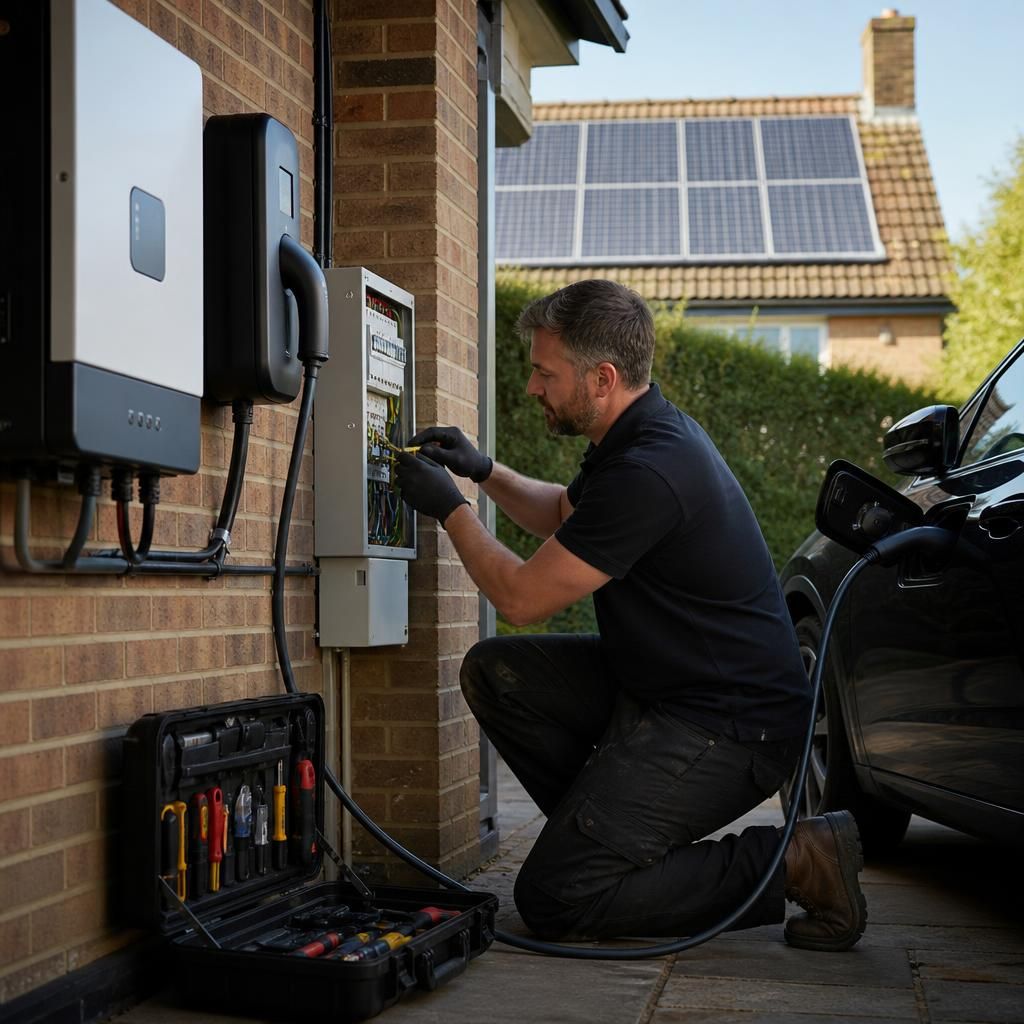
If the existing solar system is suitable, the panels can usually stay in place while we add the bidirectional charging equipment. The work then centres on the inverter, consumer unit, cable route and control settings rather than the roof.
During installation, we isolate the relevant circuits and test the PV system before reconnecting it. We then check that the home can use solar generation, the car can charge correctly and surplus electricity follows the agreed export settings. If the inverter or controls need changing, we explain the effect before any work starts.