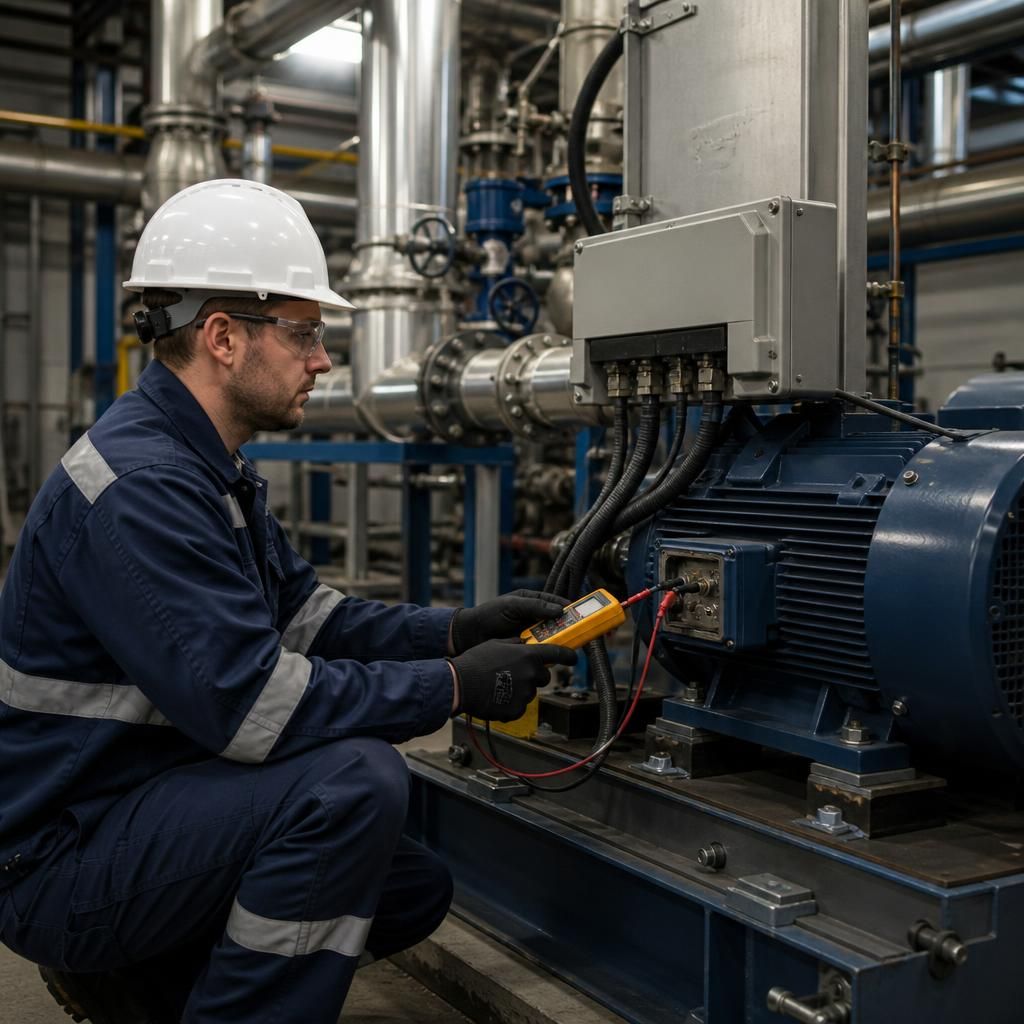
Can the industrial electrical contractor assess our machinery’s power demands?
Yes. We assess your machinery’s running and starting loads against the available electrical supply, then identify any needed changes to the distribution board, cabling or incoming capacity before equipment is installed or upgraded.
Yes, but a useful assessment goes beyond reading the rating plate. We compare the machinery’s real electrical demand with the capacity, condition and arrangement of the existing installation. That shows whether production can continue safely, which parts need upgrading and what capacity remains for future equipment.
Your machine may be marked at a particular kilowatt rating, but that figure does not describe every stage of its operation. Motors, compressors, welders, heaters and hydraulic equipment can draw different amounts of current while starting, running and stopping. We look at those operating cycles rather than sizing the supply from the nameplate alone.
We start by understanding how the machinery is used. The useful information includes:
- the manufacturer’s electrical data and rated running current;
- starting current and the method used to start motors;
- single-phase or three-phase requirements;
- how often each machine runs and whether several machines start together;
- planned additions, changes to production or increased operating hours; and
- any symptoms such as nuisance tripping, lights dimming or equipment stopping under load.
We then inspect the supply route from the incoming intake through the switchgear, distribution boards, protective devices and final circuits. Cable size, cable length, connections, segregation and the condition of older equipment all affect how much usable capacity reaches the machine. A supply can appear large enough on paper but still suffer excessive voltage drop on a long run or through an overloaded distribution board.
Starting current deserves particular attention. A motor that runs within the available capacity may still cause a protective device to trip when it starts. We consider the starting method, the size and type of protective device, and whether other equipment is operating at the same time. This helps separate a genuine capacity problem from a control, protection or connection fault.
Where the machinery creates electrical disturbance, we consider the wider effect on the installation. Variable-speed drives, welders and other non-linear loads can contribute to harmonics or affect power quality. We can identify when further investigation or monitoring is appropriate, rather than recommending a larger supply without establishing the cause.
If the existing installation is close to its limit, the next step depends on the constraint. The practical work might involve:
- a dedicated circuit for a machine;
- replacement of an undersized cable or distribution board;
- revised protective devices and discrimination between them;
- changes to the machine’s starting or control arrangement;
- redistribution of loads across phases; or
- an increase in the available incoming supply, subject to the network operator and site requirements.
We do not assume that an incoming supply upgrade is the only answer. Reducing simultaneous starting, moving a machine to a suitable circuit or correcting an overloaded phase can sometimes address the actual limitation. Equally, we will say when the existing installation does not leave enough margin for the proposed equipment.
For a planned installation, we assess the proposed machinery before cable routes and protective equipment are specified. That gives you a clearer view of the work involved, possible disruption and the electrical capacity left for later expansion. For an existing site, we use the machinery’s operating behaviour and any fault history to guide the investigation.
The assessment can lead to a written scope and quotation before electrical work starts. It will set out the recommended changes and any factors that depend on the machinery supplier, the incoming supply or further investigation. Our industrial electrical work is carried out under NICEIC and ECA standards, giving you a properly considered basis for approving an upgrade rather than relying on an assumed load.
After the assessment, you should know which machines can operate on the present installation, where the limits are and what needs to change before new equipment is connected. That information supports safer production planning and helps prevent an expensive machine installation being held up by an overlooked supply requirement.
A machine rarely works alone. Extraction, cooling, controls, pumps and ancillary equipment can add demand that is missing from the main machine’s rating plate. We assess the complete operating arrangement, so the site requirement reflects how the equipment will actually run.
If a machine supplier gives separate electrical details, we bring those figures together with the associated equipment and operating sequence. You then have a clearer requirement to share with the supplier and a sound basis for deciding where the machine can be connected.