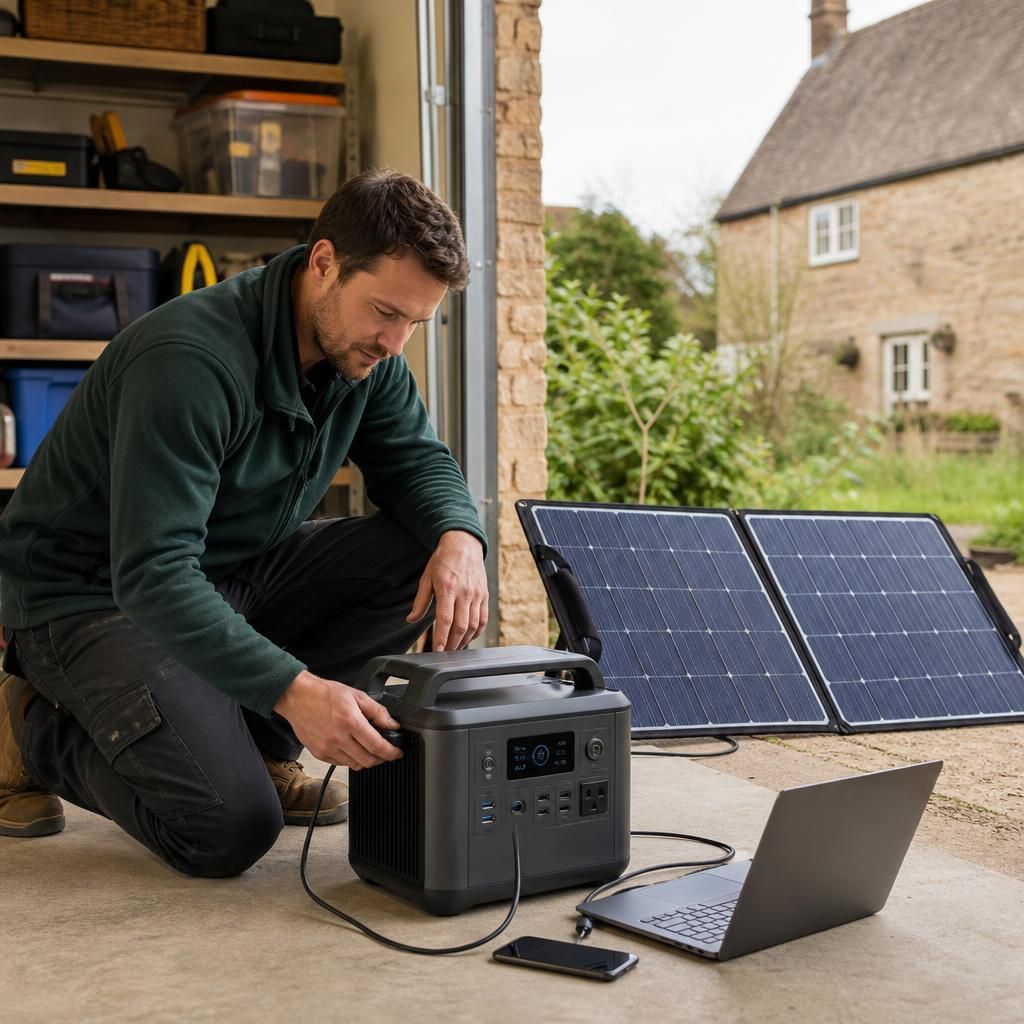
What information do you need to recommend the right portable solar generator?
The right portable solar generator depends on what you need to run, the starting power of those appliances, how long you need them operating and how often you can recharge the unit. We’d also need to know whether you’ll charge it from mains electricity, portable solar panels or a vehicle, and where you’ll use and store it.
To recommend a portable solar generator accurately, we need to understand how you intend to connect it, what electrical equipment already exists, and which compromises matter most to you. A unit that works well for charging devices can be unsuitable for a boiler, freezer or home circuit.
Tell us how you want to connect it. A portable power station normally supplies individual appliances through its own outlets. It does not automatically power the circuits in a house. If you want backup through selected sockets or circuits, we need to know whether a changeover switch or another approved connection already exists. Plugging a power station into a normal wall socket to energise the house can send electricity back into the wiring and create a serious hazard. We can identify whether a fixed connection needs an electrician’s design rather than treating the unit as a simple plug-in appliance.
Describe the equipment you already have. Existing solar panels, a home battery, an inverter, a generator inlet or a changeover arrangement can affect the recommendation. Some systems cannot work together, while others may duplicate the storage you already own. Photos of the relevant equipment, its rating plates and the sockets you want to use can help us understand the arrangement before we suggest a model.
Give us the appliance model numbers where possible. A stated wattage does not always show the whole picture. Refrigerators, freezers, pumps, fans and heating controls can have motors or compressors that behave differently when they start. Sensitive electronics may also need a clean, stable output. We therefore compare the appliance requirements with the generator’s continuous output, short-term surge capability and output waveform.
The output layout matters too. We check whether you need standard mains sockets, USB outlets, a 12-volt connection or a particular plug arrangement. If several appliances may operate together, the number and position of the outlets can be as important as the headline power rating.
Tell us how you expect to recharge it. The solar input must match the panels and the power station. We check the panel voltage, current, connector type and the generator’s maximum solar input. Panels connected in series can exceed the allowed voltage, while panels connected in parallel can exceed the current limit. Either mistake can damage equipment or prevent it from charging properly.
If you already own portable panels, send the information from their labels or manuals. If you plan to buy them at the same time, we can assess the complete pairing rather than recommending a power station that accepts less solar input than the panels can produce.
Explain how often the unit will work. Occasional power cuts, regular use in an outbuilding and repeated off-grid work place different demands on a battery. Frequent cycling makes battery management, recharge time and long-term capacity more important. We also consider whether the unit needs to remain charged and ready between uses, or whether it will normally be recharged immediately after each use.
Battery capacity figures can be quoted as a nominal amount, but the usable energy is lower after inverter losses and the manufacturer’s reserve. We use the usable figure when comparing models. Temperature, battery age and the power drawn by the inverter can also affect the energy available in practice.
Tell us your priorities and budget. Some households mainly want the lowest purchase cost. Others will accept a heavier or more expensive unit for a stronger inverter, additional outlets, a larger solar input or the ability to add battery modules later. Knowing which features matter prevents us from recommending capacity or functions you will not use.
Noise can be important in a kitchen, study or bedroom, even though a battery power station is quieter than a fuel generator. We can also consider the display, controls, app requirements and whether everyone who may use it needs a simple plug-in arrangement.
We also need to know about the property. An older house may have a consumer unit, wiring arrangement or earthing arrangement that requires closer attention before any connection to fixed circuits is considered. We check the proposed connection rather than assuming that a portable unit can safely supply existing house wiring.
For a first discussion, the most useful information is:
- the appliances and equipment you want to support, with model numbers or rating-plate photographs;
- the existing solar, battery or generator equipment at the property;
- how you want power delivered, either from the unit’s outlets or through selected house circuits;
- the solar panels or charging equipment you already own, including their electrical ratings;
- how frequently the generator will be used and how it will be stored between uses;
- your budget and the features you are prepared to prioritise; and
- any restrictions involving noise, controls, weight or the people who will operate it.
With those details, we can compare the generator’s usable battery capacity, inverter output, surge performance, charging limits and connection method against your actual requirements. That gives you a recommendation based on the way the equipment will be used, rather than on a single capacity figure printed on the box.
If the power station will support a particular appliance, tell us how that appliance behaves after an interruption. Some boilers, pumps and refrigeration units need to be restarted manually, while others may not resume until their controls receive a stable supply. That affects whether you need uninterrupted power, a simple plug-in backup or a planned restart process.
We also check how the equipment will be used during an outage. If someone in the household may need to operate it without technical help, clear controls and a straightforward restart procedure can matter more than extra capacity. We can base the recommendation on the people using it, not just the appliances it can power.