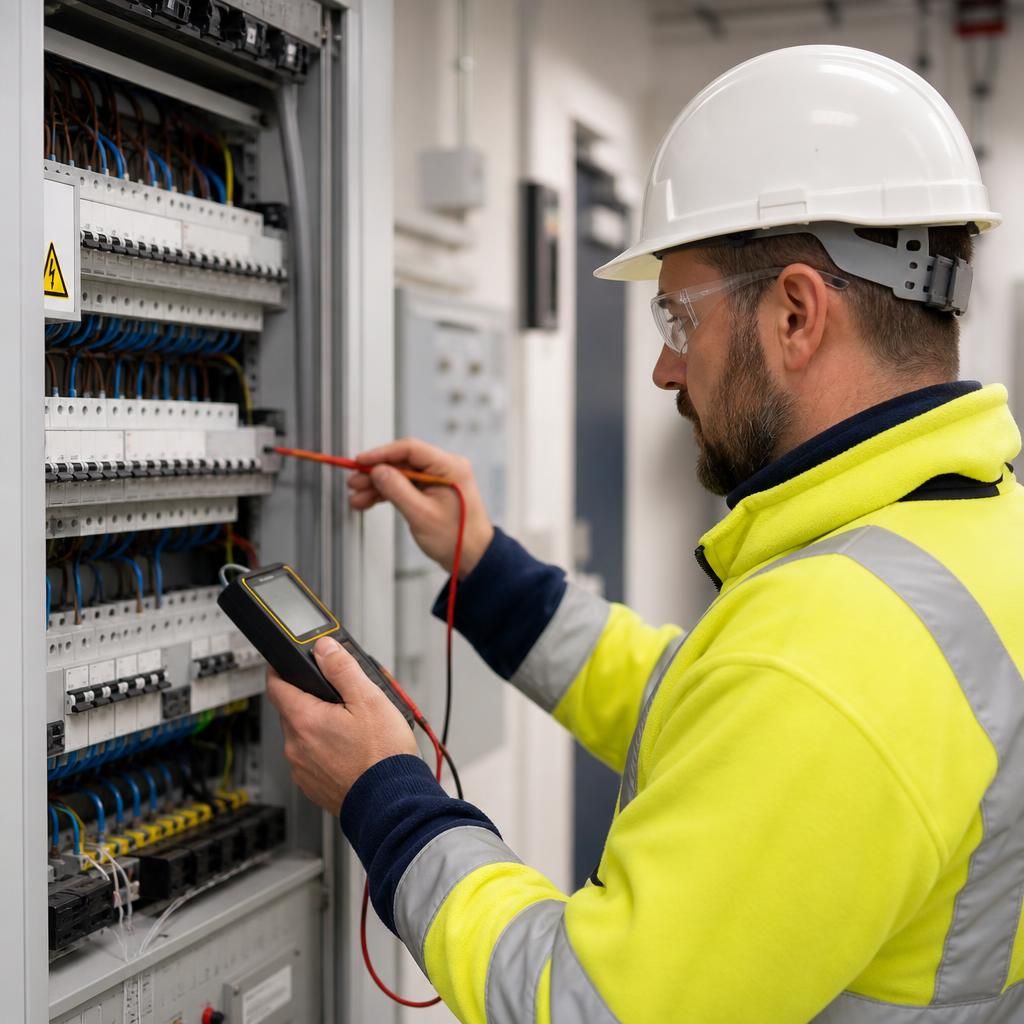
What affects the cost of a commercial EICR?
Commercial EICR cost depends mainly on the premises’ size, the number of circuits and distribution boards, access to electrical equipment, and the complexity and condition of the installation. Any remedial electrical work identified is priced separately, so the inspection cost and repair costs remain clear.
The main factors behind a commercial EICR cost are the time needed to inspect the installation properly and the scope agreed for the report. The business use, age of the wiring, available records and any specialist electrical systems can all change that scope.
The type of premises affects the inspection. An office, workshop, retail unit, agricultural building and communal property can present different risks. Equipment that is accessible and lightly used may need a different approach from machinery, commercial catering equipment or installations exposed to dust, moisture or impact. We consider how the premises operate, because the report needs to reflect the risks created by that use.
The age and history of the installation also matter. A building that has been rewired in one planned project is usually easier to understand than one altered several times by different contractors. Older sections, extensions and changes in use may leave circuits or equipment without clear records. We may need additional investigation when the installation does not match the available drawings, schedules or labels.
Useful records can help us define the inspection accurately. These may include:
- the previous EICR and any remedial work records;
- circuit charts, distribution-board schedules and electrical drawings;
- details of alterations, extensions or changes in the building’s use;
- information about specialist equipment and electrical supplies; and
- any known faults, restrictions or areas that have not been inspected recently.
Missing paperwork does not automatically prevent an EICR. It can mean that we spend more time tracing circuits, confirming what equipment is supplied and establishing whether the installation is arranged as expected.
Specialist systems may need to be included or excluded clearly. A commercial property might have three-phase equipment, standby supplies, fixed machinery, external installations or generation and storage equipment. The cost depends on whether these form part of the agreed electrical installation inspection and whether they need particular testing arrangements. An EICR is not automatically a test of every separate system on the premises, so the quotation should state what is covered.
The way the premises is occupied can affect the practical work. Some testing requires equipment to be isolated. If the site cannot be shut down as one complete installation, we may need to plan the inspection around different areas, tenants or operating periods. We agree any necessary arrangements before the inspection so the business understands what access and cooperation are needed.
Report requirements can alter the scope too. A landlord may need an assessment for one rented unit, while a property manager may need separate records for several areas or supplies. A facilities manager may also need the report to refer clearly to distribution boards, limitations and recommended remedial work. The price should reflect the number of reports and the level of detail required, rather than assuming that every commercial EICR has the same format.
Inspection cost and repair cost are separate decisions. An EICR records the condition of the installation; it does not include every repair that the inspection may identify. If we find an urgent defect, a potentially dangerous condition or a problem requiring further investigation, the report will explain the finding and its significance. We can then quote for any remedial work separately, so the cost of correcting defects is not hidden inside the inspection price.
Some findings may also need more testing before a conclusion can be reached. If parts of the installation cannot be inspected or tested safely, the report should record that limitation. Resolving the limitation may require access, isolation or additional work, which is why it is useful to discuss restricted areas before the quotation is prepared.
When comparing commercial EICR quotations, check that each one covers the same premises, electrical supplies, areas and reporting requirements. A lower figure may reflect a narrower inspection rather than a more efficient one. We set out the agreed scope and any exclusions in writing, then identify remedial costs separately if the report finds work that needs attention.
In a multi-occupied building, the inspection boundary can affect the commercial EICR cost. We establish whether the report covers landlord supplies, communal areas, external lighting, tenant distribution boards or separate tenant equipment.
That prevents time being allowed for systems outside the agreed responsibility, while reducing the risk of important shared electrical equipment being missed. The quotation can then show exactly which areas and supplies are included.