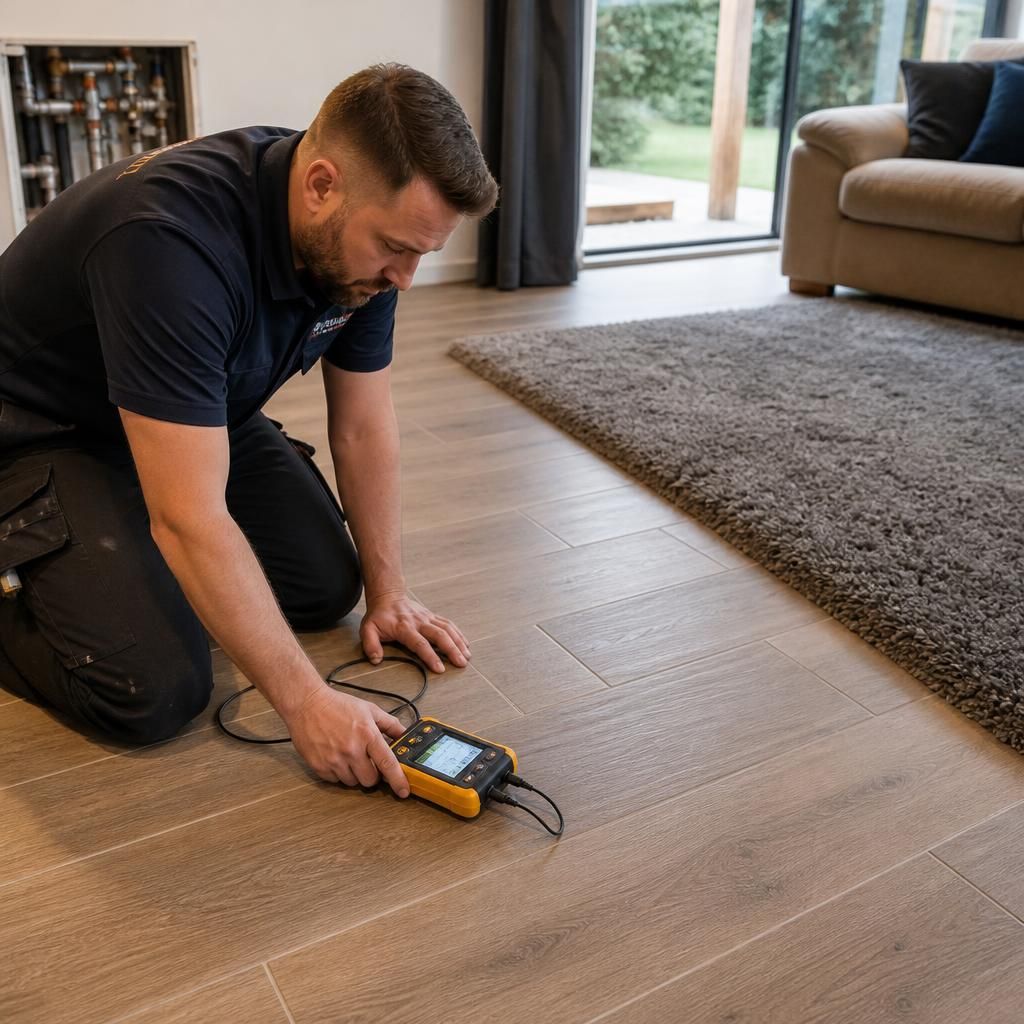
Can underfloor heating be repaired without removing the whole floor?
Often, yes. We can trace the fault and lift only selected boards or tiles for access, although a larger opening may be needed if the cable or pipework is damaged beneath a fixed floor.
The repair method depends on where the fault is and what sits above the heating system. A thermostat, sensor, actuator or manifold component is usually accessible. A damaged cable or pipe needs more careful tracing, but the repair still normally focuses on the affected area rather than the whole floor.
Before lifting anything, we establish whether the problem is electrical, hydraulic or related to the controls. A room that stays cold may have a failed thermostat or actuator rather than a damaged heating circuit. Uneven heating can point to air in the system, poor balancing, a sticking valve or restricted flow. We test the controls and wiring, check the manifold and compare the affected circuit with one that is working correctly.
For an electric system, we test the resistance and insulation of the heating cable. This helps us identify a break or damaged section beneath tiles, timber or screed. We can then mark the likely access point and discuss the least disruptive route. A cable or heating mat cannot always be repaired with a simple accessible connection, so we follow the system manufacturer’s requirements rather than creating an unreliable joint beneath the floor.
For a wet system, we check system pressure, flow and return temperatures before investigating the pipework. A leak may show as pressure loss, dampness or a cold section of floor, but not every cold area means that a pipe has failed. We isolate circuits and pressure-test them to narrow down the fault. If a buried pipe is damaged, we expose the smallest practical section and use a suitable repair method for that system.
The amount of flooring removed depends on the finish and the depth of the heating. With liftable boards, access is often relatively straightforward. Tiles may need careful removal around a marked area, while a screeded floor takes more cutting and local excavation. We protect the surrounding surface and avoid lifting sound flooring simply to make the work easier.
Floor reinstatement needs to be considered before the repair starts. We can explain what access the heating fault requires, but matching an old tile, engineered board or decorative finish may depend on the original material still being available. If the floor is listed, highly unusual or difficult to replace, that decision may influence whether a targeted repair or a wider renewal is the sensible option.
Some faults can be resolved without opening the floor at all. Examples include a failed room sensor, loose connection, faulty programmer, manifold flow meter, actuator or pump. Once the accessible component is replaced or corrected, we test the relevant zone and confirm that the floor is heating properly.
A repair becomes less attractive when several circuits have failed, the system is poorly documented or the floor already needs replacing. In those cases, we compare the cost and disruption of repeated local access with renewing the affected circuit or control equipment. We do not assume that a complete floor removal is necessary, but we will explain when a small repair is unlikely to be durable.
The final price is mainly affected by the fault-finding time, the replacement parts, the type of floor covering and the work needed to reinstate it. A visible control fault is a different job from tracing a buried leak through screed. We inspect the system first, set out the proposed access and provide a written quotation before work starts, so the repair is not treated as an open-ended disturbance.
If the heating has stopped working, note which rooms or zones are affected and check whether the manifold, thermostat or boiler shows an obvious fault indication. Don’t keep topping up a wet system that is losing pressure or use a damaged electrical circuit. We can test the system, identify the failed component and tell you whether the floor can stay largely intact or where access will be needed.
A cold patch does not always mean the heating cable or pipe has failed. Thick rugs, furniture and changes in floor covering can affect how heat reaches the room.
We compare the cold area with the heating layout and test the controls before any flooring is disturbed. That can prevent an unnecessary opening in an otherwise sound floor.