
How long will a portable solar generator run before it needs recharging?
A portable solar generator may run for a few hours or much longer, depending on its usable battery capacity, the appliances connected and the power lost during conversion. A higher-wattage appliance uses the charge faster, while solar panels can extend runtime when they produce enough power in daylight.
A portable solar generator may run for several hours or only a short time, depending on the battery’s usable capacity, the appliances connected and how often they draw power. The figure on the box is only a starting point. Real runtime is affected by the inverter, standby consumption, start-up surges, battery temperature and the amount of energy reaching the panels.
Start with usable capacity, not the headline capacity
Portable power stations are usually described in watt-hours (Wh). This indicates how much energy the battery stores, but not all of that energy may be available to the connected appliances. The system may keep a reserve to protect the battery, and the inverter uses some energy when supplying mains-style AC power.
A device running from a USB or DC outlet may use less energy than the same device connected through the AC inverter. The inverter can consume power even when the appliance itself is using very little. This matters for chargers, routers and other small loads left connected for long periods.
Check the appliance’s actual demand
An appliance’s rating in watts tells you how much power it may draw while operating. It does not always represent its average demand over the whole period.
- A lamp with a fixed output may draw roughly the same amount continuously.
- A fridge cycles between running and resting, so its average demand is lower than its running rating.
- A boiler control, router or alarm may use little power but remain connected for many hours.
- A kettle, heater or hairdryer uses a large amount of power in a short period.
For a realistic estimate, list each appliance, its wattage and the length of time it will operate. Multiply the wattage by the operating time, then add the energy used by all the appliances. Allowance is still needed for the power station’s own consumption and conversion losses.
Motor-driven appliances need extra care
Fridges, freezers, pumps and some power tools can briefly draw much more power when their motors start. A power station may have enough stored energy for the appliance but still shut down if its inverter cannot handle that starting demand.
Check both the continuous output and the peak or surge output. The continuous figure must cover the appliance while it is running, while the peak figure must cover the short start-up demand. A manufacturer’s stated surge capability may only last for a limited period.
Small loads can use more energy than expected
A portable generator left in AC mode may keep its inverter running even after the main appliance has finished. Chargers can also continue drawing a small amount while connected. Switching off unused outlets and unplugging equipment can therefore make a noticeable difference to runtime.
Some models have an eco or low-power mode that reduces inverter consumption when the load is small. This can help with light loads, but it may not suit equipment that starts and stops automatically. Check how the mode responds to a fridge, pump or other intermittent appliance before relying on it.
Solar panels do not provide a fixed daily recharge
Solar input varies with the season, cloud cover, shade, panel direction and the angle of the panels. The power station may also limit how much energy it accepts, even when the panels could produce more. A panel’s quoted output is a peak laboratory rating rather than a guaranteed figure throughout the day.
During good sunlight, solar input can reduce the rate at which the battery empties or replace some of the energy being used. It will not necessarily keep the battery level steady if the connected appliances consume more power than the panels are supplying. On a dull day, the solar contribution may be much smaller.
The panels and power station must also use compatible connectors, voltage ranges and input limits. A panel can be electrically compatible yet still exceed the power station’s permitted input if several panels are connected together.
Temperature and battery age also affect the result
Very cold or hot conditions can reduce the energy available from a battery and may restrict charging. A battery that has been used and recharged repeatedly may also hold less energy than when new. The runtime shown in an early product test may therefore be longer than the result from an older unit in a cold shed.
Keep the power station within the manufacturer’s stated temperature range and leave ventilation around it. Do not cover it with clothing or store it where heat cannot escape.
Use the generator’s display as a live estimate
Most portable power stations show battery percentage, output power and sometimes an estimated remaining time. Treat the time figure as a guide. It changes when an appliance starts, stops or changes its demand, and it may be calculated from the current load rather than your intended usage.
A better approach is to monitor the battery while using the equipment you expect to connect. Note the battery level at the start, run the intended appliances for a known period and check how much capacity they use. This gives a more useful indication than testing the unit with a single lamp and applying that result to every appliance.
Before buying, compare the whole specification
- Usable battery capacity in watt-hours.
- Continuous AC output and peak surge output.
- Separate USB, DC and AC outlet limits.
- Solar input range and maximum accepted solar power.
- Charging options when there is no sunlight.
- Whether the inverter can remain on efficiently with small or intermittent loads.
- Operating and storage temperatures.
For occasional phone charging, lighting and communications equipment, a smaller unit may be sufficient. Running a fridge, pump or heating control requires a different assessment because the equipment may have a starting surge and may need to operate for an extended period.
If the intended use is keeping essential equipment running during a power cut, work out the load as a group rather than choosing a capacity from one appliance. Separate essential items from convenient ones, allow for motor start-up, and decide how much solar input is realistically available at the property. That produces a more dependable runtime estimate than relying on the battery size alone.
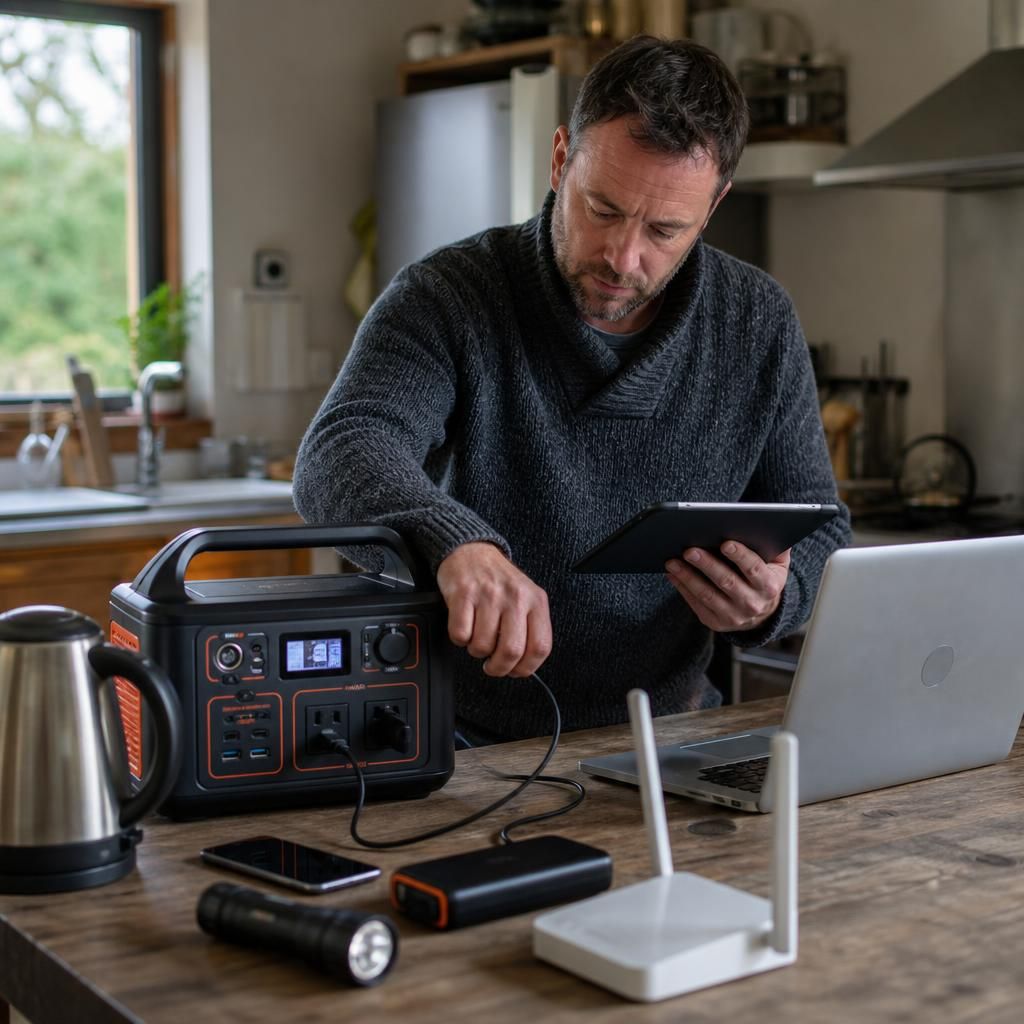
Runtime is easier to manage when the power station supplies only the equipment that matters. During an outage, keep essential low-power items connected and run high-demand appliances separately, for as little time as needed. A kettle or pump can use more stored energy in minutes than a router uses over many hours.
If the battery still shows charge but the unit switches off, check the output demand rather than assuming the battery has failed. The connected appliance may be exceeding the inverter’s continuous rating or triggering its protection during start-up. Remove non-essential loads, then reconnect equipment one item at a time.