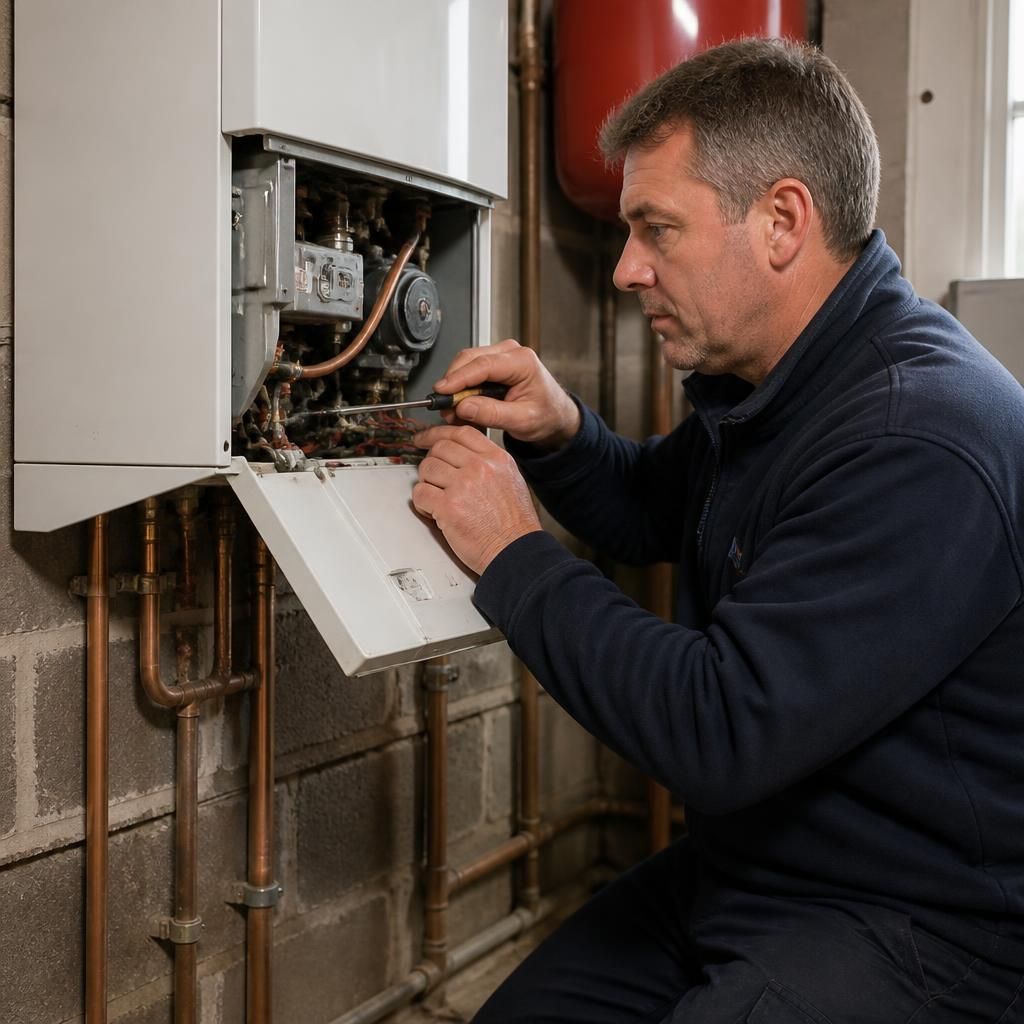
Will you repair an older boiler after an emergency breakdown?
Often, yes. We inspect the fault, the boiler’s condition and the availability of suitable parts, then explain whether a repair is sensible or replacement is the safer option.
Yes, an older boiler can often be repaired after an emergency breakdown. The deciding factors are the fault, the boiler’s safety, its general condition and whether suitable parts are available.
If the boiler has stopped during cold weather, tell us what happened before it failed. A fault code, unusual noise, burning smell, leaking water or repeated reset attempts can help us narrow down the cause. Don’t keep resetting a boiler that locks out repeatedly, and don’t remove its casing.
A gas boiler may have a failed pump, fan, sensor, ignition component, valve or circuit board. An oil boiler may need attention to its burner, nozzle, pump, controls or fuel supply. We also check related items such as the thermostat, condensate pipe, expansion vessel and system pressure, because the boiler is not always the source of the problem.
Safety comes before getting the heating running again. We inspect the combustion arrangements, flue, wiring, controls and signs of water or fuel damage. Gas work is carried out by Gas Safe registered engineers. Oil-fired work is covered by OFTEC registration, which is particularly relevant on homes that are not connected to the gas grid.
A repair is usually sensible when the fault is clear, the boiler remains safe and the repair gives the appliance useful life without creating further risks. We explain what has failed, what the repair involves and what condition the rest of the boiler is in. That gives you the information needed to decide rather than committing you to replacement.
Some older boilers need more careful consideration. Corrosion around the heat exchanger, repeated leaks, damaged flue components or several unrelated faults can make a repair poor value. An obsolete control board or discontinued burner component can also affect the decision. If a part cannot be sourced, we explain that before recommending another course of action.
If the boiler is unsafe, we won’t leave it operating simply because the house needs heat. We explain the reason clearly and identify what must happen next. In some cases, that means isolating the appliance until it can be repaired properly. In others, replacing the boiler is the more practical route.
Older properties often have wider heating issues that become apparent during a breakdown. Sludge in radiators, undersized pipework, poor controls or an ageing hot water cylinder can affect how well a repaired boiler performs. We point out those issues separately, so essential repair work is not confused with optional improvements.
If replacement is the sensible option, we can explain the available heating arrangements for the property, including the implications of staying with gas or oil. We consider the existing flue, fuel supply, hot water requirements, controls and radiators rather than treating the boiler as an isolated appliance.
After the work, we test the boiler and its controls and explain any checks you need to carry out. You should be left knowing what failed, what we changed and what signs would justify contacting us again.
When a repair is appropriate, we explain the work and provide a written quotation before it starts. You can then decide whether to proceed without unexpected charges appearing after the boiler is opened up.