
Does a 22kW EV charger need a dedicated circuit?
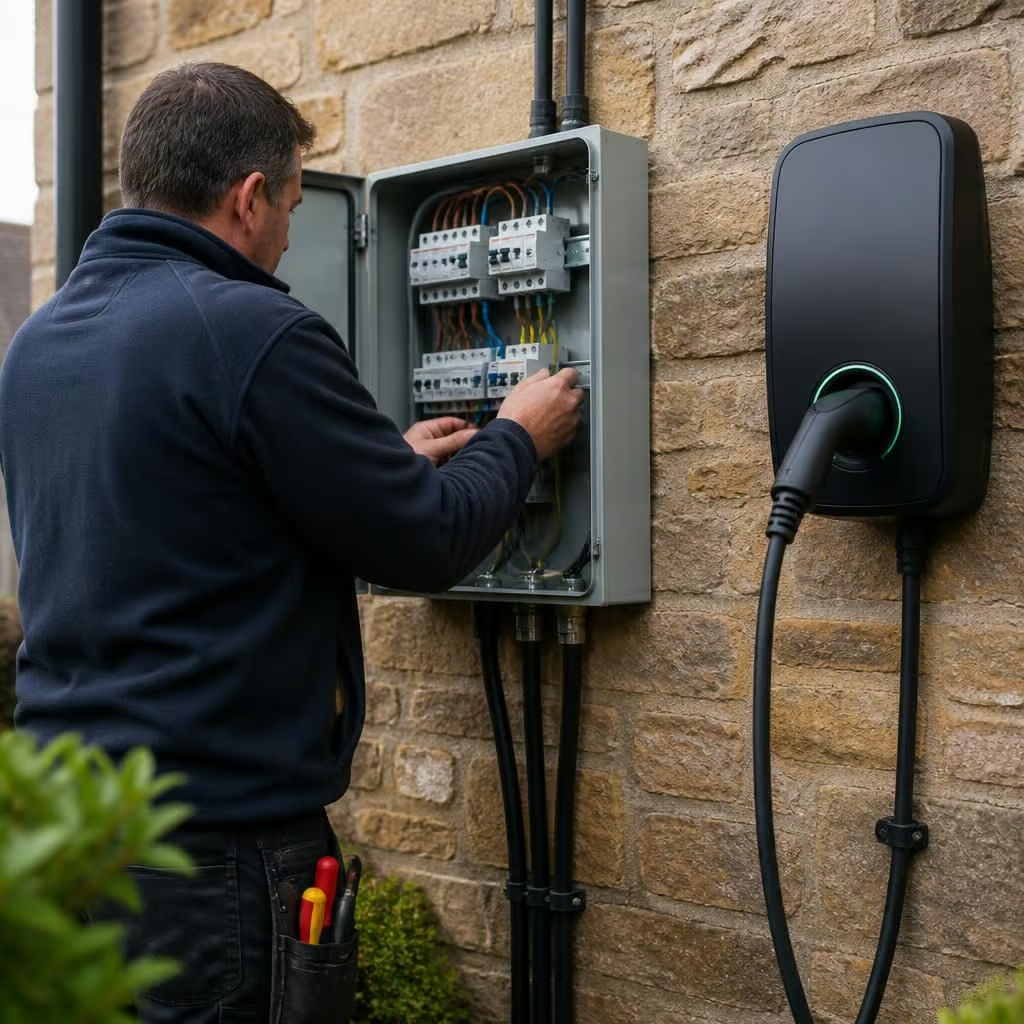
Yes. A 22kW EV charger normally needs its own dedicated three-phase circuit, designed and installed from the distribution board to the charger. We first check the incoming supply, available capacity, cable route and protective devices, because many homes have a single-phase supply and cannot support 22kW without an upgrade.
A dedicated circuit means the charger has its own cable run and protective equipment from the distribution board. No sockets, lighting, immersion heater or other fixed load shares that circuit. At 22kW, that separation is important because the charger can place a substantial continuous load on all three phases.
It does not usually mean a separate electricity meter. The charger can remain connected to the property’s existing supply, provided the supply, meter tails, distribution board and earthing arrangement are suitable. The circuit may also be installed in a separate small consumer unit near the charger if that gives better protection or a cleaner cable route.
Why a shared circuit is unsuitable
- Another appliance could overload the cable or protective device while the vehicle is charging.
- A fault elsewhere could disconnect the charger or make fault-finding more difficult.
- The circuit must have the correct residual-current and overcurrent protection for an EV chargepoint.
- The cable must be sized for its length, installation method, ambient conditions and voltage drop.
A 22kW unit commonly draws around 32 amps on each phase. The actual design still depends on the charger’s specification and the way the cable runs. A long route through an outbuilding, buried duct or insulated wall may need a larger cable than a short, direct run.
The incoming supply matters as much as the charger circuit. Most homes have a single-phase supply, which cannot normally provide 22kW at the charger. A property needs a suitable three-phase connection, with enough capacity left for the rest of the building. A three-phase supply may be present at a farm, workshop, larger rural property or commercial premises, but its existence does not automatically make a 22kW installation suitable.
We check the supply arrangement, meter tails, main switch, distribution board and earthing before we specify the circuit. If the available capacity is insufficient, the electricity network operator may need to approve or alter the connection. That process is separate from fitting the charger and can affect the final design and cost.
Protection for the charger
EV charging has particular requirements because the vehicle is connected for a long period and can introduce smooth DC fault currents. The circuit therefore needs appropriate overcurrent protection and residual-current protection. Depending on the chargepoint’s built-in protection, this may involve a suitable Type A RCD with 6mA DC detection, or another arrangement specified by the manufacturer and installation standard.
The earthing arrangement also needs checking. Properties with PME earthing may require additional measures to protect against a broken protective conductor. The correct method depends on the supply and the chargepoint, so we do not treat the protective device as a standard item that can be selected without testing the installation.
Load management does not remove the need for a dedicated circuit. A load-management system can reduce or pause charging when the property is using other electricity. It may help prevent the main supply from being overloaded, particularly where the available capacity is limited. The charger still needs its own correctly designed circuit and protective equipment. Load management controls the demand; it does not turn a shared socket circuit into a 22kW EV circuit.
Older homes may need more than a new cable. An older consumer unit may have no spare way, unsuitable protection or limited capacity. The main bonding, earthing and cable condition may also need attention. We explain any required consumer unit work before installation rather than connecting a high-load charger to equipment that was never designed for it.
On a detached garage or outbuilding, the route creates further design questions. We assess whether the cable should run underground, across a building, or through existing ducting. The installation method affects cable sizing, mechanical protection and the position of any additional distribution equipment.
What we check before installation
- We confirm whether the property has single-phase or three-phase electricity.
- We review the available capacity and the likely demand from the building.
- We inspect the consumer unit, earthing and main bonding.
- We measure the proposed cable route and assess how the cable will be installed.
- We select the protective devices and cable size for the charger and installation conditions.
- We confirm whether network operator approval or notification is required.
After the work, our electrician tests the circuit and charger, records the results and provides the relevant electrical certification. The installation is carried out by our NICEIC- and ECA-registered electrical team, so the circuit is designed as part of the property’s wider electrical system rather than treated as an isolated appliance connection.
If the property cannot support 22kW, a lower-power charger may be more practical. It can still charge safely from a properly designed dedicated circuit, without the cost or disruption of arranging a three-phase upgrade. We compare that option with the vehicle’s onboard charging capacity and how often the car needs to be charged.
Your car may accept less than 22kW, even when the property has a suitable three-phase supply. A dedicated circuit is still required, but the chargepoint can be configured to match the vehicle’s onboard charger and the building’s available capacity.
That avoids paying for a higher charging rate the car cannot use. We check the vehicle specification alongside the supply and electrical installation, then confirm the practical charging capacity before the circuit is designed.