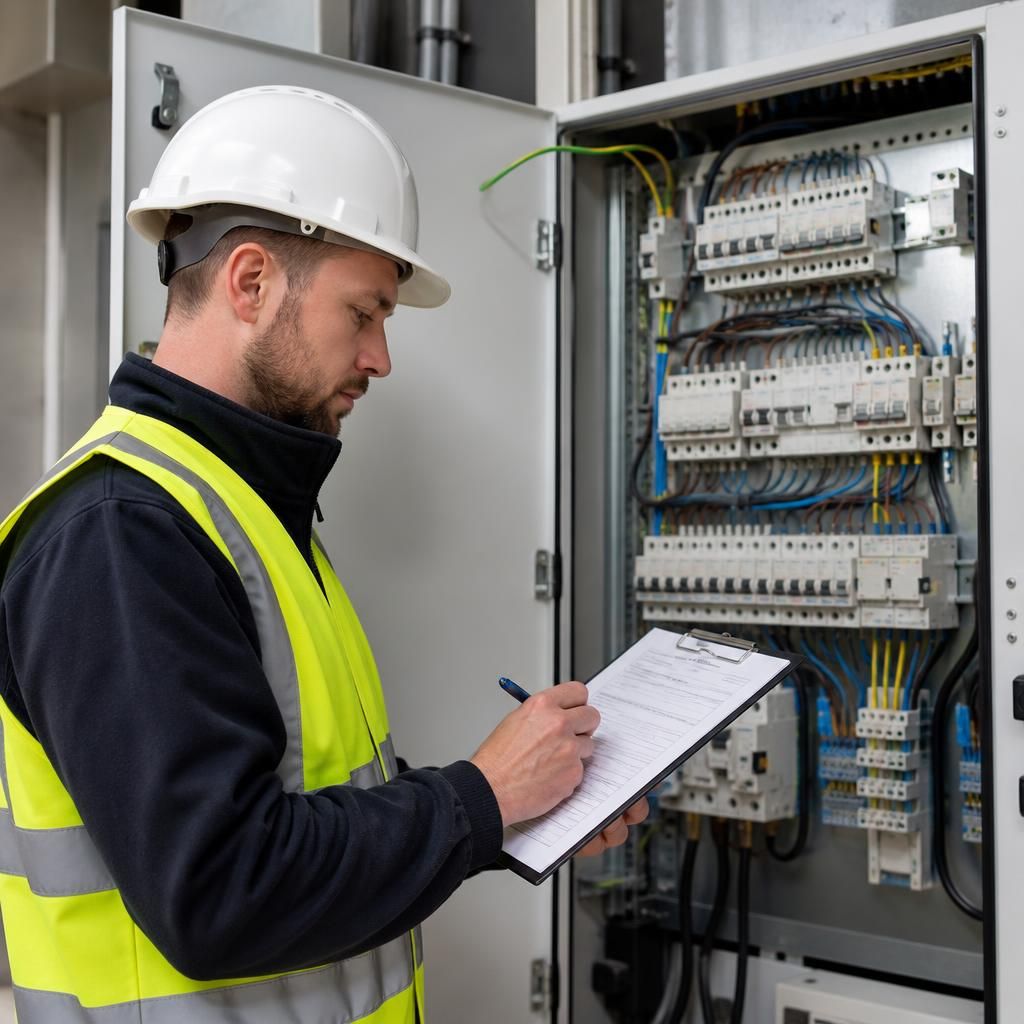
How are commercial EICR findings reported?
Commercial EICR findings are recorded as observation codes: C1 for danger present, C2 for potentially dangerous faults, C3 for improvements recommended and FI where further investigation is needed. The report lists each finding, its location and the required action, then confirms whether the installation is satisfactory or unsatisfactory.
A commercial EICR records each significant finding as a numbered observation, with a classification code showing the level of risk or the action needed. The report links each observation to its location, circuit or item of equipment, then states whether the installation is satisfactory or requires remedial work.
The report normally contains the following information:
- the premises and areas inspected;
- the extent of the inspection and any agreed limitations;
- the inspection and test results;
- each observation and its classification code;
- the overall assessment of the installation; and
- details of the person or organisation responsible for the inspection.
We describe where we found an issue rather than giving a general comment about the building. An observation might identify a distribution board, a socket outlet in a particular room, an external circuit, emergency lighting equipment or a machine connection. This helps a landlord, facilities manager or contractor locate the problem without repeating the whole inspection.
The classification codes show the priority.
- C1 – danger present: someone faces immediate danger, so urgent action is needed to remove the risk.
- C2 – potentially dangerous: the installation could become dangerous under a fault or foreseeable condition, so remedial work is required.
- C3 – improvement recommended: the installation does not meet the latest standard in some respect, but the finding does not normally indicate danger.
- FI – further investigation required: we cannot fully establish the condition or safety of an installation without additional investigation.
A code is not a price or a description of the repair. It explains the significance of the finding. The report should also explain the underlying issue, such as inadequate protection, damaged equipment, exposed live parts, poor earthing or a suspected fault that could not be confirmed during the inspection.
C1 and C2 findings normally make the installation unsatisfactory. An FI finding can also prevent us from confirming that the installation is safe. C3 observations usually remain recommendations rather than failures, unless another factor changes the assessment. The report makes this distinction clear in the overall conclusion.
We record limitations as well as defects. If furniture, stored goods, locked rooms, fixed machinery or live operational equipment prevented access, the report states what we could not inspect or test. That matters because an apparently satisfactory result only covers the parts included within the agreed inspection. It does not confirm the condition of inaccessible areas.
The test results support the observations. Depending on the installation, these may include continuity, insulation resistance, polarity, earth fault loop impedance and the operation of protective devices. If a result falls outside an expected range, we relate it to the relevant circuit or equipment and explain whether it requires investigation or remedial work.
For a larger site, the findings may be grouped by building, floor, distribution board or circuit. This gives the person managing the property a workable list rather than a collection of disconnected technical notes. It also helps an electrical contractor quote for the correct work and identify which areas may need isolation while repairs take place.
The report does not itself confirm that remedial work has been completed. Once repairs are authorised, we explain what each item involves and provide a written quotation before work starts. After the work, the appropriate electrical certification or an EICR confirming the updated condition records what we have tested and completed. A separate inspection may be needed where an FI finding required access, fault tracing or more extensive investigation.
Commercial premises often contain equipment that cannot simply be switched off during an inspection. We record any agreed exclusions and explain the effect they have on the conclusion. A follow-up visit may be appropriate once machinery, tenant areas or restricted rooms can be made available.
Landlords and property managers should keep the completed report with the property’s compliance records and pass relevant information to anyone responsible for the premises. Where a statutory duty applies, the responsible person must deal with findings within the required period and retain evidence of the work. The report itself should be read alongside the premises’ fire, emergency lighting, equipment and operational safety arrangements.
Our electrical inspection work is carried out under the standards and procedures associated with NICEIC and ECA registration. That gives the report a clear technical basis and helps commercial clients understand what has been inspected, what remains uncertain and what needs attention next.
A commercial EICR records the installation’s condition on the inspection date. It isn’t a permanent guarantee that the wiring will remain safe after equipment is added, damage occurs or the premises are altered.
If the business changes its layout, machinery or electrical equipment, the existing findings may no longer describe the whole installation. We can explain whether the change calls for further inspection or updated testing, so the compliance record continues to match the premises.