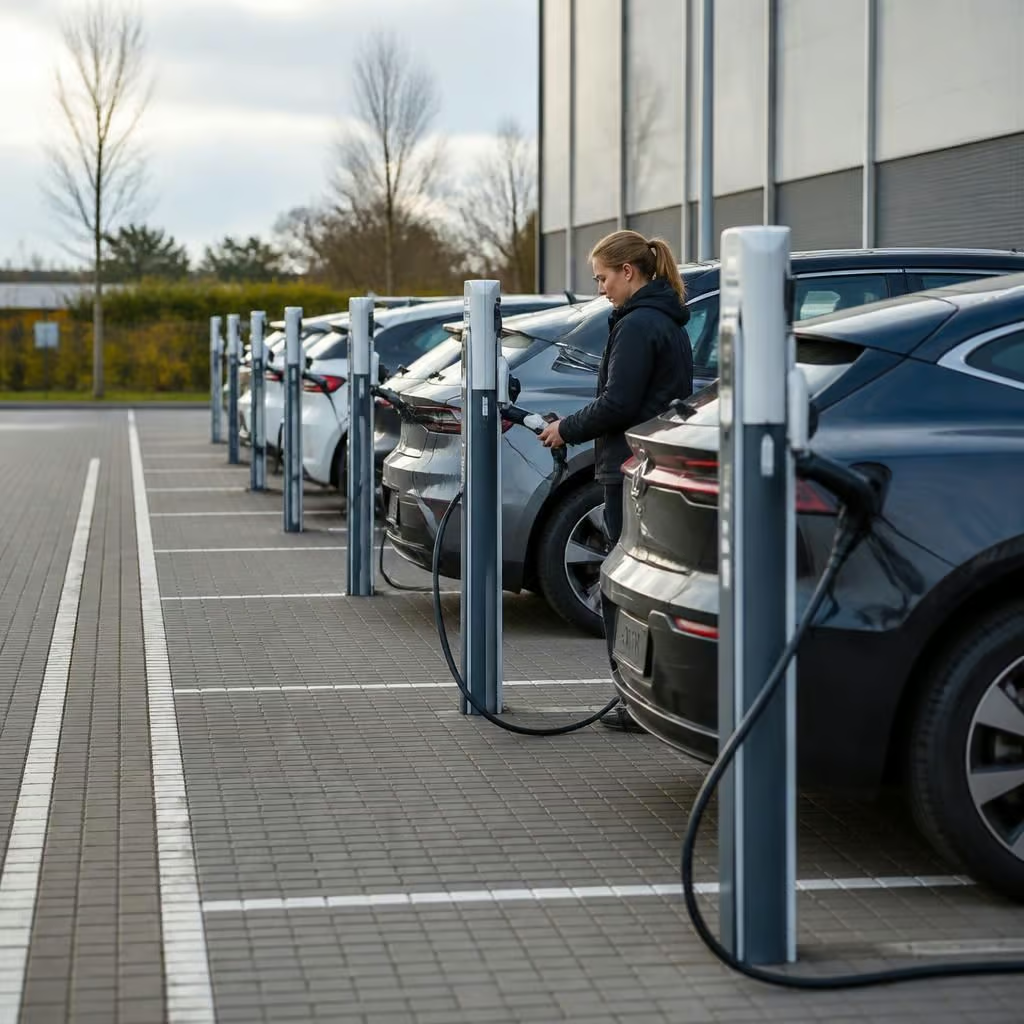
How many vehicles can a commercial charging station charge at once?
A commercial charging station can charge as many vehicles at once as it has available charge points, provided the site’s electrical supply can support them. We assess the incoming supply, charger ratings and expected demand, then can plan load management or staged expansion where several vehicles need to charge together.
The number of vehicles a commercial charging station can charge at once depends on how many charge sockets are installed, the electrical capacity available and how the system distributes power. A station may have several physical charge points, but they may not all deliver their maximum output simultaneously.
A single charge point may serve one vehicle, while a dual-socket unit can serve two. A larger site can use several units across a car park, workplace, depot or visitor parking area. The total number of vehicles charging at once is therefore mainly a design decision rather than a fixed limit.
Power sharing affects the practical capacity. If several vehicles are plugged in at the same time, a load management system can divide the available power between them. One vehicle might receive more power while another receives less, then the allocation can change as vehicles finish charging or leave the site. This allows more vehicles to connect without designing the whole installation around every charger operating at full output.
That arrangement often suits workplaces and commercial premises where vehicles remain parked for several hours. It may also suit a fleet that returns in stages. A site serving vehicles that need rapid top-ups in quick succession may need a different balance between charger output, the number of units and the available electrical supply.
Before we specify the charging station, we look at:
- how many vehicles need to charge during the busiest period;
- how long each vehicle is likely to remain parked;
- the number and position of parking bays;
- the required cable reach and whether drivers can connect without obstructing other bays;
- the existing incoming supply and spare capacity;
- the distribution board, protective devices, earthing and cable routes; and
- whether the site may need more charge points later.
The available electrical supply sets the upper limit. A site with enough spare capacity may support several charge points at their intended output. If the supply is more limited, load management can let more vehicles connect while keeping the building’s demand within a safe level. We may also recommend a staged installation, with provision made for additional charge points when demand grows.
Adding more sockets does not always mean that every vehicle will charge faster. More equipment increases the electrical demand, cabling, protective equipment and installation work. If the property needs a supply upgrade, that can affect the design, cost and programme, so we identify it before work starts rather than discovering the constraint during installation.
The number of vehicles connected is only part of the design. The useful capacity is the number that can receive enough energy during the time they are parked. For example, a workplace may need several vehicles connected throughout the day, while a delivery depot may need a concentrated charging period between shifts. We use that pattern to decide how many charge points are needed and how power should be shared.
A survey also checks the physical arrangement. Chargers may need to be positioned close to the parking bays, with routes for power cables, communications wiring and protective equipment. Bollards or other protection may be appropriate where units could be struck by vehicles. The final layout should let drivers connect safely without trailing cables across walking routes or blocking neighbouring spaces.
For a growing fleet, the installation can be planned in stages. The first phase may include the initial charge points, suitable electrical infrastructure and space for future equipment. This avoids assuming that today’s vehicle numbers will remain unchanged, while keeping the first installation aligned with the site’s present needs.
We set out the expected number of simultaneous connections, the charging output available to each vehicle and any power-sharing arrangement in the quotation. That gives you a clearer view of what the station can deliver in normal use, rather than judging capacity only by the number of sockets on the wall.
For a fleet, the key question is often which vehicles need energy first. A managed system can be set up around departure times, so vehicles leaving sooner receive priority rather than every connected vehicle receiving an equal share.
That arrangement can make a smaller electrical supply work harder without requiring every bay to charge at maximum output. We discuss the fleet’s usual movements during the survey, then explain how the proposed charging station would support those routines.