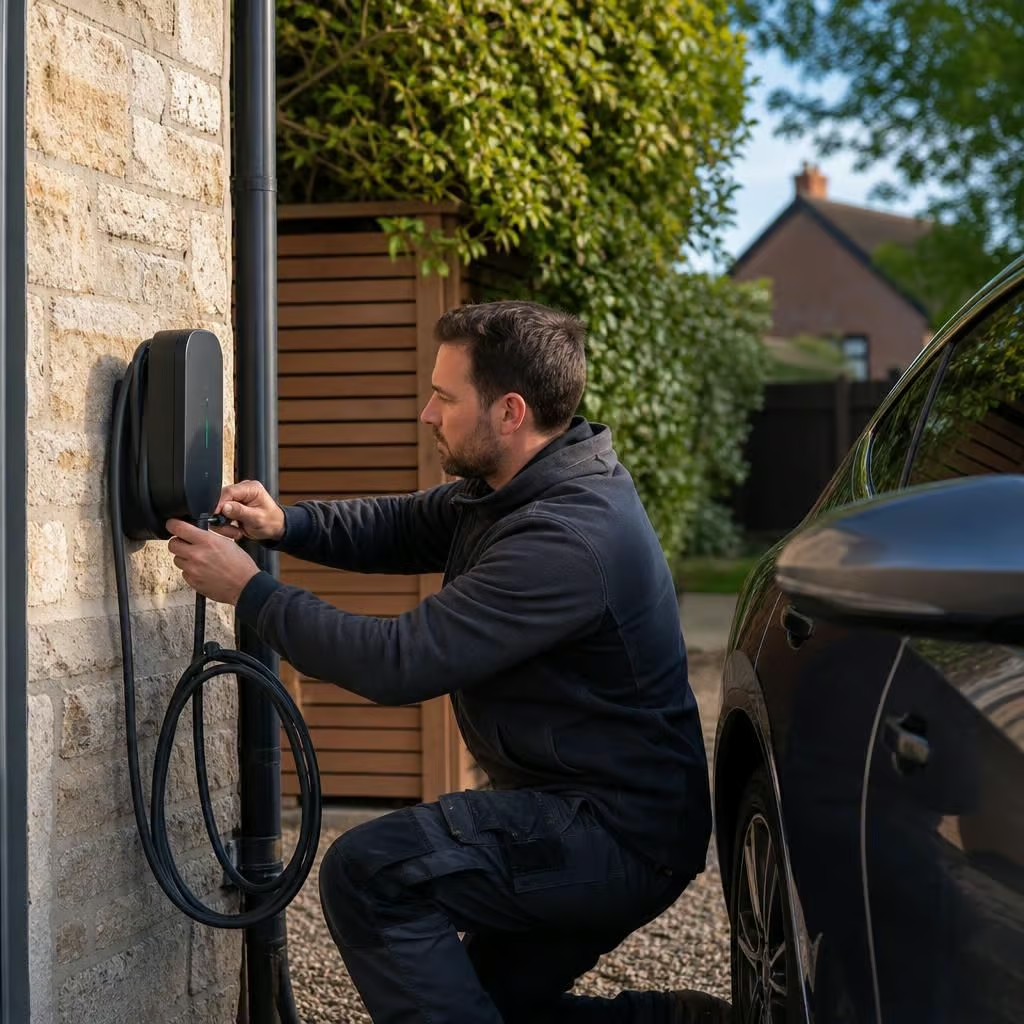
Does my EV charger installation need planning permission?
Usually not: an EV charger at a home with off-street parking can generally be installed under permitted development rights. Approval may still be needed for a listed building, an Article 4 direction or an installation outside those rules, so we check the property and proposed position before quoting.
For a typical house with off-street parking, installing a wall-mounted EV charger usually falls within permitted development rights. That means you can normally install it without a planning application, provided the property and charger position meet the relevant conditions.
Those conditions cover more than the charger itself. The planning position can change if the unit is close to a highway, fixed to the front elevation, mounted on a separate structure, or placed where its size or height exceeds the permitted limits. A cable route across a pavement or highway is not covered by domestic permitted development rights either.
We look at the parking space, the wall carrying the charger and the route back to the consumer unit. This identifies planning issues before an installer fixes equipment to the property. It also helps us avoid a position that leaves the charging cable across a footpath or creates a trip hazard.
Listed buildings need particular care. Permitted development rights do not remove the need to protect the building’s historic fabric. Listed building consent may be needed for the charger, cable route or any drilling into the building. Planning permission may also be relevant, depending on the property and its setting. The council’s conservation or planning team makes that decision.
A conservation area does not automatically mean that planning permission is required. However, an Article 4 Direction can remove permitted development rights for particular work in a defined area. The position also depends on where the charger sits and whether it can be seen from the highway. We flag this for confirmation rather than assuming that every conservation-area property has the same rules.
Flats and shared parking are different from houses. A leaseholder may need the freeholder’s consent before fixing a charger to an external wall. Communal car parks can involve ownership, access and cable-routing issues, even where planning permission is not needed. A charger serving a space that is not within the property’s private curtilage may also fall outside the usual household permitted development rights.
Workplace and commercial installations need a separate check. Several charge points, a car park installation, a ground-mounted unit, new electrical infrastructure or changes to access can introduce planning considerations. The site may also have lease restrictions, highway requirements or conditions attached to its existing planning permission.
Planning permission is only one part of an EV charger installation. The electrical work must comply with the current wiring requirements, and the charger must be connected safely to the property’s supply. If the existing consumer unit has no suitable capacity or protection, we may need to upgrade it before the charger can be used. That is an electrical requirement, not a substitute for planning approval.
Your electricity supply may also need checking before installation. A higher-powered charger can affect the maximum demand at the property, particularly where there is electric heating, solar generation or battery storage. We assess the supply and charger settings together so the final installation works within the available capacity.
If the planning position is unclear, we can identify the issue and tell you what needs confirming with the local planning authority. You may choose to apply for a lawful development certificate where you need written confirmation that the proposed work is permitted development. That certificate is not normally required for a straightforward installation, but it can be useful before selling a property or when a freeholder, lender or solicitor asks for evidence.
Before work starts, you should have clarity on:
- Whether the charger position falls within domestic permitted development rights.
- Whether the building is listed or affected by an Article 4 Direction.
- Who owns the wall, parking space and cable route.
- Whether the cable can reach the charger without crossing a public path.
- Whether the consumer unit and electricity supply can support the installation.
- Whether any planning, listed building, freeholder or highways consent is needed.
Once the position is agreed, the installation can be planned around the building rather than forcing the charger into a legally or technically unsuitable location. Where approval is needed, we explain what must be obtained before fixing the equipment.
The charger’s power rating usually isn’t what decides the planning position. The important details are where the unit sits, how it is fixed, and how the cable reaches the parking space. A smaller charger in a sensitive position can still need approval, while a higher-powered unit may be acceptable in a suitable location.
That distinction helps avoid paying for a planning application when the proposed position is the real issue. We can discuss an alternative wall or cable route where that keeps the installation within the relevant rules, without compromising safe access to the charger.