
What happens if a landlord’s appliance fails its PAT test?
Take the appliance out of use immediately and label it clearly so nobody reconnects it. We can assess whether it needs a repair or replacement, then record the result and action taken as part of the landlord’s electrical safety records.
A failed PAT result should lead to a documented decision about the appliance, not an automatic instruction to throw it away. The fault may be repairable, but nobody should use the appliance again until a competent person has assessed the reason for the failure.
Start by identifying exactly what failed. A PAT result can relate to the plug, fuse, flex, casing, earth continuity, insulation resistance or another electrical fault. A damaged cable may be straightforward to replace. Signs of overheating, exposed conductors, liquid damage or an insulation fault may make replacement the safer option.
We record the appliance identification, the test result and the observed fault. That prevents a failed item being confused with another appliance in the property, particularly where several similar items are supplied. We also check whether the appliance is suitable for its location and intended use.
- Remove access to the appliance. Unplug it where that can be done safely, and label it clearly as not for use.
- Keep it separate from equipment that has passed. This matters when a cleaner, contractor or tenant could otherwise reconnect it.
- Do not keep using it because it appears to work. A visual inspection cannot always identify an insulation or earthing fault.
- Do not attempt an improvised repair. Tape, a replacement fuse of the wrong rating or a damaged extension lead does not make the appliance safe.
We then decide whether repair or replacement is appropriate. A competent person may be able to replace a damaged plug or flex and retest the appliance. If the casing, heating element, motor or internal wiring is unsafe, repair may not be economical or technically suitable. An older low-value appliance is often better replaced, while specialist or built-in equipment may need attention from the manufacturer or a suitably qualified repairer.
The appliance should not return to the rental property simply because a replacement has been bought. We check the replacement before it is supplied and update the property’s equipment record. If a repaired appliance is safe to use, the record should show what was repaired, who carried out the work, the date and the subsequent test result.
Tell the tenant what has happened. The message should identify the appliance, explain that it must not be used and say what alternative arrangement applies. If it is a fridge, washing machine, cooker or another item that affects day-to-day living, agree how the tenant will manage until the matter is resolved. Do not leave the tenant to guess whether the failed appliance can be used occasionally.
If the tenant reports that the appliance caused a shock, burning smell, smoke, sparking or a tripped circuit, treat that information as important evidence. We investigate the appliance and any related socket, plug or circuit rather than assuming the appliance alone caused the problem. A PAT failure does not always identify the full source of an electrical fault.
Keep the evidence with the property records. A useful record includes:
- the appliance description, make and serial or asset number where available;
- the room or property where it was supplied;
- the date and type of inspection or test;
- the failed result and the fault found;
- the decision to repair, replace or withdraw it;
- the repair or disposal details; and
- the final test result or details of the replacement supplied.
Keep the record alongside the PAT report, photographs and relevant invoices. This gives a clear account of the action taken if a property manager, insurer or future contractor needs to review the appliance history.
A failed PAT test is not the same as a failed fixed-wiring inspection. Portable appliances and the electrical installation have different checks. The landlord’s electrical installation report covers items such as wiring, sockets, switches and the consumer unit. It does not automatically prove that a supplied kettle, lamp, washing machine or extension lead is safe. Equally, a PAT test does not replace the required inspection of the fixed installation.
There is no general rule that every appliance in a private rental must receive a PAT test at one universal interval. The sensible frequency depends on the equipment, how it is used, its age, its environment and the findings from earlier checks. A landlord still needs to take reasonable steps to keep supplied electrical equipment safe, and a failed result is evidence that further action is needed.
If damage appears to have been caused by a tenant, keep the safety decision separate from any later discussion about responsibility or costs. Remove the risk first, preserve the evidence and check the tenancy agreement before seeking payment or making a deposit deduction. Do not return a dangerous appliance to use while that question is being decided.
For landlords managing several properties, we can combine the failed-appliance assessment with a wider check of plugs, leads, extension equipment and the relevant electrical installation. Our NICEIC-registered electricians can identify when the issue is limited to a portable appliance and when the socket, circuit or consumer unit also needs attention.
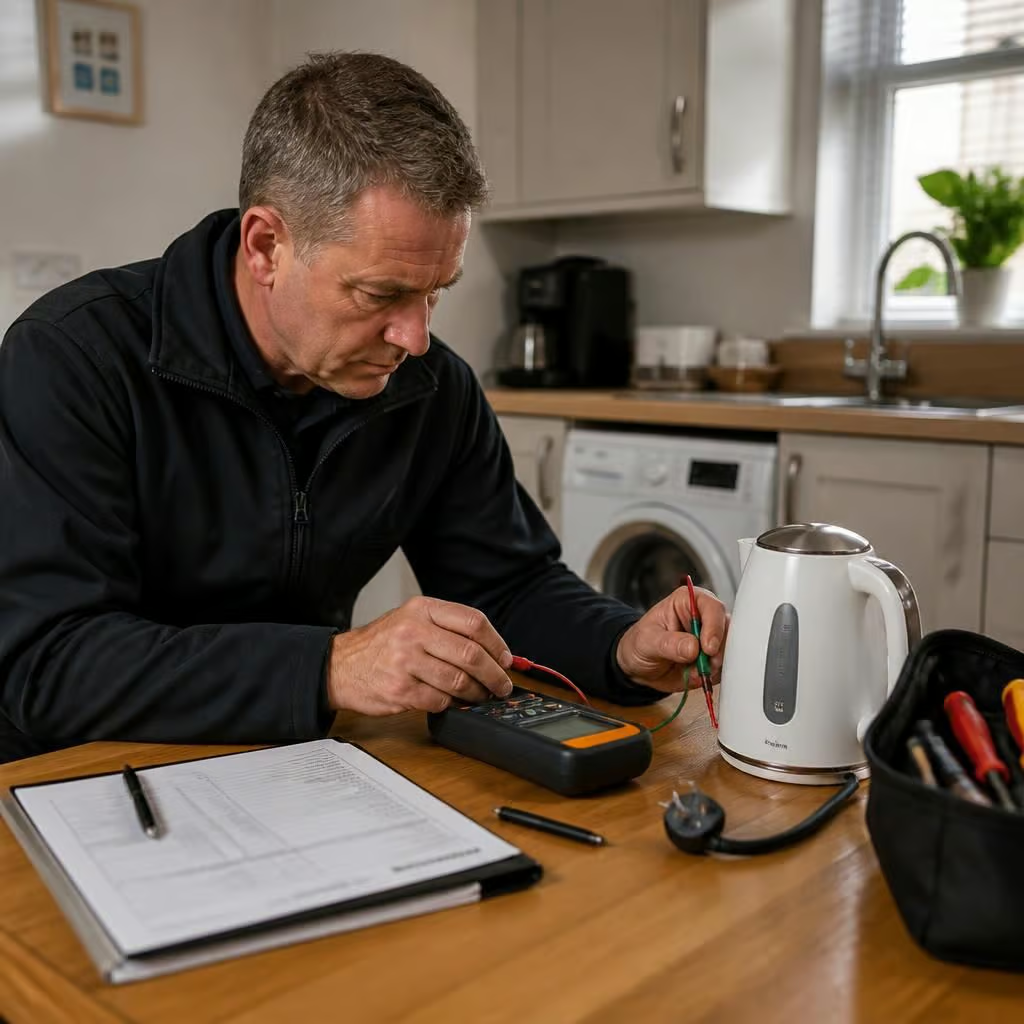
Before deciding what happens next, confirm who supplied the appliance. A tenant’s own kettle or heater should not be recorded as landlord equipment, but it should still be taken out of use if it has failed or shows damage.
If the appliance caused a shock, burning smell or repeated tripping, we check the socket and circuit as well as the appliance. That separates a faulty item from a wider electrical problem and leaves the landlord with a clear record of the action taken.