
Do I need a new consumer unit if my fuse box still works?
Not necessarily. If your fuse box is in good condition and meets current safety requirements, it may not need replacing, but we may recommend a new consumer unit if it is outdated, damaged, lacks modern protective devices or cannot safely support changes to your electrical installation.
A working fuse box does not automatically need replacing. An upgrade is usually recommended when the board lacks effective RCD protection, the enclosure or wiring is damaged, the earthing arrangement is unsuitable, or planned electrical work would leave the installation inadequately protected.
The fact that the fuses have not blown only shows that the circuits are supplying power. It does not confirm that the installation will disconnect quickly during a fault or protect people from electric shock. Older fuse boxes often use rewireable fuses and provide little protection against leakage to earth.
RCD protection is one of the main reasons to consider an upgrade. An RCD monitors the current leaving and returning through a circuit. If some current takes an unintended path, it can disconnect the supply. Modern consumer units may use individual RCBOs, which give each circuit its own overload and residual-current protection. That can prevent one fault from switching off several circuits at once.
We do not recommend replacing a board simply because it is an older design. Your installation may be safe to retain if its protective measures are effective and its condition is sound. An inspection identifies what the fuse box can and cannot provide, rather than treating age alone as a failure.
Several findings can change the recommendation:
- No suitable RCD protection: circuits supplying sockets, outside equipment or other areas may have less protection than expected from a modern installation.
- Damage or deterioration: heat marks, cracked covers, loose connections, corrosion or signs of overheating need investigation before the board remains in service.
- Earthing or bonding concerns: the incoming earthing arrangement and bonding to services such as water and gas must support safe fault disconnection.
- Limited capacity: an old board may have no sensible space or arrangement for additional circuits, such as an electric vehicle charger, an electric shower or an outbuilding supply.
- Repeated fuse operation: frequent blown fuses can indicate overloading, a faulty appliance or a circuit fault. Replacing the board alone will not cure the underlying problem.
A recent electrical inspection may also help clarify the decision. An EICR records observations against the condition of the installation, but a coded issue does not always mean that the consumer unit itself must be replaced. We trace the reason for the observation and explain whether the appropriate work is a board upgrade, a repair elsewhere, or no immediate action.
Current wiring rules do not normally make every older fuse box an automatic replacement. Electrical standards develop over time, but existing installations are not generally required to match every later provision simply because the rules have changed. The important question is whether the installation is safe for continued use and suitable for the demands placed on it.
Planned work can make an upgrade more appropriate. If an extension, kitchen alteration, rewire or new high-load circuit is being added, the existing protective arrangements may no longer be adequate. We look at the whole installation, including cable sizes, circuit separation, fault protection and the available space in the board. That avoids adding modern equipment to a board that cannot protect it properly.
Older homes can need extra care during this assessment. Solid walls, barn conversions and properties that have been altered over several decades may contain different generations of wiring. A fuse box can appear tidy while hidden connections, borrowed neutrals, inadequate bonding or older cable routes need attention. We test the circuits and explain any limitation before proposing replacement work.
Replacing the consumer unit is not the same as rewiring the house. If the existing cables test correctly and are suitable for continued use, we may be able to replace the board while retaining the circuits. If testing finds damaged insulation, poor connections or inadequate cable protection, those issues need resolving as part of the work or before a new board is fitted.
The upgrade itself normally involves isolating the incoming supply, labelling and disconnecting the existing circuits, fitting the new board, reconnecting each circuit and carrying out tests. We check that the protective devices operate correctly and that the circuits are identified accurately. We provide the relevant electrical certification when the work is complete, so the installation records match what is now fitted.
We use the inspection findings to set out the options clearly. If the fuse box is safe, keeping it may be reasonable. If the board leaves important circuits without appropriate protection or cannot support planned changes, an upgrade can improve how faults are contained and how the installation is used. Our NICEIC and ECA-registered electrical team can assess that decision without assuming that every working fuse box needs replacing.
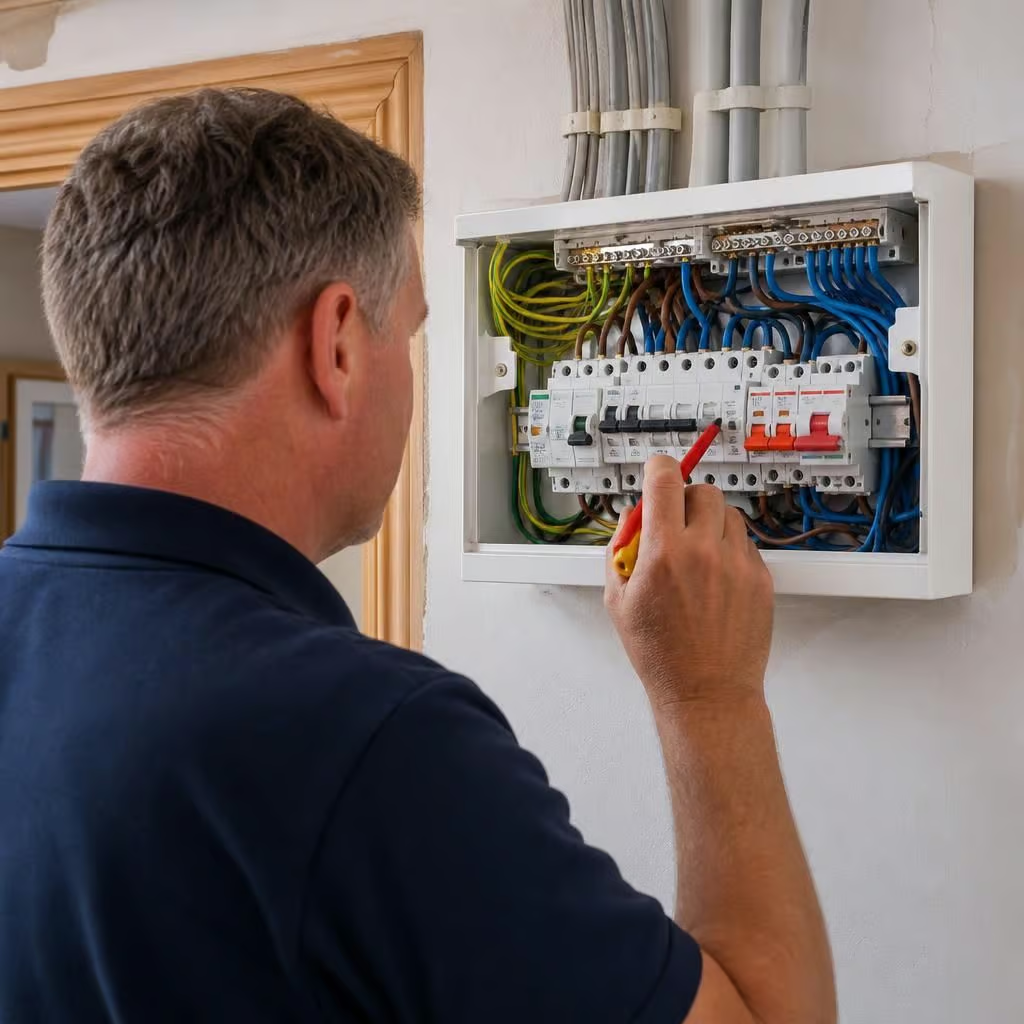
A new consumer unit can reveal a fault that the old fuse box did not detect. An RCD may trip because a circuit, cable or appliance is allowing current to leak to earth. That does not mean the new board is faulty.
If this happens, we identify the affected circuit and test it rather than bypassing the protection. You may need a repair to one circuit or appliance before the upgrade is complete. The result is a board that can disconnect the faulty circuit for the right reason, instead of leaving the problem hidden behind a fuse.