
What happens during a commercial EICR inspection?
During a commercial EICR inspection, we carry out a visual examination and electrical tests on the installation, including wiring, protective devices and earthing. We record any defects in the report, explain their significance and identify any remedial work needed.
A commercial EICR inspection follows the fixed electrical installation from the incoming supply through distribution boards, circuits and connected equipment. We agree the scope with the responsible person, make the installation safe to test, carry out the required checks and explain what the report means for the building.
Before the inspection
We first establish which parts of the premises are included. This may cover offices, workshops, shops, communal areas, plant rooms, external supplies and landlord-owned equipment. Separate buildings or tenant installations may need their own assessment.
It helps to provide previous EICRs, records of alterations, electrical drawings and details of known faults. If those documents are unavailable, we work from what we find on site and record any limitation that affects the inspection.
The responsible person should also identify equipment that must remain running. Servers, refrigeration, security systems, production machinery and other sensitive loads may need a planned isolation. We can then explain where interruption is necessary and avoid switching off equipment without agreement.
When we arrive
We meet the person responsible for the premises and confirm the areas included in the assessment. We identify the main intake, distribution boards, earthing arrangements, circuit schedules and any areas that need specialist access.
A commercial installation often has several distribution boards, additions made at different times and circuits serving equipment with different risks. We trace circuits where schedules are incomplete and compare the labelling with the installation. Poor labelling is recorded where it could make isolation or future maintenance unsafe.
We also consider how the building is used. A circuit in an office has a different risk profile from one serving a workshop, kitchen, agricultural building or plant room. We take account of exposed wiring, heat, moisture, mechanical damage, outdoor equipment and access by staff or the public.
How testing is managed
Some tests require circuits to be isolated. We plan these around the building’s operation where possible, but an inspection cannot always be completed without interruptions. Sensitive electronic equipment may need to be disconnected or protected before testing.
We use test instruments to check matters such as continuity of protective conductors, insulation resistance, polarity, earth fault loop impedance and the operation of residual current devices where fitted. The exact tests depend on the installation and the condition of its equipment.
We do not treat every item in a commercial building as part of the fixed installation. Portable appliances, machinery internals, fire alarm systems, data networks and specialist equipment may require separate inspections by the appropriate person. We clarify those boundaries so the report is not mistaken for a test of equipment it does not cover.
Where access is restricted, equipment cannot be safely isolated or a circuit cannot be identified, we record the limitation rather than guessing. The report should show what was inspected, what could not be checked and why that matters.
How findings are classified
Not every observation means the installation is immediately dangerous. We assess each finding against the requirements that apply to the installation and give it the appropriate classification:
- C1 means danger is present and urgent action is needed.
- C2 means the condition is potentially dangerous and should be dealt with promptly.
- C3 identifies an improvement that would increase safety but is not normally considered immediately dangerous.
- FI means further investigation is required before the condition can be fully assessed.
The observation should describe the location, the issue and the reason for the classification. That gives the business or property manager something practical to act on, rather than a list of unexplained technical terms.
What the completed report provides
The report identifies the premises and the installation covered, records the inspection limitations and lists the observations found. It also states the overall outcome of the assessment. A satisfactory result means no relevant safety issues were identified within the agreed scope. An unsatisfactory result means coded observations need attention or further investigation.
An unsatisfactory EICR does not mean that every part of the installation needs replacing. A single defective circuit, damaged accessory, missing connection or incomplete record may be enough to affect the outcome. We separate immediate safety concerns from planned improvements so the next decision is clearer.
After the inspection
Remedial work is separate from the inspection. You can use the findings to plan repairs, obtain a quotation or arrange further investigation. If we are asked to carry out the work, we explain which observations it addresses and provide written costs before work starts.
Once repairs are complete, the affected circuits need appropriate testing and the paperwork must show what has changed. A follow-up inspection or confirmation may be needed, depending on the findings. We do not treat unrelated upgrades as necessary simply because they could be useful.
Our electrical team is NICEIC-registered and ECA-recognised. For a commercial client, that means the inspection is carried out by electricians working within established technical and safety procedures, with clear paperwork for the person responsible for the premises.
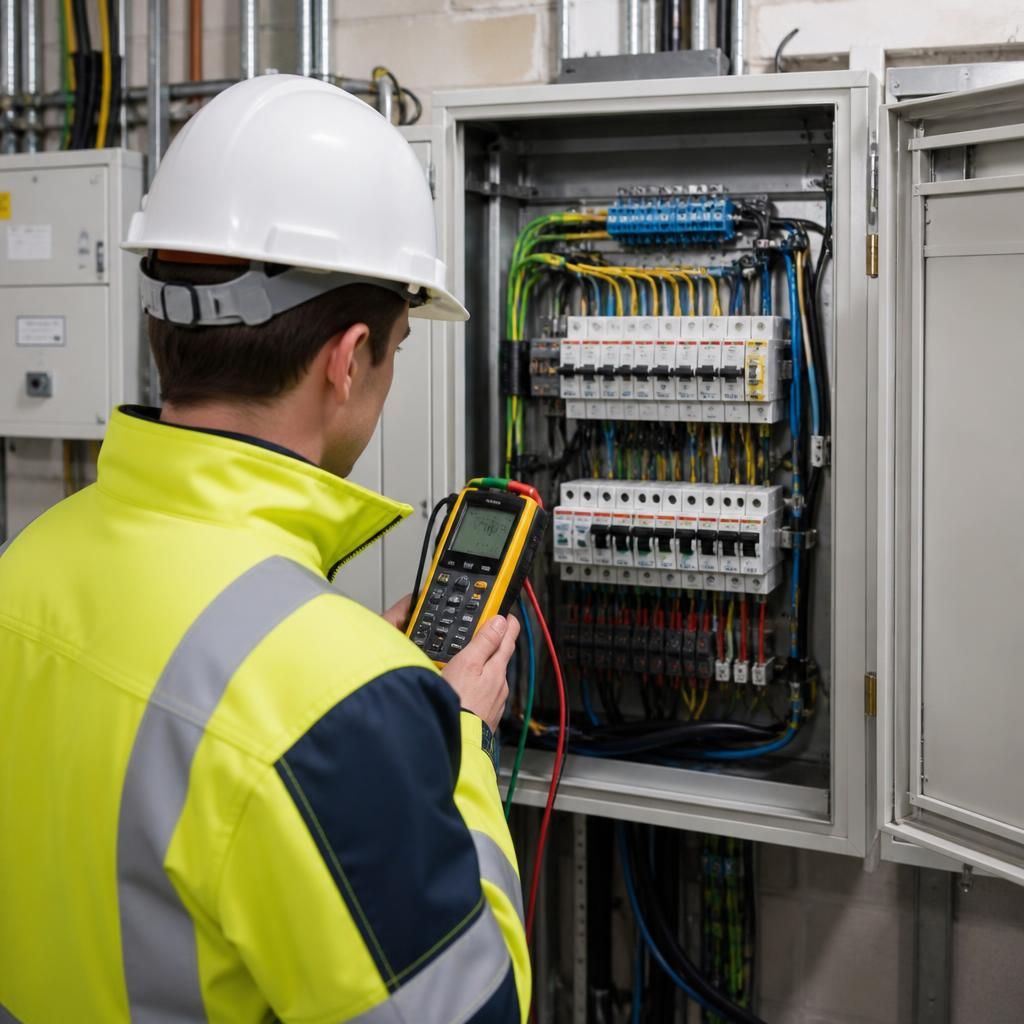
A distribution board can look tidy while faults remain hidden behind covers, accessories or previous alterations. We inspect accessible boards, switches, sockets and connection points for heat damage, loose parts, cracked casings, corrosion and signs of unsuitable work.
How the premises operates matters too. A socket exposed to workshop dust, a supply near water or a cable vulnerable to vehicle impact needs different consideration from office wiring. We relate what we find to the building’s actual use, then record the location and significance of any defect.
This gives the responsible person more than a pass-or-fail statement. The completed EICR shows which parts were examined, which issues need attention and where access or isolation limited the inspection. It can then support a sensible decision about immediate repairs, further investigation or future electrical work.