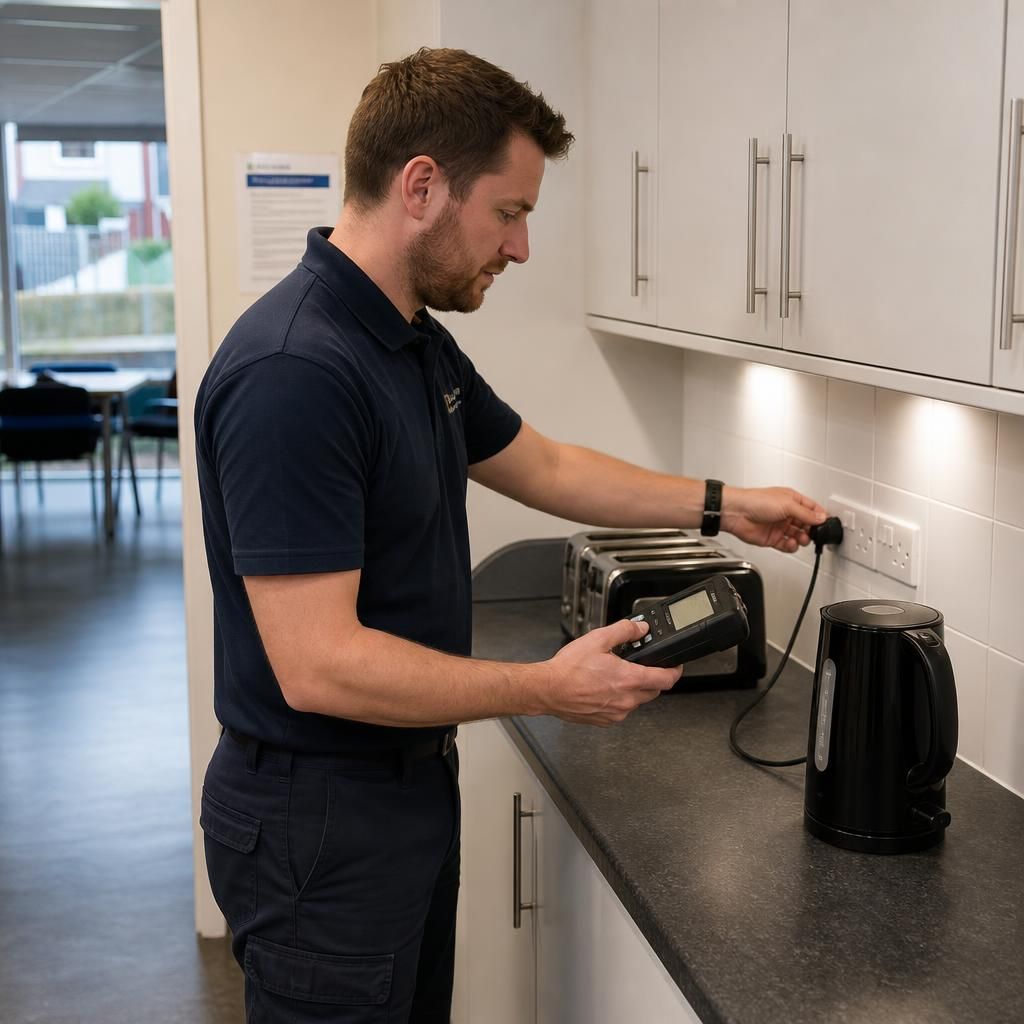
Can landlord PAT testing cover communal areas?
Yes. Portable appliances provided by the landlord or managing agent in communal areas, such as shared kitchens, laundries and hallways, should be included in the PAT testing programme, while fixed wiring and sockets need separate electrical checks.
The relevant question is not simply where an appliance is located. It is who owns it, who controls it and who is responsible for keeping it safe. If the landlord or managing agent provides equipment in a shared area, that equipment can normally be included in the PAT testing schedule.
This commonly applies to appliances in:
- shared kitchens and dining areas;
- communal laundry rooms;
- reception rooms, offices and staff areas;
- cleaners’ cupboards and maintenance areas;
- plant rooms, workshops and storage areas; and
- external areas where the landlord provides portable electrical equipment.
Typical items include fridges, microwaves, washing machines, vacuum cleaners, kettles, portable heaters, fans, power tools and extension leads. Equipment supplied for cleaners, caretakers or other contractors also needs consideration if the landlord controls its use and maintenance.
Communal lighting, sockets, extractor fans and other permanently connected equipment are not portable appliances. They need appropriate inspection of the fixed electrical installation or the equipment itself, rather than a PAT label. Fire alarms, emergency lighting and specialist plant may also need separate inspection and testing arrangements.
Landlords should also separate communal equipment from residents’ belongings. A tenant’s own television, charger or kitchen appliance would not normally form part of the landlord’s PAT schedule. The position changes if the landlord supplies the item, takes responsibility for it under the tenancy or provides it for shared use.
For a house in multiple occupation or a block of flats, we first establish which areas and appliances fall under the landlord’s control. A managing agent may hold the records, but the landlord still needs a clear arrangement for maintenance and remedial work. The tenancy agreements, management contract and any arrangements with a residents’ association can help define that responsibility.
There is no single testing interval that applies to every portable appliance. A shared vacuum cleaner used daily in a busy hallway presents a different risk from a rarely used appliance in a locked store. We consider the type of equipment, how often people use it, the environment, the age and condition of the item, and whether it is likely to be moved or damaged.
The inspection normally starts with the plug, cable, casing, switches and signs of overheating or damage. Where testing is appropriate, we use electrical test equipment to check the relevant safety characteristics. We record the appliance, its location and its result so that the landlord can identify what was checked and what needs attention.
A failed appliance should not remain available simply because it is in a communal area. We identify it clearly and recommend removing it from use, repairing it or replacing it. We also record the action taken. A label on its own does not prove that an appliance is safe, particularly if the item has since been damaged or repaired.
PAT testing does not replace the landlord’s wider electrical safety duties. In a rented property, the fixed installation needs its own inspection and documentation. That includes the wiring, consumer units, sockets, switches and fixed equipment serving communal areas. Where a fault appears to come from the installation rather than a portable appliance, the appropriate electrical inspection must follow.
Communal areas can also introduce extra risks. Moisture in a laundry room, dust in a workshop, outdoor use, trailing leads and high levels of public use can all affect the inspection plan. We take those conditions into account rather than applying the same schedule to every appliance in the building.
For a landlord or property manager, a useful record should show:
- the appliance description and identification number;
- its normal location;
- the inspection or test date;
- the result and any defect found;
- the action taken after a failure; and
- the date or review point for the next assessment.
We can help assess landlord-controlled appliances in communal areas and explain where a separate fixed-wiring inspection is needed. Our electrical work is carried out by NICEIC- and ECA-recognised professionals, with the findings set out in paperwork that can be kept with the property’s safety records.
Shared equipment can be moved between rooms or unplugged by different users, so its record needs to follow the appliance rather than the socket. We identify each item clearly and note its usual location, helping the landlord or managing agent match the result to the right equipment.
If residents, cleaners or contractors use the appliance, the person managing the building also needs a simple way to report damage or faults between inspections. That means a cracked cable, loose plug or overheating casing can be dealt with before the next planned assessment.