Will smart security sensors work with pets in the house?
Yes. Pet-friendly motion sensors can distinguish many pets from people, but correct settings and placement matter, especially with large, active or climbing animals.
The main factor is how the sensor sees movement, not simply whether a pet is present. A correctly selected sensor can distinguish the smaller heat pattern and movement of a cat or dog from a person, but no pet setting removes every possible false alarm.
Standard passive infrared (PIR) sensors detect changes in heat as something moves across their detection zones. Pet-tolerant models use software and lens design to disregard smaller heat patterns below a set threshold. That threshold has to suit the animal in the home. A sensor suitable for a small cat may not be suitable for a large dog, and two animals moving together can appear larger than one.
Your pet’s behaviour matters as much as its size. A dog that stays on the floor is easier to accommodate than one that jumps onto furniture beneath a sensor. Cats can climb shelving, curtains or stair rails and move through areas that would normally be outside a pet’s detection zone. We take those habits into account rather than relying on the label “pet immune”.
Placement has the greatest effect on the result. We normally aim sensors across a room, rather than directly at a doorway or at the place where an animal sleeps. We also avoid positions facing:
- radiators, warm-air outlets and open fires;
- large windows receiving strong sunlight;
- curtains or hanging plants that can move;
- staircases, worktops or furniture that a pet can climb;
- areas where a dog can approach the sensor closely.
A corner position often gives useful coverage, but the best location depends on the room and the animal’s access. A sensor placed too high, too low or at the wrong angle can create blind spots or make a pet appear larger to the detector. We check the coverage from the animal’s normal routes, not just from the doorway.
Rooms where pets are allowed do not always need the same protection. An alarm can use motion detection in circulation areas while relying on door and window contacts in a room where an animal moves freely. This reduces the number of times a pet crosses a detection zone. In some homes, an indoor camera can provide visual confirmation, although cameras need careful positioning around private spaces.
Many smart alarm systems also have a stay or home mode. This can leave selected rooms or routes unmonitored while the household and its pets are inside, while contacts on external doors and windows remain active. The exact options depend on the system. We set the modes around how the home is actually used, including where the pet stays overnight and which doors people use.
False alarms can still occur if a pet jumps on a sofa, knocks an object into the sensor’s view, or moves close to it. Heating changes, sunlight and moving furnishings can also affect detection. During commissioning, we test the alarm with the pet moving through its usual areas. We then check that a person entering the protected route is still detected, so reducing false alarms does not create an obvious gap.
If an animal’s routine changes, the settings may need reviewing. A new puppy, a recently adopted cat, a rearranged room or furniture moved beneath a sensor can alter the way the system performs. Tell us about those changes before relying on the alarm in a new configuration.
For a home with pets, the right design is usually a combination of pet-tolerant motion sensors, door and window contacts, suitable alarm modes and sensible placement. We can assess the rooms, the animal’s size and habits, and the points that need protection before recommending where detection should be used.
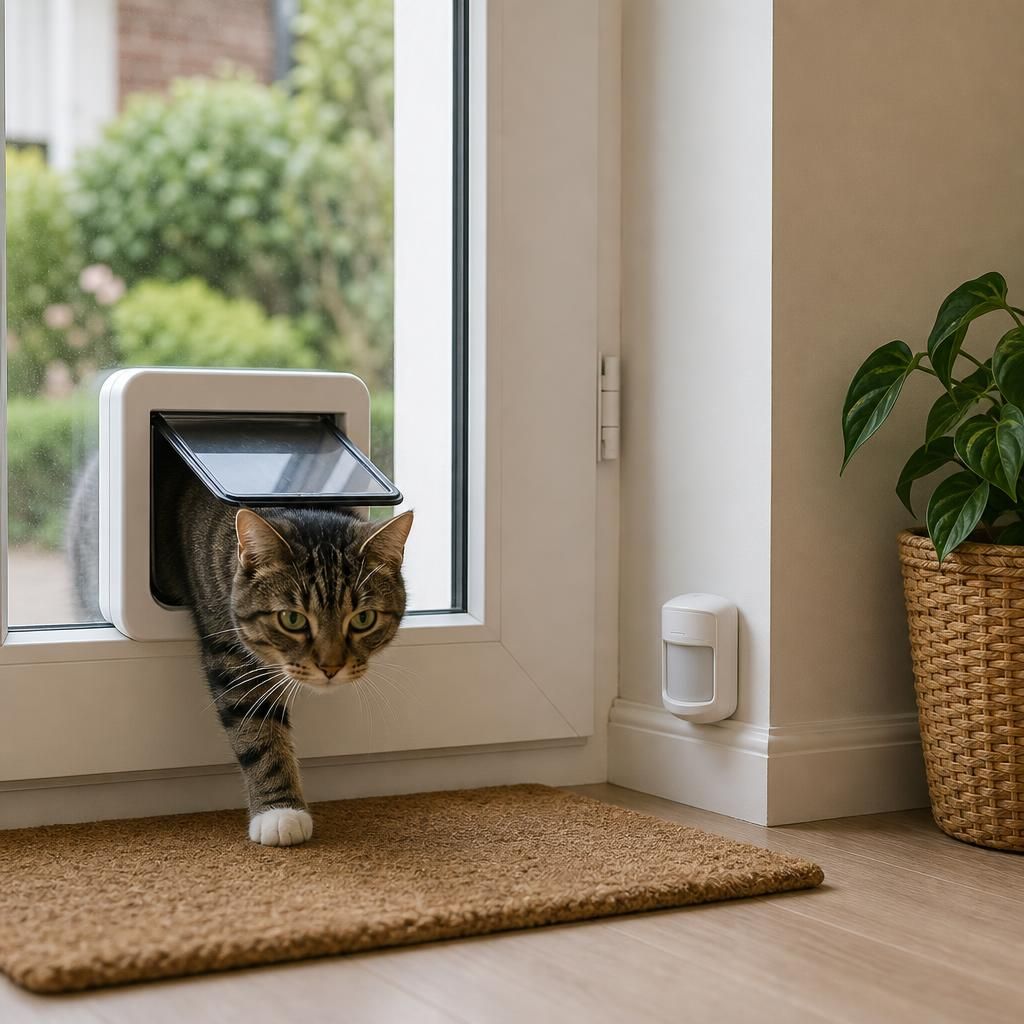
A cat flap needs separate consideration. A door contact won’t protect that opening, and a motion sensor aimed at it may detect your pet every time it passes through. We assess whether the flap is used while the alarm is set, then protect the surrounding room without placing detection across the animal’s normal route. That keeps the opening covered without treating every pet movement as an intrusion.