
Do I need planning permission for a 22kW EV charger?
In most cases, you don’t need planning permission for a 22kW EV charger at a house with off-street parking; the charger’s power rating alone does not change that. You may need consent for a listed building, a property in a conservation area or a home without permitted development rights, so check with your local planning authority before installation.
The 22kW rating does not, by itself, create a separate planning requirement. Planning control depends on the property, the charger position and how the parking space is reached. Electrical capacity, building regulations and permission from the property owner are separate matters.
For a house with its own off-street parking, permitted development usually covers a wall-mounted charger or a charging post within the property’s curtilage. The installation must meet the current limits on its position, projection or height. The charger must also serve the home rather than provide a new commercial charging facility.
A charger facing the road needs particular care. A wall-mounted unit may not qualify in every position if it is fixed to a wall fronting the highway, and a charging post has restrictions on how close it can stand to the highway. The cable route matters too. A cable cannot be left across a public pavement, so we plan the connection within the property boundary.
A listed building brings a separate consent issue. Even where the charger itself might fall within permitted development, fixing equipment to the building or running cables across historic fabric may need listed building consent. The same applies to alterations that affect the appearance of walls, gates or other protected features. We look at the building and the proposed cable route rather than relying on the charger’s size alone.
Conservation areas and other protected locations can have additional restrictions. Local planning authorities may also have removed permitted development rights from a particular property. Previous extensions, planning conditions or a change from a single home to another use can affect the position.
Flats and leasehold homes need a different check. The parking space may belong to a communal area, and the external wall, forecourt or electrical intake may not be part of the individual leaseholder’s property. Freeholder, management company or landlord approval can therefore be needed even when the local planning position is acceptable.
A shared driveway also needs agreement before installation. The charger may sit on one owner’s land while the cable passes close to another property or serves parking used by several households. We identify who owns the wall, driveway and supply route before fixing equipment.
Planning permission is not the same as approval for the electrical work. A 22kW charger normally needs a suitable three-phase supply, and the existing service may not have enough capacity. We check the incoming supply, consumer unit, earthing, protective devices and cable route. If the property cannot support 22kW, a lower-rated charger or managed charging arrangement may be more suitable.
When we assess a property, we record:
- the ownership and location of the parking space;
- the charger position in relation to the road, pavement and property boundary;
- whether the building is listed or in a protected area;
- the proposed cable route and any external alterations;
- the available electrical supply and whether three-phase power is present; and
- any landlord, freeholder or management-company conditions.
If the installation does not clearly meet permitted-development conditions, we explain what needs checking with the local planning authority before work starts. That may mean a formal planning application, listed building consent or written permission from the property owner. We do not treat an electrical installation as approved simply because the charger is small or removable.
For a straightforward house installation, this check gives you a clear route before you commit to the equipment. Our NICEIC and ECA electrical experience also covers the supply, protection and certification, so the planning question is considered alongside whether the property can safely run the charger.
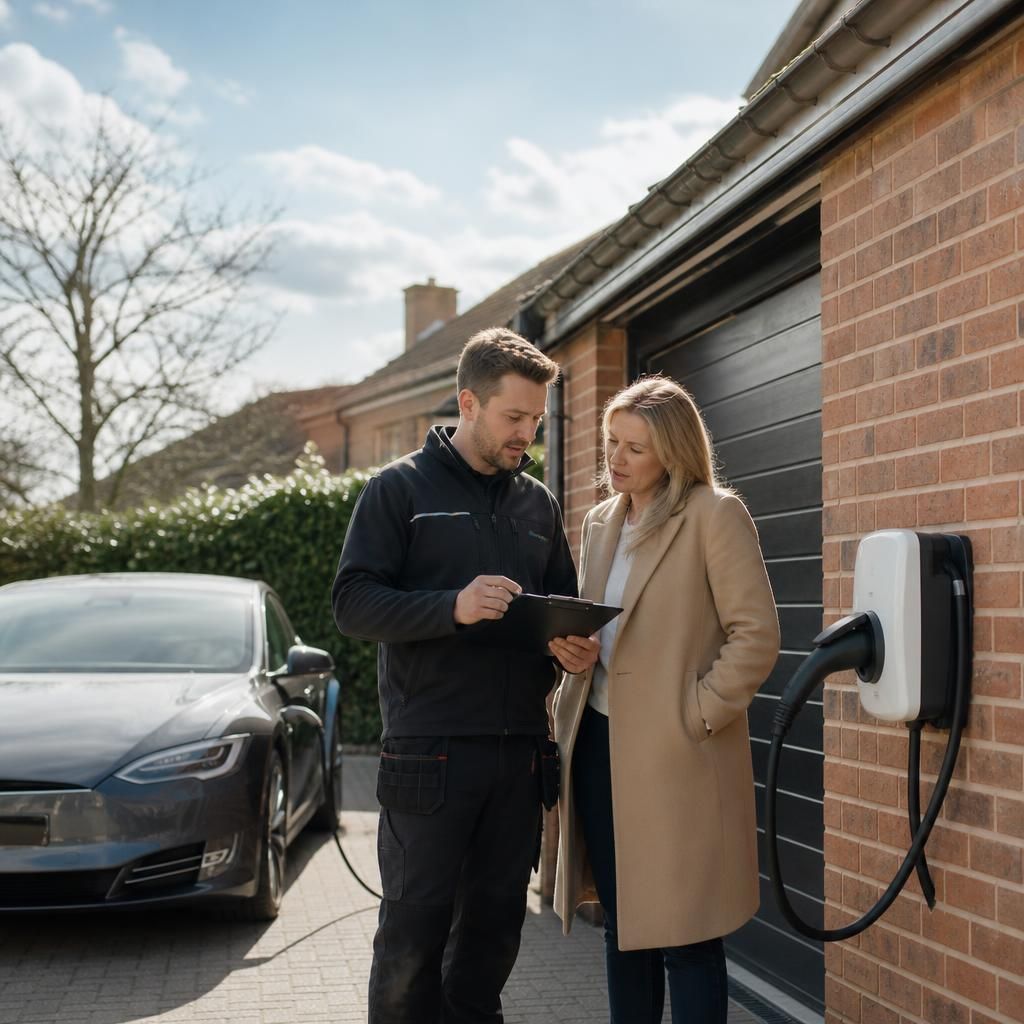
The safest time to settle the planning position is before buying the charger. A site photograph and marked-up plan can show the parking space, property boundary, highway and proposed cable route clearly.
That information helps the local planning authority or property owner assess the actual installation, rather than a generic 22kW specification. It also reduces the risk of choosing equipment that cannot be fixed in the intended position.