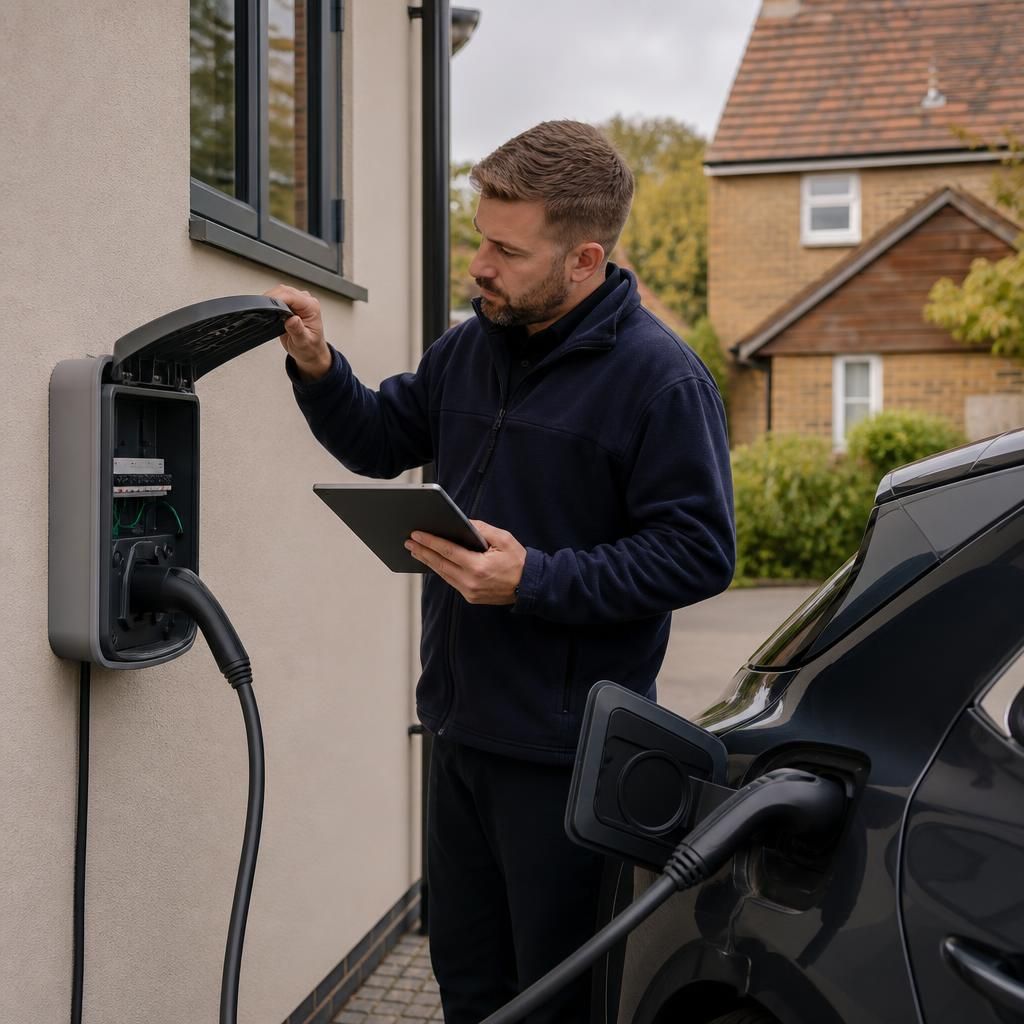
Does a 3-phase EV charger need load balancing?
Not always, but load balancing is often important for a 3-phase EV charger because it adjusts charging power when other appliances increase demand. We assess the property’s supply, phase capacity and normal usage to confirm whether it is needed and prevent the charger from overloading the installation.
No. A 3-phase EV charger does not automatically need load balancing. It depends on the available capacity of the electrical supply, the charger’s maximum output and what else may be running at the same time.
A 3-phase charger spreads its demand across the three phases rather than placing all of it on one phase. That helps use the supply efficiently, but it does not create extra capacity. Large loads such as an electric cooker, immersion heater, heat pump, workshop equipment or battery charger can still bring the property close to its limit.
Load balancing becomes important when the charger could take a significant share of the available supply. A dynamic system measures the electricity entering the property and reduces the EV’s charging rate when other demand rises. When that demand falls, the charger can increase its rate again, subject to its configured limits.
In a 3-phase installation, the monitoring equipment needs to account for each phase. The most heavily loaded phase may determine how much charging power is available, even when the combined demand across all three phases appears acceptable. A system that only measures total demand may not provide the right protection.
Some chargers and energy management systems include this function. Others need separate current sensors and a control unit. We check the equipment specifications rather than assuming that a charger labelled “smart” includes dynamic load management.
- Without load balancing: the charger may continue drawing its configured power while other appliances operate. That can cause the main supply protection or another protective device to disconnect.
- With dynamic load balancing: the charger reduces its output before the property exceeds its agreed supply limit.
- With a fixed limit: the charger is restricted to a set maximum. This is simpler, but it does not respond to changes in household demand.
Load balancing does not increase the capacity of the incoming supply. If the charger needs more power than the property can support, we may need to discuss a lower charging rate, a supply alteration or other electrical work. The control system manages demand; it cannot replace an inadequate cable, consumer unit or service connection.
Solar panels and a battery also need to be included in the assessment. Generation can reduce power imported from the grid at some times, but it is not always available when the car is charging. A battery charging at the same time as the vehicle can increase demand, while exporting solar power does not necessarily make that capacity available to the charger.
We assess the incoming supply, phase arrangement, consumer unit, main protective devices and existing high-load equipment. We also consider the charger’s output, the EV’s charging capability and any planned heat pump, solar or battery installation. That tells us whether load balancing is needed, whether phase monitoring is required and what charging limit is appropriate.
The current sensors are normally installed around the supply conductors so the control equipment can see the property’s demand. We check the proposed communications route and the charger’s behaviour if the monitoring signal is lost. The installation should fail in a controlled way rather than allowing the charger to keep drawing an unsafe level of power.
For a 3-phase charger, the right answer is therefore based on the whole electrical installation, not simply the number of phases. We design and test the arrangement as electrical work under the relevant wiring requirements, with NICEIC and ECA-registered electricians carrying out the assessment and installation.
A 3-phase charger does not mean the car will always charge across all three phases. Some vehicles accept only single-phase AC, so the charging load may still sit on one phase. The charger’s rating and the vehicle’s onboard charger must both be checked before we decide how much capacity is available.
That matters when the property already has uneven demand, such as a workshop circuit or electric heating on one phase. We match the load-balancing settings to the car, the charger and the incoming supply, so charging reduces appropriately without treating three-phase capacity as one shared figure.