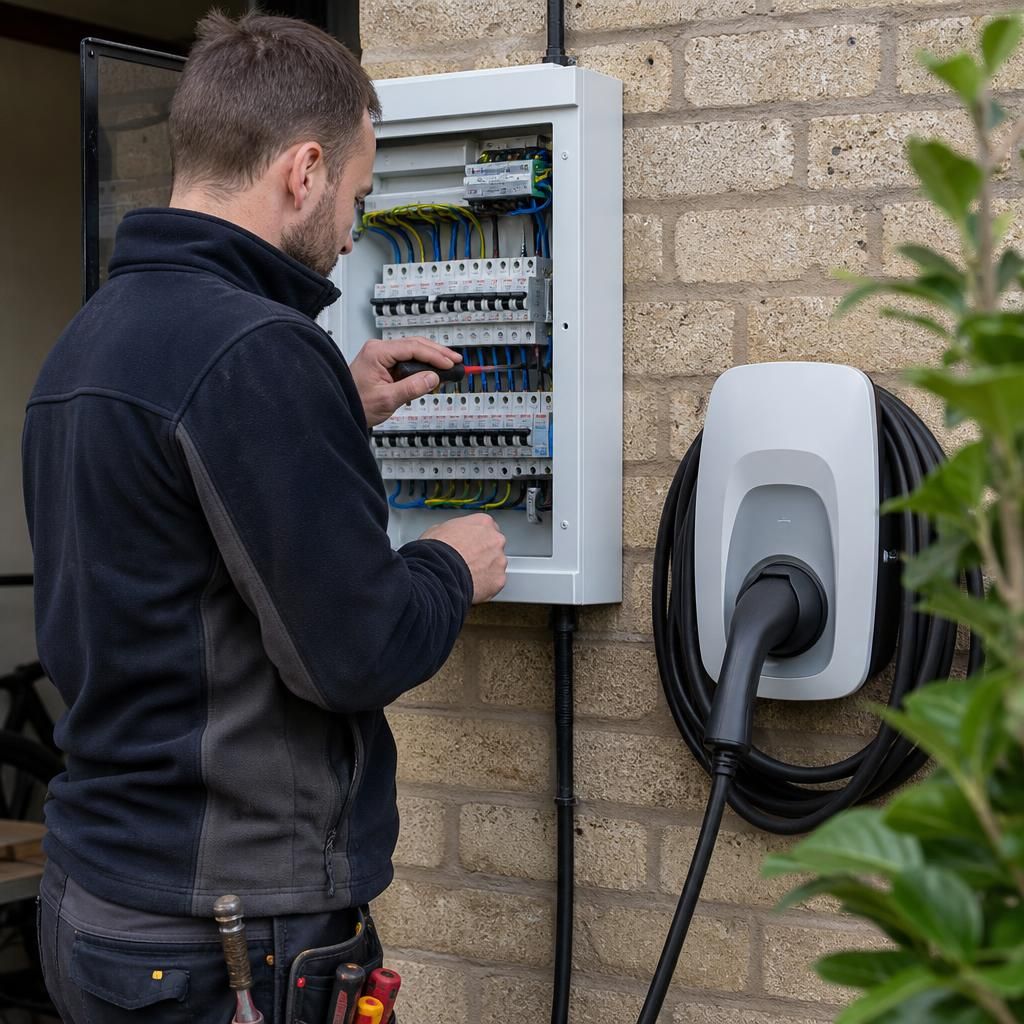
Does a 7kW EV charger need its own dedicated circuit?
Yes. A 7kW EV charger normally needs its own dedicated circuit from the consumer unit, with correctly sized cabling, protective devices and earthing for safe, reliable charging.
A dedicated circuit gives the charger its own correctly sized supply from the consumer unit. It does not mean a separate electricity meter or connection to the grid. The charger still uses the same incoming supply as the rest of the home, but its heavy, sustained load is kept apart from socket circuits and fixed appliances.
A 7kW single-phase charger draws roughly 32 amps while operating at full power. That is a substantial load for a domestic installation. A shared circuit could overload its cable, protective device or connections, particularly if the same circuit also supplies an oven, immersion heater, workshop equipment or outdoor sockets.
The dedicated circuit normally includes:
- a cable running directly from the consumer unit to the charge point;
- a suitable circuit breaker or RCBO;
- the correct form of residual-current protection for the charger;
- an accessible means of isolation; and
- earthing and fault protection appropriate to the property and the charge point.
The cable size cannot be chosen from the charger rating alone. The route length, installation method, ambient temperature, insulation, grouping with other cables and voltage drop all affect the design. A short external run may need different cable arrangements from a long route to a detached garage.
Your consumer unit may also need work before a charger can be connected. Older boards might not have enough spare ways, suitable RCD protection or adequate space for the new protective device. We inspect the board, check the earthing arrangement and test the existing installation before deciding what needs changing. If the board is unsuitable, we explain whether a replacement, an additional enclosure or another compliant arrangement is appropriate.
A dedicated circuit does not automatically mean that the incoming supply is large enough. Your home may already have several high-demand appliances operating at the same time. We assess the main service fuse, supply characteristics and likely household demand. Where the available capacity is limited, a compatible load-management system may reduce the charger’s output when other equipment is running. This can help manage demand, but it does not remove the need for correctly designed wiring between the consumer unit and charger.
Properties with older wiring need a closer look. Solid-wall homes, barn conversions and rural properties can have long cable routes, outbuildings or consumer units in awkward locations. An oil or LPG-heated home may still have a limited electrical supply, even though the heating system itself is not electric. We plan the route around the building rather than assuming that the nearest socket circuit can be extended.
If the charger is going on an outside wall or garage, the cable needs suitable mechanical protection and weather-resistant termination. A buried route may require different protection from a cable clipped to masonry. We also consider where the isolation point sits and how engineers can access it later without entering an unsafe area.
The protective arrangements depend partly on the charge point’s design. Some units include equipment that detects direct-current leakage; others require additional protection in the installation. We select the arrangement to match the charger and the wiring system, rather than fitting the same device to every property.
Solar panels or a home battery do not change the basic principle. A charge point still needs a properly designed final circuit. Solar integration can affect how charging is controlled, but it is considered after the supply, protection and earthing arrangements have been made safe.
We carry out the electrical design, install the circuit and test the completed work. You receive the relevant electrical certification, with the results recorded for the installation. As NICEIC- and ECA-registered electrical contractors, we work to the requirements that apply to domestic EV charging installations rather than treating the charger as another outdoor socket.
If an existing supply cannot support unrestricted 7kW charging, the practical answer may be load management, a lower charging rate or an upgrade to the incoming supply. We set out those options before work starts, so you can choose an installation that fits the property and the way you charge.
A dedicated circuit doesn’t automatically mean that your whole home needs rewiring. If the existing installation is sound, we can usually design the charger circuit around it rather than replacing unrelated wiring.
If testing finds damaged cables, poor earthing or other defects, we explain what needs attention before connecting the charger. You’ll know which work relates to safe EV charging and which is separate maintenance for the property.