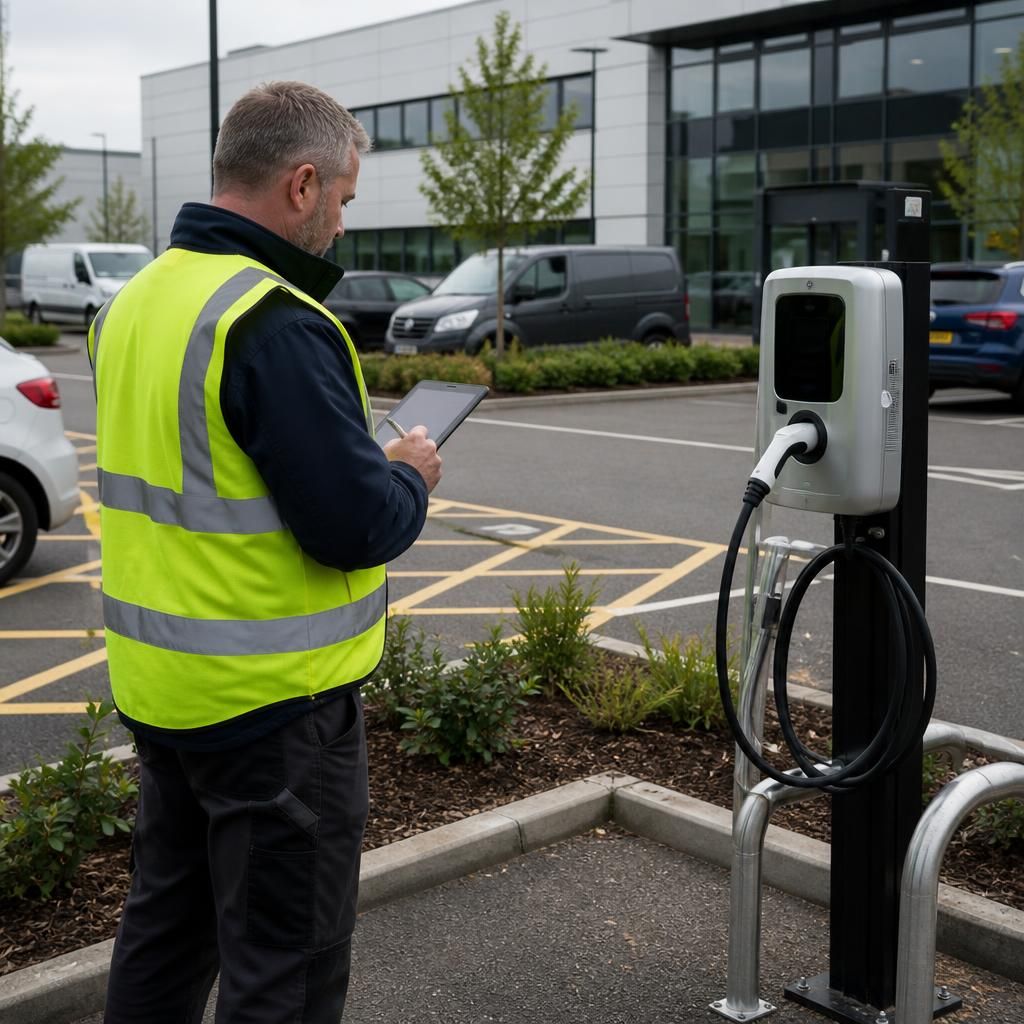
Does our workplace need a site survey before EV charger installation?
Yes, a site survey is usually needed before workplace EV charger installation. We use it to assess the electrical supply, parking layout, cable routes and safety requirements, so the proposed installation is suitable for your site.
In most cases, a physical site survey is needed before we can give a firm workplace EV charger installation quotation. A workplace installation has to work safely with the building’s electrical system, parking arrangements and the way people will use the chargers.
The survey also shows whether the proposed installation can be completed without avoidable excavation, alterations or changes to the building. If the site needs additional electrical work, we can explain that before you commit to the installation.
We assess the electrical intake and distribution equipment. An electrician checks the incoming supply, meter position, distribution boards, earthing arrangement, protective devices and available phases. We look for existing loads that could affect charging, such as heating, machinery, refrigeration, lifts or workshop equipment.
A site may have enough capacity for one charger but not for several units operating together. We can therefore discuss load management where it is appropriate. This allows the charging equipment to respond to the building’s demand rather than creating an avoidable strain on the supply.
If the proposed load may require changes to the supply, we identify that at the survey stage. The installation might need a distribution board upgrade, additional protection or a discussion with the distribution network operator. We do not assume that the supply shown on an old drawing still reflects the way the building is used today.
We look at how the chargers will be reached and protected. A workplace charger may serve employees, visitors, company vehicles, a fleet or members of the public. The best position depends on who needs to use it, where vehicles park and whether drivers need to connect from either side of a bay.
We consider the distance between the electrical equipment and the parking bays, along with walls, doors, gates, slopes and areas used by pedestrians. We also check how cable routes can be protected from vehicles, delivery traffic and accidental impact. Where a post, bollard, trench or surface-mounted containment is needed, the quotation can reflect the actual site rather than an assumed layout.
Access matters as much as the charger position. We consider disabled parking arrangements, pedestrian routes, emergency access, lighting and the need to keep entrances, fire exits and service areas clear. For a shared car park, we can discuss a layout that does not leave cables crossing walkways or obstructing other users.
The survey covers the building as well as the parking area. We may need access to the intake room, meter, distribution boards, plant areas and any proposed route through the building. If the property is rented, shared or managed by a landlord, the responsible person should confirm access and permission before the survey.
Listed buildings, older commercial premises and sites with several occupants may have extra restrictions on drilling, external equipment or cable routes. We flag those practical issues early, so the proposed work does not depend on an assumption that the building owner cannot approve.
We discuss operation before choosing the final arrangement. The number of vehicles, typical parking duration and preferred charging times affect the installation. A business with vehicles parked all day may need a different arrangement from one where cars arrive and leave throughout the day.
We can also record how users will be identified and how charging activity will be managed. That may include access control, separate users, workplace reimbursement or public payment arrangements. These decisions affect the equipment, communications connection and location of the charging units, so they are best considered before installation.
During the visit, we normally need a site contact who can explain the building’s use and point out any planned changes. It helps to have existing electrical drawings, details of the supply and any landlord or managing agent requirements available, although the survey does not rely on drawings alone.
Afterwards, we use the findings to prepare the installation specification and written quotation. This sets out the proposed charger positions, cable route, electrical work, access equipment and any permissions or supply changes that may be required. You can then compare the likely cost and disruption with the practical benefit before work starts, without relying on a generic allowance.
Our NICEIC- and ECA-registered electrical team carries out the electrical assessment and installation. That means the survey is tied to the work that follows, rather than being a separate desktop exercise. If the site is unsuitable for the original plan, we explain why and identify what would need to change.
A survey is particularly important when the site has an older electrical installation, several buildings, long distances between parking and the supply, restricted access or more than one proposed charger. It is also worthwhile when the first phase may expand later, because we can consider future provision while the initial work is being planned.
Workplace charging often has to fit around deliveries, visitors and fleet movements. A survey lets us understand those routines before the layout is fixed, so the proposed charger positions do not create a daily obstruction.
We can then separate the charging area from service routes, entrances and pedestrian movement in the installation plan. That gives you a clearer view of how the finished arrangement will work for staff and visitors, not just where the cable can physically reach.