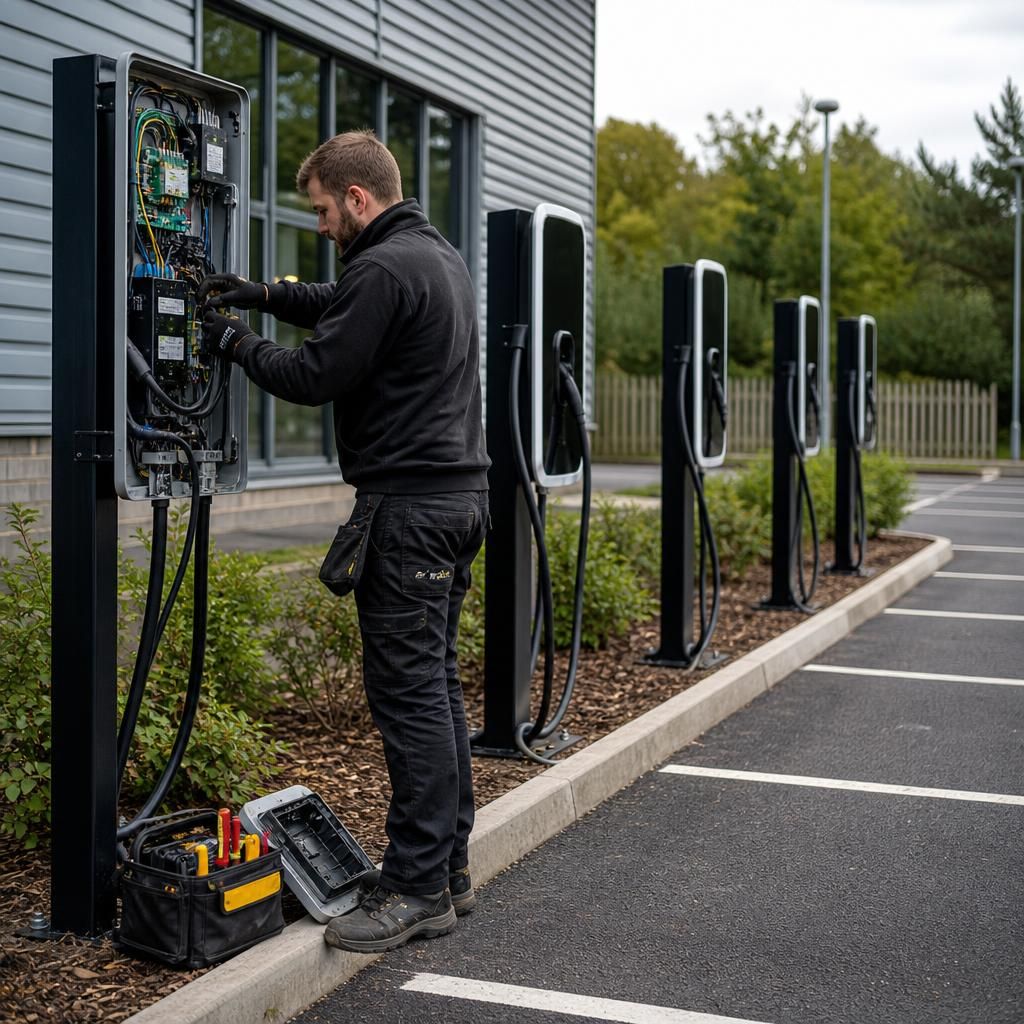
How long does workplace EV charger installation take?
There’s no single timescale for workplace EV charger installation. We first complete the survey and any required approvals, then fit, configure and test the chargers; a straightforward installation may be completed in one working visit, while larger systems take longer.
The time needed for a workplace EV charger installation depends on the electrical supply, cable route, number of charge points and any site approvals. The physical fitting is only one part of the project. Surveying, arranging network work, completing groundworks and commissioning the charge points can add time.
The survey sets the likely timescale
Your existing supply may support the planned chargers, or it may need changes before installation. We check the incoming supply, consumer unit or distribution board, available capacity, earthing arrangement and the proposed charging load. We also assess the distance between the electrical equipment and each parking space.
A short cable route through an accessible building is usually simpler than a route across a yard, car park or shared commercial premises. The survey also identifies the need for ducting, trenching, protective posts, wall repairs, access equipment or traffic controls. If the workplace is rented, we can highlight information that the landlord or managing agent may need before work starts.
Supply approvals can extend the project
Several chargers operating together can place a substantial demand on the building. If the available capacity is limited, we may recommend load management so the charge points share the supply rather than operating at full output together. That can reduce the need for a larger supply, but it must be designed around how staff, visitors or fleet vehicles use the site.
Where the supply needs an alteration, we explain what has to happen before the chargers can be connected. A request to the distribution network operator, a new connection or an upgrade to the building’s electrical equipment is separate from fitting the charge points. The timetable then depends partly on the relevant network operator and the work required on site.
What happens during the installation
- We confirm the charger positions, cable routes, isolation arrangements and any agreed access requirements.
- We install the dedicated circuits, protective equipment and cabling needed for the charge points.
- We mount the chargers and complete the connections at the distribution board and each parking bay.
- We configure load management or connected charging features where the design includes them.
- We test the circuits, protective devices and charge points before putting them into use.
The working area may need to be kept clear while cables are installed and tests are carried out. Most disruption comes from the cable route rather than the charger mounting itself. Surface-mounted cable containment can limit building work, while buried routes may require excavation, reinstatement and temporary restrictions around parking spaces.
Multiple chargers need more planning
Installing several charge points is not simply a single-charger job repeated across a car park. We need to plan the distribution equipment, cable routes, load sharing, communications and protection as one system. The site may also need a charging management platform, user access arrangements or a reliable data connection.
That planning can make the installation take longer, but it helps prevent a site from being left with chargers that cannot operate together at the required capacity. It also allows future charge points to be considered before routes and electrical equipment are fixed in place.
Testing and handover are part of the time required
Your chargers are not ready for staff or visitors simply because they power up. We test the electrical installation and confirm that each charge point operates correctly. Where connected functions are included, we check the relevant controls and explain the basic operation to the person responsible for the workplace.
We provide the electrical test results and installation paperwork needed for the site’s records. Electrical work is carried out to the applicable requirements by our NICEIC- and ECA-recognised team, so the business has clear documentation for maintenance, insurance and future alterations.
Common reasons the timetable changes
- The existing supply does not have enough capacity for the planned charging load.
- The distribution board needs replacement or additional protective equipment.
- Cabling must cross a yard, roadway, shared area or protected building fabric.
- Trenching, ducting, bollards or surface reinstatement are needed.
- Several chargers need coordinated load management or communications equipment.
- Landlord, site management or network approval is required before the work can proceed.
- The proposed parking layout changes after the survey.
A written quotation separates the charger installation from any supply upgrade, groundworks or additional site work. That gives you a clearer project plan before work starts and avoids treating an unresolved survey issue as an unexpected addition during fitting.
For a business planning around staff arrival times, fleet movements or customer parking, the useful date is the completion date for the whole project, not just the day the chargers are mounted. We can set that out once the survey confirms the electrical design, cable route and any approvals involved.
Your project may have two practical milestones: the electrical installation being finished and the chargers being ready for use. We can complete the cabling, mount the units and carry out our tests, but a supply alteration or network approval may still need to happen before charging starts.
That distinction matters when you plan staff parking, fleet movements or customer access. We set out which parts depend on site work and which depend on an external approval, so the completion date reflects the whole project rather than just the day the chargers are fitted.