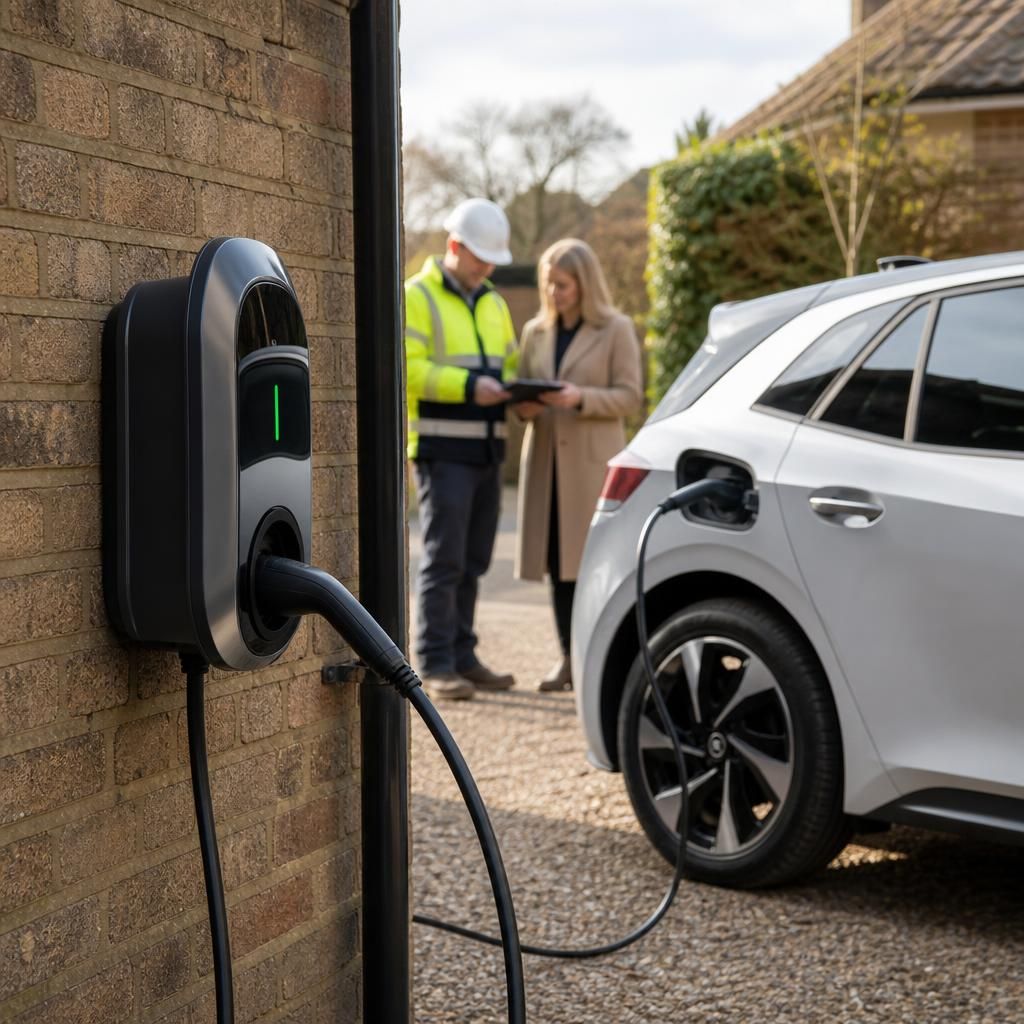
What affects the cost of EV charger installation?
EV charger installation cost depends on the charger you choose, the cable route, and whether your existing electrical setup needs upgrading. We assess those factors at your property and provide a written quotation before work starts.
The main cost differences come from the charger you choose, the distance between the consumer unit and parking space, and the condition and capacity of the existing electrical installation. A straightforward installation can cost less than one involving a long cable route, excavation, consumer unit work or an electricity network review. We assess those points before preparing the quotation, so the price reflects the work the property actually needs.
The charger itself
Charger prices vary according to the features you need. A unit with a fixed charging cable may cost more than a socketed model, but it can be simpler to use each day. Smart charging, app controls, scheduled charging, access controls and solar integration can also affect the equipment cost.
A higher-rated charger is not automatically the better choice. The available supply, the car’s onboard charger and the way you use the vehicle all affect the benefit. We match the charger to those limits rather than specifying equipment that the property cannot use effectively.
The cable route
The distance between the consumer unit and the parking space is one of the clearest installation cost factors. A short route through an accessible garage may need little additional work. A longer route through walls, loft spaces or external areas takes more cable and more labour.
Surface-mounted cable can be practical where the route is visible and accessible. Concealed cable may involve lifting flooring, opening walls or making good afterwards. We explain the difference before work starts, including where a tidy external route is more sensible than cutting into the building.
A charger on a detached garage, outbuilding or driveway may need additional protection and a different cable route. If the route crosses a garden, gravel area, paving or a private drive, trenching and reinstatement can add to the cost. We include any required groundworks in the quotation rather than treating them as an unexpected extra.
The condition of the electrical installation
An older home may not have enough spare capacity or suitable protection for an EV charger. We check the consumer unit, earthing, bonding and the existing circuits before connecting new equipment. A replacement consumer unit, additional protective device or other remedial electrical work may therefore form part of the price.
This is particularly relevant in older rural properties, where the wiring may have been extended over several renovations. The charger must have suitable protection even when the rest of the house appears to be working normally. NICEIC- and ECA-registered electrical work gives you the relevant inspection and certification for the installation.
The available electricity supply
Your home may have limits on the power it can draw at once. We consider the main fuse, the supply arrangement and other large loads such as electric heating, an immersion heater, an air source heat pump or a battery system.
If the charger could overload the supply alongside those appliances, we may recommend load management. This controls charging in response to the home’s demand, so the charger uses available capacity rather than always drawing its maximum rate. The equipment and setup needed for that control can affect the installation price.
Some properties need the electricity network operator to review the proposed connection. We deal with the technical information and explain any network requirements that could change the scope. The cost cannot be confirmed until those requirements are clear.
Where the charger will be mounted
The mounting position affects both the cable route and the amount of preparation. A wall close to the usual parking position is generally simpler than a charger mounted on a separate post. A post may suit a property without a suitable wall, but it needs a stable base and a protected cable route.
Listed buildings, shared driveways and properties with restricted parking may need extra consideration before the position is agreed. We look at access, cable protection and how the charger will be used, rather than choosing a location based only on the nearest wall.
Solar panels, batteries and tariffs
Existing solar panels or battery storage can influence the charger selected. You may want the car to charge from surplus solar generation, or you may prefer scheduled charging from a suitable electricity tariff. Those options can require compatible controls or a different charger specification.
They do not automatically make the installation cheaper. The final cost depends on the equipment already fitted, how it communicates and whether the charger needs additional control devices. We separate the installation cost from future electricity costs, because the tariff and charging pattern determine what you pay to run the car.
Possible grants and other financial support
Some EV chargepoint grants are available only to particular properties, occupiers or vehicle users, and the rules can change. Eligibility may depend on factors such as the type of home, parking arrangement or whether the property is used for a qualifying purpose.
We check the current position when it applies to the property and explain what evidence or application steps are needed. A grant should not be assumed when comparing quotations, and it should not replace a site assessment.
What the quotation should show
A useful quotation separates the charger, installation labour, cable and protection from any work needed to upgrade the existing supply. It should also make clear whether it includes testing, certification, network notifications, trenching, reinstatement and disposal of old equipment.
We give a written quotation before work starts. If the survey finds an issue that changes the proposed work, we explain it and agree the change before carrying it out. That lets you compare quotations on the same scope rather than choosing on the charger price alone.
The cheapest charger installation is not always the lowest-cost choice overall. A suitable charger, a safe cable route and the right electrical protection prevent you from paying for equipment that the property cannot use properly. The best comparison is between quotations that cover the complete installation and clearly identify any assumptions.
A network operator review can leave part of the final cost outside the installer’s control. Ask whether the quotation includes only Alderminster Group’s work or also identifies any separate network requirements and charges.
This distinction matters when comparing prices. A lower figure may simply exclude work that has not yet been confirmed. We explain any outstanding assumptions before you decide, so you can compare the full likely cost rather than the charger price alone.