
Will I need permission for an EV charger installation?
Most homes with private off-street parking can have an EV charger installed under permitted development, so planning permission isn’t usually needed. Listed buildings, conservation areas, flats, shared parking or work affecting a public footway may need planning or other consent, so we check the constraints before quoting.
In most cases, an EV charger at a house with a private driveway does not need a planning application. The position of the charger, the type of property and any local restrictions can change that answer, so we check those points before recommending an installation.
Planning rules depend on the property and the charger position. A wall-mounted unit is generally more straightforward than equipment fixed to a separate structure or installed in a prominent position. The cable route matters too. We look at the visible impact from the road, the distance from the parking space and whether the installation affects a boundary, garage or outbuilding.
Listed buildings need particular care. Listed building consent may be required even where ordinary planning permission is not. A conservation area does not automatically mean that permission is needed, but local restrictions or an Article 4 direction can remove some permitted development rights. We flag these issues from the property details rather than treating every house in the same way.
Flats and shared parking usually involve extra approvals. Permitted development rights may not cover a charger in a communal parking area, and the parking space may not form part of the leaseholder’s property. We may need consent from the freeholder, management company or other party responsible for the land. The cable route through shared areas also needs agreement.
Tenants should obtain the landlord’s written permission before arranging work. A landlord may also need to approve the charger model, the position of the unit and any drilling through external walls. We can identify what needs agreeing, but the owner or leaseholder must give the relevant consent before installation begins.
Planning permission is separate from electrical compliance. The charger still needs to be connected safely to the home’s electrical installation. We check the consumer unit, earthing, cable route and available electrical capacity. Where the existing supply cannot support unrestricted charging, we can assess load management rather than assuming that a larger supply is needed.
Some installations also require communication with the electricity network operator. This is not the same as a planning application. We establish whether the proposed equipment and supply need notification or approval, then explain any action required before the work goes ahead.
A driveway that crosses a pavement raises a different issue. If the property does not already have a lawful vehicle crossing, permission from the highway authority may be needed for a dropped kerb. A private charger does not give permission to run a charging cable across a public pavement. We take the parking arrangement and cable route into account when assessing the site.
Before quoting, we ask for photographs and details of the property, parking space and consumer unit. Where necessary, we arrange a site survey to confirm:
- whether the charger can be fitted under the relevant permitted development rules;
- whether listed building, conservation area or local restrictions apply;
- who owns the wall, garage, parking space and cable route;
- how the cable can reach the parking position without creating a trip or access problem;
- whether the existing electrical installation needs upgrading; and
- whether the electricity network operator needs to be notified.
If formal planning permission or another consent is needed, we explain that before any installation is booked. Work should not start until the required approval and property-owner permission are in place. For installations that do not need planning consent, our NICEIC-registered electricians still provide the appropriate electrical certification and leave the paperwork with you.
The result is a charger position that has been checked against the property, the parking arrangement and the electrical supply, rather than a unit fitted first and permissions considered afterwards.
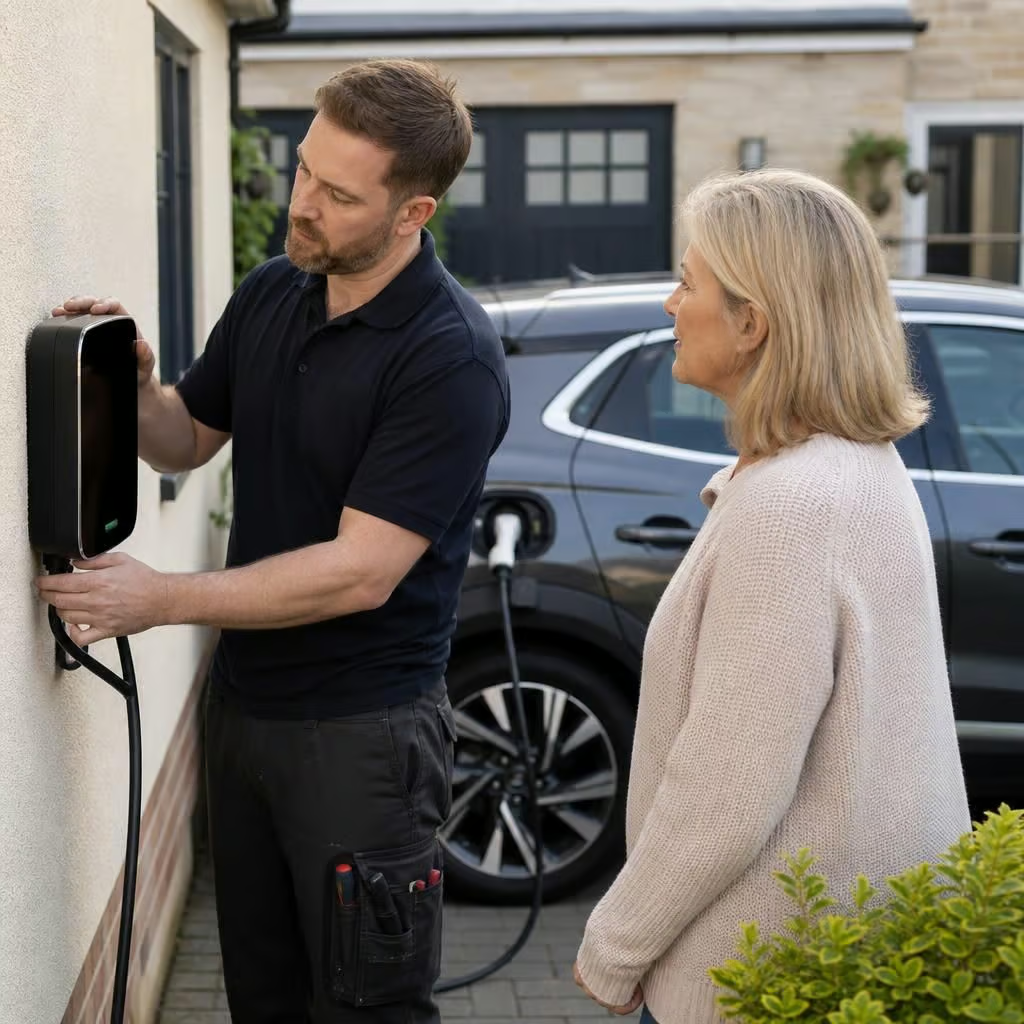
Permission to install a charger does not give you the right to use a parking space or cross someone else’s land. If the space, wall, garage or access route is shared, check the title, lease or management rules as well as planning requirements. We can identify where the proposed cable depends on another owner’s consent, so you can resolve that issue before electrical work is arranged.