
What electrical standards must a rapid EV charging station meet?
A rapid EV charging station must comply with BS 7671, the IET requirements for electric vehicle charging equipment, relevant British and European product standards, and the electricity network operator’s connection requirements. We design the installation around the available supply, install the required protection, then test and certify the completed electrical work.
A rapid EV charging station must comply with three layers of requirements: the charger’s product standards, the site’s electrical installation rules and the network operator’s connection conditions. The correct combination depends on the charger’s output, whether it supplies AC or DC, the available supply and whether the site is domestic, workplace or public.
The charger itself
A rapid charger should be manufactured and tested to the standards covering EV supply equipment. BS EN IEC 61851 covers the charging system and its communication, control and protective functions. The connector and vehicle interface fall under the BS EN IEC 62196 series. These standards address matters such as pilot communication, charging modes, connector design and protection against unsafe energisation.
That does not mean a product certificate makes the installation compliant. The equipment must still be suitable for the intended supply and installed according to its instructions. We check the manufacturer’s electrical data, protection requirements, cable terminations, ventilation needs and environmental rating before deciding where it can go.
Protection against electric shock
Rapid charging equipment can introduce direct-current leakage as well as ordinary alternating-current faults. The protective arrangement must therefore match the charger’s design. Depending on the equipment, this may involve a suitable Type A residual current device with six-milliampere DC detection built into the charger, or a Type B device installed upstream.
The correct choice cannot be made from the charger’s output alone. We check the manufacturer’s instructions and make sure the residual-current protection works with the rest of the installation. We also assess the earthing arrangement, including whether the property uses a PME supply. If a broken neutral could raise exposed metalwork to a dangerous voltage, the installation needs the protective method specified for EV charging equipment.
Cable sizing and fault protection
A rapid charger draws considerably more power than a standard domestic charge point. The cable must carry that load without overheating, including when it runs through insulation, ducting or an area with restricted ventilation. We allow for grouping with other cables, ambient temperature, route length and voltage drop.
The switchgear must also interrupt the prospective fault current available at the site. We select overcurrent protection, isolation and switching equipment to suit both the charger and the supply. Where the charger is supplied from a distribution board, that board may need additional capacity, a dedicated outgoing way or replacement equipment with a higher fault rating.
Surge protection may be needed to protect the charger and connected vehicle from transient overvoltages. Its position and specification depend on the existing installation and the risk assessment. Outdoor equipment also needs appropriate protection against water, dust, impact and accidental contact.
Supply capacity and connection requirements
A charger can meet its product standard and still be unsuitable for the site if the incoming supply cannot support it. We establish the charger’s maximum demand, the existing site load and the available capacity before installation. A three-phase supply, upgraded service or separate connection may be required for higher-powered equipment.
The distribution network operator may require notification, approval or a formal connection application. Its conditions can cover maximum import capacity, export limitations, protection settings and the point of connection. For a commercial or public site, we also consider other large loads such as refrigeration, heating, workshops and solar generation. Load management can reduce the site’s peak demand, but it must be compatible with the charger and the agreed connection.
Testing and certification
Before the station is put into service, we test the installation rather than relying on the charger’s self-checks. This normally includes continuity of protective conductors, insulation resistance, polarity, earth fault loop impedance and operation of the residual-current protection. We also verify isolation, emergency stop arrangements where fitted, phase rotation on three-phase supplies and the charger’s communication with a vehicle.
Functional testing should confirm that the station starts and stops correctly, releases the connector safely, records a fault and responds properly when the protective device operates. Where the charger uses load management or site metering, those controls need checking under realistic conditions as well.
The completed electrical installation receives the appropriate test results and certification. For a workplace or public station, the owner should retain the charger commissioning information, operating instructions, maintenance requirements and any DNO correspondence with the site records.
Additional requirements for commercial and public sites
A workplace or public charging station may also fall within the Electricity at Work Regulations, with duties covering the design, maintenance and safe operation of the electrical equipment. The site operator needs a suitable inspection and maintenance arrangement, clear isolation procedures and access to the electrical records.
Physical layout matters too. We allow for vehicle impact, cable routes, drainage, lighting, pedestrian movement and access to the distribution equipment. The installation must not leave users reaching across traffic routes or create a trip hazard. Any enclosure, bollard or barrier should protect the station without preventing safe operation and maintenance.
For a domestic property, the same technical care applies even though the installation is smaller. An older home may have limited spare capacity, an outdated consumer unit or an earthing arrangement that needs improvement first. We explain those findings before work starts, provide a written quotation and leave the owner with the test paperwork needed for future maintenance or property records.
A compliant rapid charging station is therefore more than a charger fixed to a wall or plinth. The product, supply, protective devices, earthing, controls, location and records must work together. We assess those elements as one installation so the station is suitable for the site before it is commissioned.
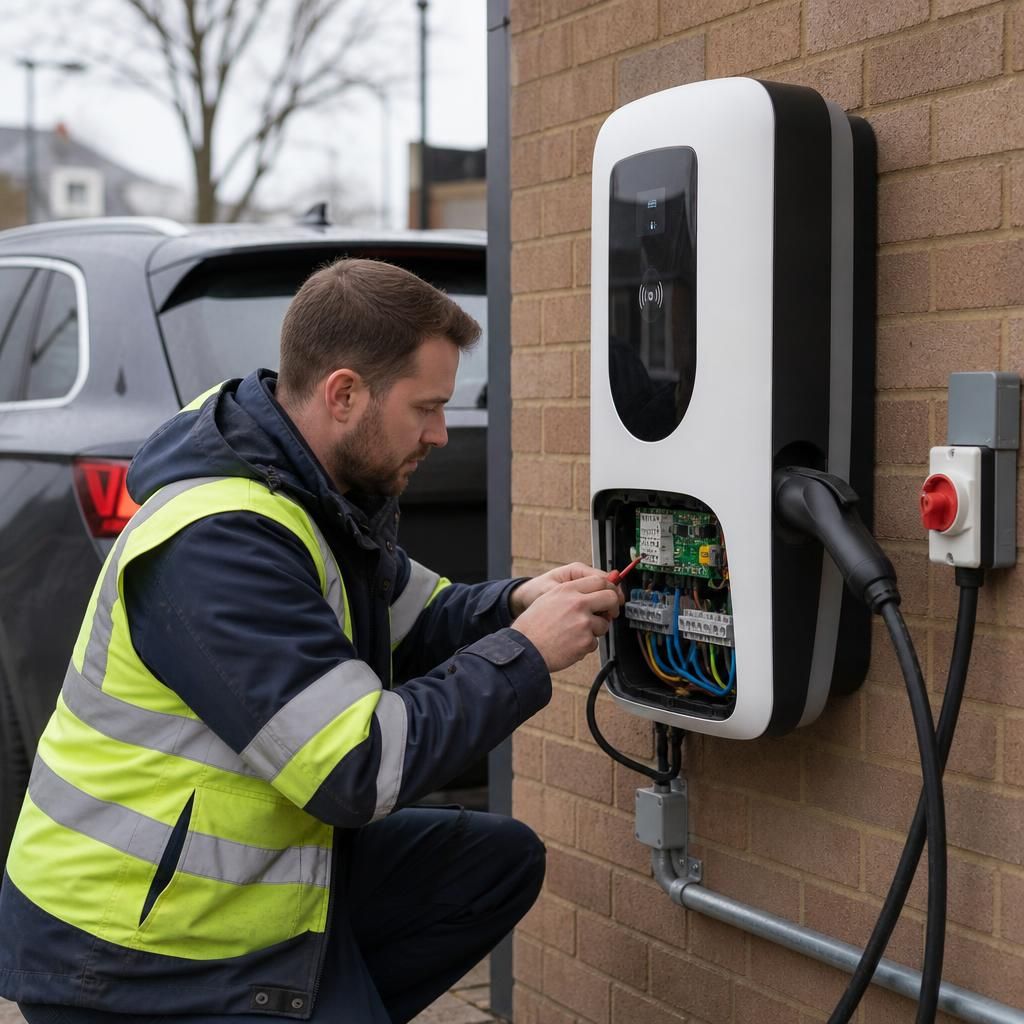
The electrical work should be completed by a competent, registered contractor, not treated as a simple appliance connection. Our NICEIC and ECA electrical qualifications support the design, installation and testing of the charging circuit, including the protective measures required for the site.
That gives you more than a compliant charger on the wall. You have a clear record of how the circuit was designed, which protective devices were fitted and what was tested before the station was used. Keep those details with the charger instructions, particularly if the property changes hands or another electrician later works on the supply.