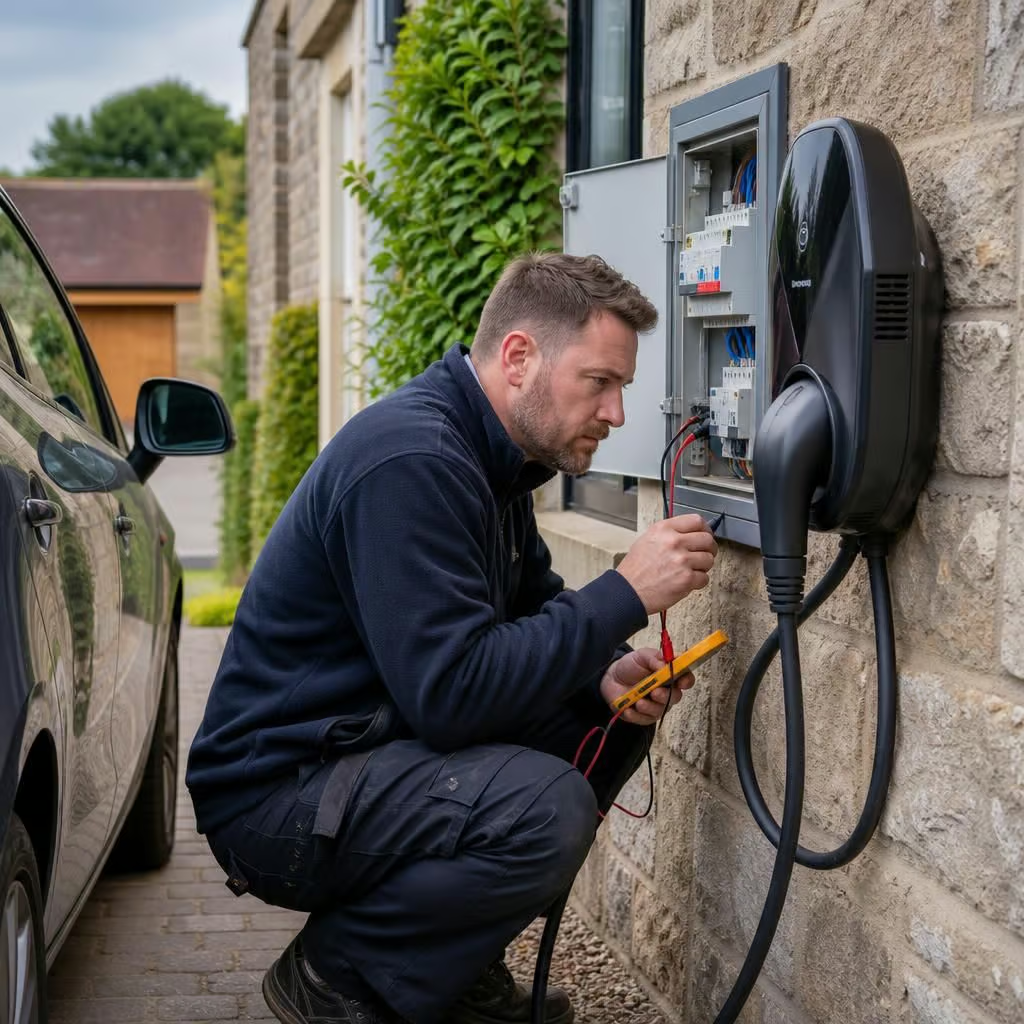
Will my electricity supply support the EV charging station I’m considering?
In many homes, the existing electricity supply can support an EV charging station, but we need to check its available capacity first. We assess the incoming supply, consumer unit and cable route, then confirm whether the charger can be installed as planned or whether an upgrade or load-management device is needed.
Most homes can support an EV charger, but the available capacity matters as much as the charger itself. A house may have electricity connected already and still need changes before charging can be added safely.
The first consideration is the incoming supply. We look at the service head, main fuse, meter tails, earthing arrangement and the property’s existing demand. Electric heating, an immersion heater, an electric cooker, solar panels, battery storage and workshop equipment can all affect how much capacity remains for vehicle charging.
The charger’s rated output is only part of the calculation. Your car may accept a particular charging rate, but the home also needs to supply it alongside everything else running at the same time. We assess the likely peak demand rather than assuming that the charger can draw its full output continuously.
Many domestic properties have a single-phase supply. That is suitable for a wide range of home chargers, provided the supply and wiring can carry the additional load. A three-phase supply offers a different arrangement, but it does not automatically remove the need for checks. The charger, vehicle and protective equipment must still be compatible.
Older properties need particular care. If the consumer unit has limited space, outdated protective devices or signs of heat damage, we may recommend electrical improvements before installing the charge point. An older cable route may also be unsuitable for the new circuit, especially where the cable must pass through outbuildings, a garage or a long driveway.
We check the earthing and bonding because faults on the supply need to be detected and disconnected correctly. The charging circuit also needs the appropriate protection for the equipment being installed. These checks help us decide whether the existing consumer unit can accommodate the work or whether a new board or additional enclosure is needed.
Load management can sometimes avoid a supply upgrade. This system monitors the home’s demand and adjusts the charger’s output when other large appliances are operating. Charging can then continue at a lower rate during periods of higher demand, with more capacity available when the rest of the property is using less electricity. We explain how this affects charging before you choose it.
A supply upgrade may be needed where the service cable or main fuse cannot support the combined demand. In that situation, we explain what the distribution network operator needs to assess and whether a lower-output charger or managed charging is a practical alternative. We do not treat a supply upgrade as automatic; the right choice depends on the property, the car and how you expect to charge.
Solar panels and a home battery can change the way charging works, but they do not remove the need for a suitable mains connection. We consider the existing generation and storage equipment, the charger’s controls and the electricity flow around the property. If you want to charge from surplus solar power, we discuss what the system can realistically provide rather than assuming the car will always run from sunlight.
Off-gas-grid and rural homes are not excluded. However, longer cable runs, detached garages, agricultural buildings and private supplies can change the design. Where the charger is away from the house, we check the cable size, voltage drop, buried route and protection at both ends.
Our assessment ends with a clear installation route. That may be a standard dedicated circuit, improvements to the consumer unit, managed charging, or further work on the incoming supply. You receive the reason for the recommendation before work starts, along with any changes that could affect the quoted cost.
Electrical installation and testing are carried out by our NICEIC-registered electricians, with ECA-recognised electrical practice behind the work. Once the charger is installed, we test the circuit and protective equipment so you can use the station as intended, with the installation paperwork completed for your records.
The fastest charger is not always the best match for your home. If you usually charge while the car is parked overnight, a lower output may meet your needs without placing as much demand on the incoming supply.
We compare your driving routine, the car’s charging capability and the electricity your home already uses. That gives you a clear choice between charging speed, installation work and the cost of any electrical changes, rather than assuming maximum power is necessary.