
Will my charger work if my home has a restricted electrical supply?
Often, yes. We check the incoming supply and your household demand, then specify load management, a lower charging rate or a supply upgrade where needed.
A restricted electrical supply does not automatically rule out home charging. It means the charger must share the available capacity with the rest of the property without overloading the incoming supply.
Your supply may be restricted because the property has an older service, a smaller incoming fuse, a long connection from the network, or equipment that already places a high demand on the system. Rural homes and older properties can have more complex arrangements, particularly where the supply serves outbuildings, pumps, electric heating or agricultural equipment.
We assess the incoming supply, the consumer unit and the way electricity is used across the property. That tells us whether the charger can operate at its full rate, needs dynamic load management, or requires a change to the supply.
What load management does
A charger without load management can draw a substantial amount of power while other appliances are running. On a restricted supply, that could exceed the safe available capacity. A load management system monitors the property’s demand and adjusts the charging rate accordingly.
Your car may charge more slowly while the cooker, immersion heater or electric heating is running. When those loads switch off, the charger can increase its output again. You can still charge at home, but the rate may vary instead of remaining at its maximum.
Some systems also allow charging to pause temporarily when demand is high. This avoids relying on a larger fixed supply than the property can safely provide. We explain how the control works before installation, including what you can expect when several appliances operate together.
What we check before recommending an installation
- the incoming supply arrangement and available capacity
- the service equipment and consumer unit
- the existing earthing and bonding
- the cable route between the consumer unit and the proposed charger position
- the normal and occasional loads in the house, garage, workshop or outbuildings
- whether solar generation, battery storage or electric heating will affect demand
- the charger position, cable length and protection required for the circuit
Your charger may be close to the consumer unit, or it may be at a detached garage or parking area. A longer route can affect the cable specification and installation work. If the route crosses external walls, drives or outbuildings, we discuss the practical options before preparing the quotation.
An older consumer unit may need additional work before it can safely support a dedicated charging circuit. We may recommend protective devices, improvements to the existing installation, or a consumer unit upgrade. We do not treat the charger as an isolated appliance when the wider electrical system needs attention.
When the supply itself needs changing
Load management is not suitable for every property. If the household’s normal demand already uses most of the available capacity, reducing the charging rate may make charging impractical. In that case, we explain whether a supply upgrade should be investigated with the local distribution network operator.
A supply upgrade is separate from fitting the charger. The network operator may need to assess the service connection, alter equipment or confirm that the local network can support the requested capacity. We can identify this requirement during the electrical assessment, so you are not committed to an unsuitable installation.
A charger should not be connected simply by increasing a protective device or replacing equipment without checking the complete installation. That can create an unsafe condition and may leave the incoming supply overloaded. We size the circuit and protection around the actual property rather than assuming that every home can accept the same charging arrangement.
Older and off-gas-grid homes
Your electrical supply may be adequate for a charger but become restricted when oil or LPG heating is replaced with electric heating, or when a heat pump, battery or other high-demand equipment is added. We consider planned changes as well as present usage.
If you are considering several electrical upgrades, installing them in isolation can produce conflicting demands. We can assess the proposed charger alongside the rest of the work, so the supply, consumer unit and control equipment are considered together.
What charging will feel like in practice
A restricted supply does not necessarily mean that charging will be unreliable. Most vehicles remain connected for several hours, so a managed charge can work well even when the available rate changes during the session.
The practical result depends on your daily mileage, when the car is usually parked, and which appliances run at the same time. We use that information to discuss whether managed charging meets your routine or whether a supply upgrade is the more suitable route.
Solar panels and a home battery can change the way the charger is used, but they do not remove the need to assess the incoming supply. Exporting or storing energy does not automatically provide enough capacity for every appliance and the vehicle to charge at once. We include those systems in the demand assessment where they are already installed or planned.
Our recommendation
You should have the supply assessed before choosing a charger based only on its advertised charging rate. The highest-rated unit is not always the most suitable option for a property with limited capacity.
We provide a written quotation before work starts. It sets out any load management, consumer unit work, cable installation or supply-related steps needed for the proposed charger. If the assessment shows that an upgrade is not worthwhile, we explain the usable alternatives rather than fitting equipment that cannot meet your needs.
Our electricians carry out the electrical work to the relevant requirements, with NICEIC and ECA registration supporting the standard of the installation. You finish with a charger that is matched to the supply available at the property, rather than one that depends on assumptions about capacity.
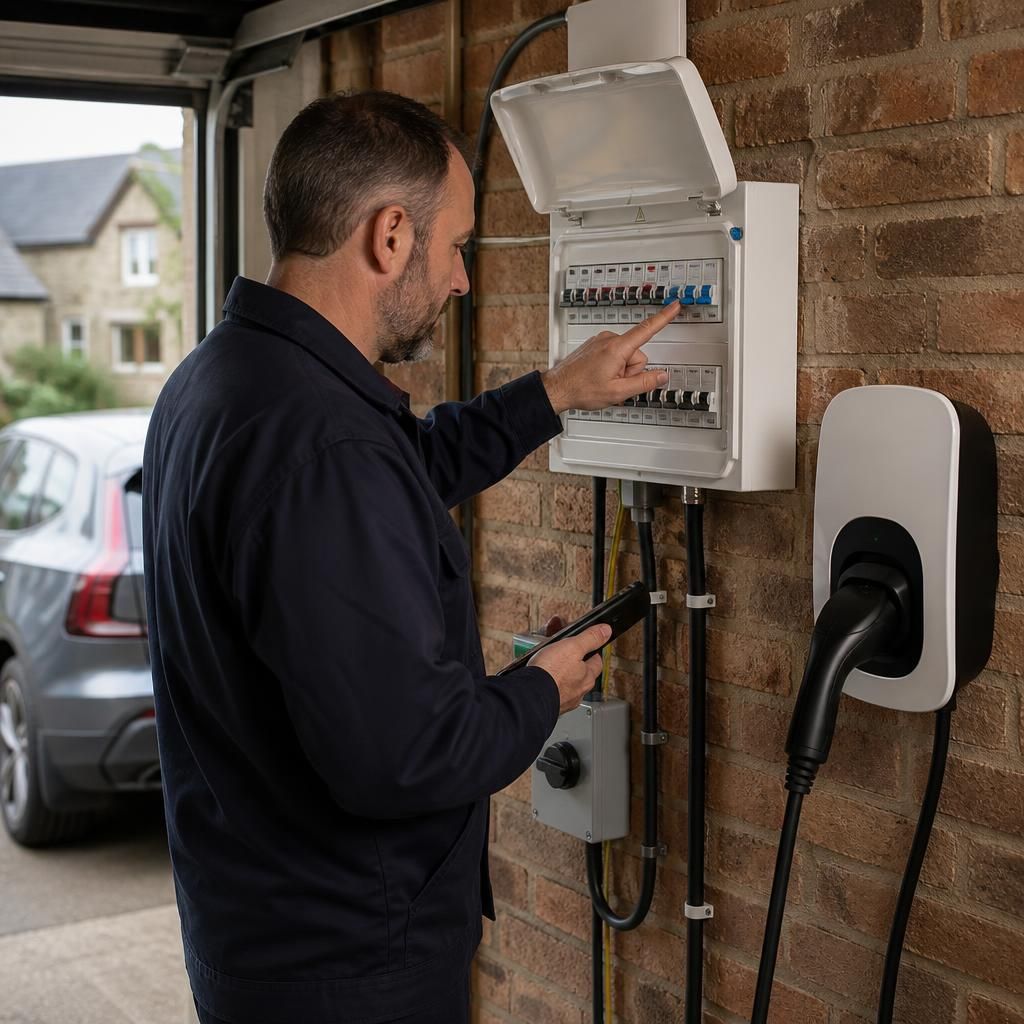
Load management depends on accurate monitoring of the property’s demand. If that monitoring signal is interrupted, the charger must not assume that spare capacity is still available.
We explain how the control equipment behaves if communication is lost, including whether charging pauses or falls back to a safer limit. That detail belongs in the quotation, so you know what to expect rather than relying on an unexplained automatic setting.