
Is a Tesla Wall Connector the right choice for my home?
A Tesla Wall Connector can be the right choice if you want a fixed home charger for regular Tesla charging and your property can support the installation. We assess the electrical supply, parking position and cable route first, so you can decide with a clear view of the work involved.
A Tesla Wall Connector is usually a strong choice for a Tesla owner who wants a neat, fixed charger at home and expects to charge regularly. It becomes less clear-cut if you need a charger with particular solar-control features, want to move between different vehicle types, or have limited electrical capacity at the property.
The main advantage is simplicity. The charger stays in one place, the cable is ready to use, and charging can be managed through the Tesla system. You avoid carrying a separate portable charging lead and using a standard socket for routine charging. A fixed unit also gives the parking space a dedicated charging point rather than leaving equipment across a driveway or garage floor.
That convenience matters most when the car is parked at home for several hours. The car’s own charging capability, the electricity supply and the installation design all affect how quickly it charges. A higher-rated charger does not make the vehicle accept more power than it can use.
A Tesla Wall Connector can also suit some homes with more than one electric vehicle. European models using the appropriate Type 2 connection may be compatible, but we check the vehicle and cable arrangement rather than assuming every car will work. If you are likely to change vehicle brands, that compatibility question deserves attention before you choose the charger.
The installation is more than fixing a box to the wall. We consider the cable route, the position of the consumer unit, earthing arrangements, protective devices and the distance to the parking space. An older property may need work to the consumer unit or supply before a dedicated EV circuit can be installed safely. That does not automatically rule out the charger, but it can change the work and cost involved.
Properties with long drives, detached garages, outbuildings or listed walls need particular thought. We can discuss a route that protects the cable, avoids unnecessary visual impact and leaves the charging point where you will actually use it. Surface-mounted cable may be practical in one property, while another may need a different route through the building or along an existing service path.
Solar panels and battery storage can also affect the decision. A Wall Connector may still be suitable, but we look at how the charger would interact with the home’s generation, battery and electricity tariff. The right arrangement depends on whether you mainly want overnight charging, to use surplus generation, or to control demand across the property.
There are reasons to choose another type of home charger. A different unit may be preferable if you need a particular load-management function, wider vehicle compatibility, or closer integration with an existing energy system. The most expensive charger is not automatically the best match, and the Tesla name alone does not resolve limitations in the property’s electrical supply.
Installation work is carried out as a dedicated electrical job. We fit the protective equipment required for the circuit, test the installation and explain how to use the charger. NICEIC and ECA electrical standards matter here because the work affects the home’s fixed wiring, not just the vehicle.
You should also allow for the full installed cost rather than judging the charger by its purchase price alone. The final quotation depends on the cable route, the position of the charger, any consumer-unit changes and the condition of the existing installation. We provide the quotation before work starts, so you can compare the complete job rather than an equipment-only price.
In practical terms, choose a Tesla Wall Connector when you want a permanent, tidy home charger for a compatible Tesla and the installation works with your property. Ask us to assess alternatives if your future vehicle, solar plans, parking arrangement or electrical supply is likely to make flexibility more important than keeping the charging equipment within the Tesla system.
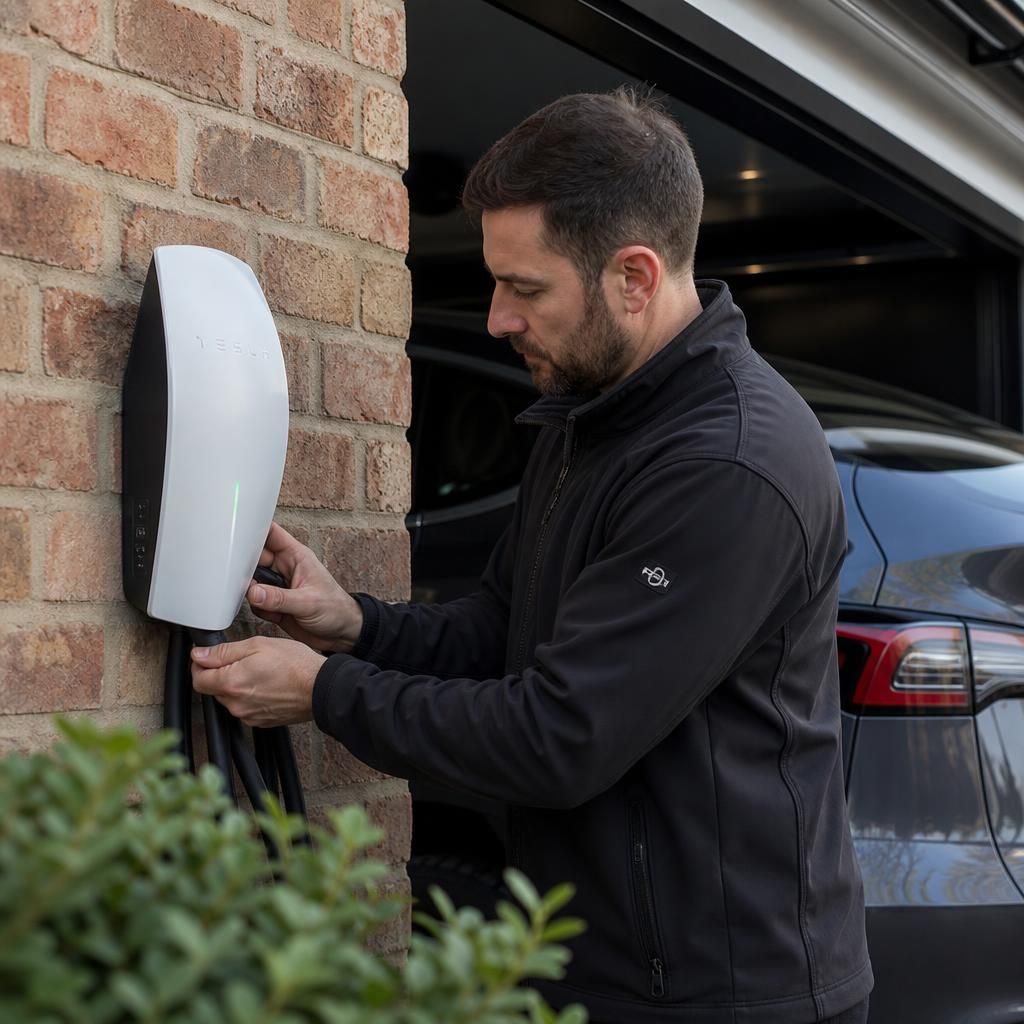
If several people use the car, the everyday controls matter as much as the charger itself. We show you how charging starts, how scheduled charging fits around your routine and what to check if the vehicle doesn’t begin charging.
That handover helps you use the Wall Connector without relying on a portable lead or changing settings by trial and error. We also explain what the charger’s indicators mean, so you can distinguish a normal charging pause from a fault that needs attention.