
How long does installing a home EV charger take?
A straightforward home EV charger installation is usually completed in a single visit. The site survey shows whether extra cable routing, consumer-unit work or a new circuit is needed, which can make the installation take longer.
Most home EV charger installations fit into one planned appointment. The total time from enquiry to completed charging point depends on what we find at the survey and whether the existing electrical installation needs work first.
The survey determines the installation plan. We look at the consumer unit, available capacity, the proposed charger position and the safest route for the cable. We also consider how the cable will pass through walls, under floors, around the outside of the house or across a garage. A short, accessible route is usually simpler than a long route through finished rooms or outbuildings.
Your preferred parking space may not be beside the consumer unit. In that case, we work out whether the cable can run internally, externally or through a garage. We agree the route with you before work starts, including the position of any visible containment and how the cable will enter the building.
The electrical installation can add time when the existing system needs upgrading. Older homes may have a dated consumer unit, limited spare capacity, outdated protective devices or wiring that needs remedial work. We explain what needs attention and provide a written quotation before carrying out additional work. This avoids discovering an unexpected charge partway through the installation.
A charger may need its own circuit and suitable protection. We install and test the circuit rather than treating the charger as an ordinary socket. If the supply arrangement needs to be checked with the network operator, that can add time beyond the physical fitting.
On installation day, we normally:
- confirm the agreed charger position and cable route;
- install the protective equipment and dedicated circuit where required;
- run and secure the cable neatly;
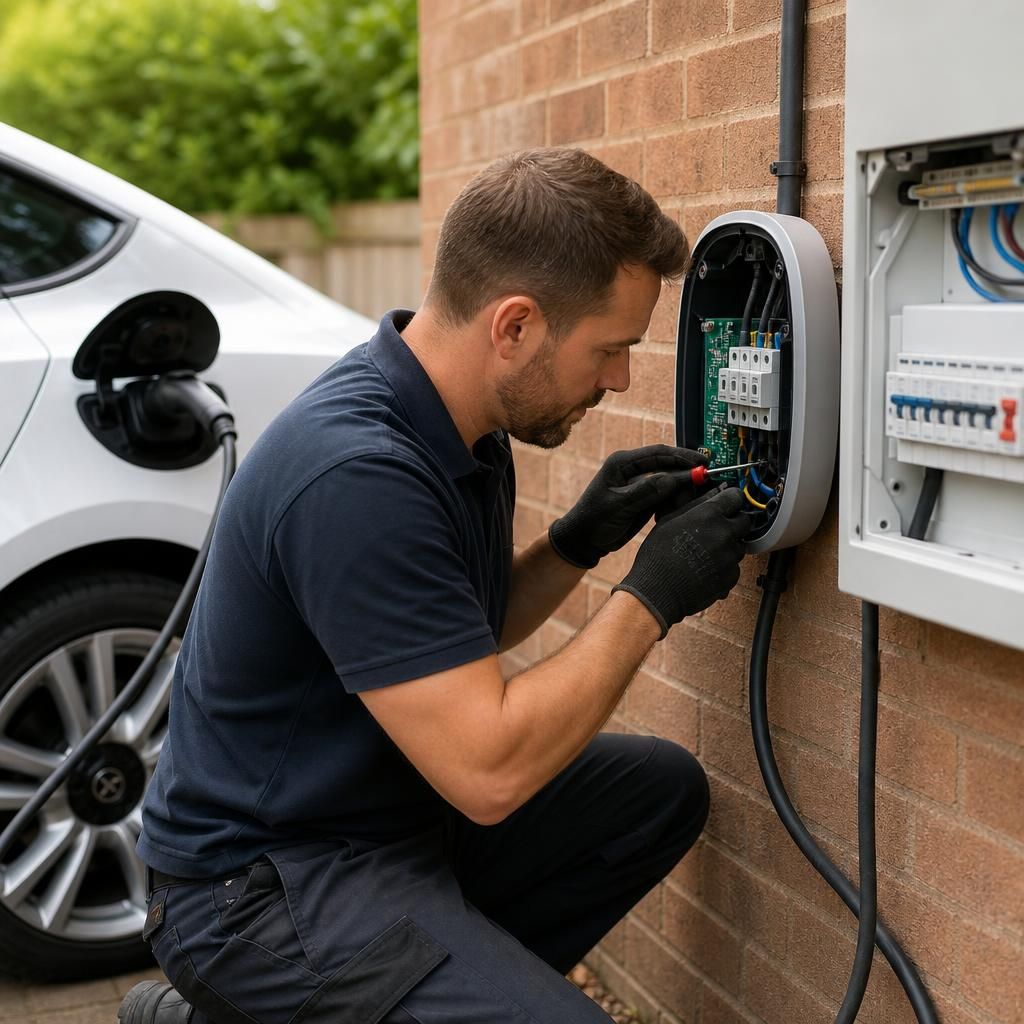
- mount and connect the charger;
- test the circuit, charger and protective devices; and
- explain the controls and provide the relevant electrical paperwork.
The work may take longer if the cable has to cross several rooms, pass through thick masonry, run to a detached garage or be buried outside. Trenching, reinstating surfaces, lifting floors and working around existing services are separate tasks from mounting the charger itself.
Listed buildings, barn conversions and older solid-wall properties often need more careful routing. We take account of the building fabric and avoid creating unnecessary damage. A longer route can sometimes reduce disruption, so we compare the practical options rather than assuming the shortest route is best.
Your home may also have solar panels, battery storage or another high-demand electrical load. We consider how the charger will operate alongside those systems and whether load management is appropriate. That helps prevent the proposed installation from relying on assumptions about how much power the property can use at once.
Once the installation is complete, our NICEIC-registered electricians test the work and issue the appropriate certification. You are left with a connected, tested charging point and a clear explanation of what was installed. If the survey identifies work that cannot sensibly be completed in the same appointment, we set that out before the installation date rather than extending the job without agreement.
The installation appointment runs more smoothly when the practical details are settled beforehand. Keep the parking space accessible and make sure we can reach the meter, consumer unit and proposed charger position. If the charger will be used with solar panels, battery storage or a particular vehicle, tell us before the appointment so we can account for that equipment during commissioning.
It also helps to decide where you want the cable and charger to sit before the survey. A position that is convenient for charging may not be the simplest for wiring, so we can explain the alternatives before fixing anything in place. That reduces delays caused by changing the location on installation day.