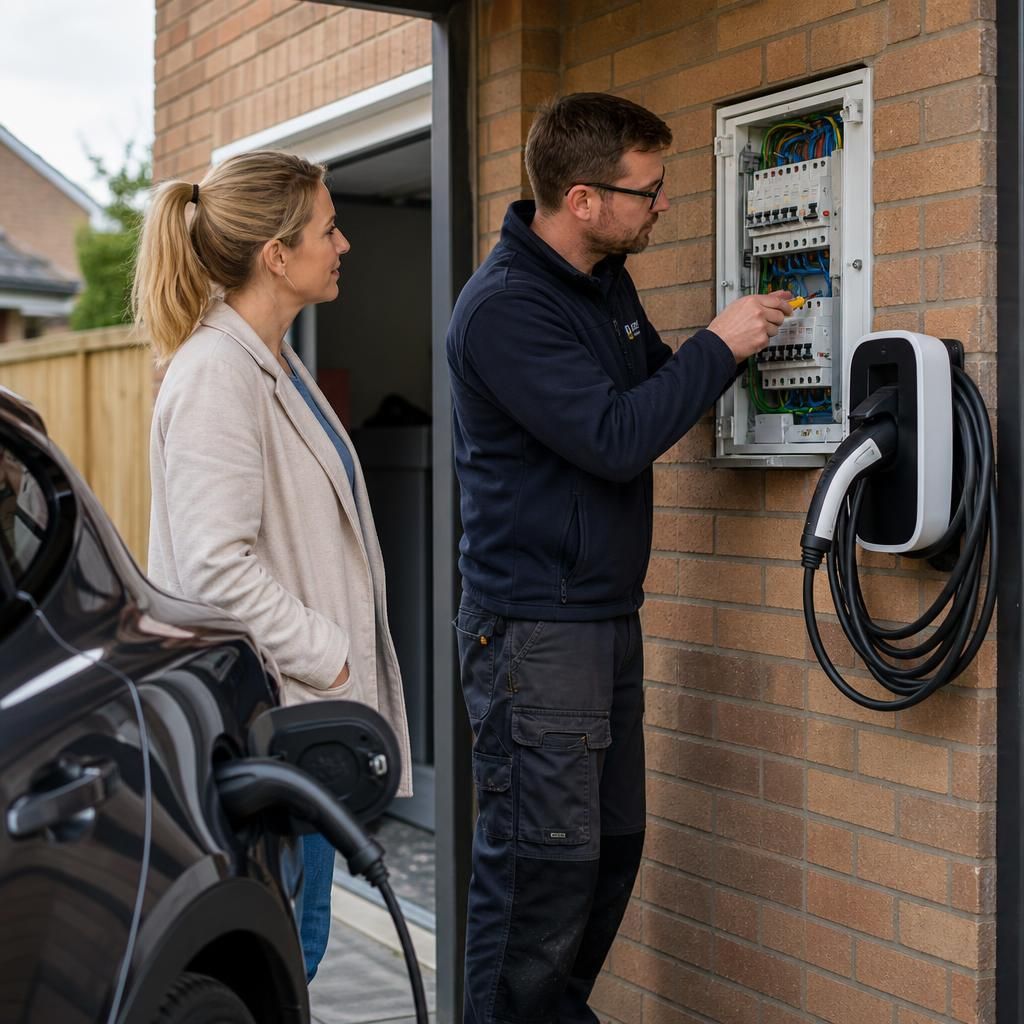
Will the proposed charger work with my electrical supply?
Usually, yes, but we need to check the available capacity, consumer unit, earthing and cable route before confirming. If the supply needs managing or upgrading, we’ll explain the practical options so the charger can operate safely without overloading the installation.
Yes, a home EV charger can often be installed on a standard domestic supply, but it may need to charge below its maximum rate. The important issue is the demand already placed on the property. An oven, immersion heater, electric heating, heat pump, workshop equipment and battery system can all be running while the car is charging.
A typical single-phase charger may draw up to 32 amps at around 7.4kW. That does not mean the whole house has 7.4kW available for the car at all times. We calculate the likely maximum demand and choose an arrangement that stays within the supply’s safe operating limits.
The main checks cover:
- the type of incoming supply and its available capacity;
- the service cut-out, meter tails and main switch;
- the consumer unit and its spare capacity;
- the earthing arrangement, including PME and open-PEN protection where relevant;
- the route, length and size of the cable to the charger;
- the residual-current protection required by the chosen charger; and
- the other electrical loads that may operate at the same time.
Your consumer unit may be modern enough for the charger but still need additional protection or a dedicated circuit. An older board may need replacing before the installation can proceed. We explain the reason for any upgrade rather than treating it as an automatic extra.
A supply that cannot support full-rate charging does not always need replacing. We may be able to set a lower charging current or use dynamic load management. This monitors the home’s demand and reduces the car’s charging rate when other equipment is drawing power. Once that demand falls, charging can increase again. The charger, meter position and communications method must all suit this arrangement.
Load management is particularly useful where the property has electric heating, a heat pump, solar panels, battery storage or a small service capacity. It does not increase the capacity of the incoming supply. It manages the available capacity so the charger does not compete with the rest of the installation.
Earthing needs careful attention on some properties. Many homes use a PME earthing arrangement. Where there is a risk from a broken supply neutral, the installation may need open-PEN protection or another approved protective measure. The right approach depends on the supply and the charger. We do not assume that a previously installed outdoor socket provides suitable protection for EV charging.
A detached garage or parking space can add a separate issue. A long cable run may cause voltage drop, and an outbuilding may need its own earthing and isolation arrangements. If the route crosses a drive or garden, we agree the cable path and any trenching or surface work before work starts. The cable is sized for the charger, the distance and the installation conditions.
Properties with three-phase electricity need a different assessment. A three-phase supply does not automatically make a single-phase home charger charge faster. The charger and vehicle must support the arrangement, and the loads need to be distributed correctly across the phases.
If the existing supply is not suitable for the proposed charger, the options may include a lower-rated unit, managed charging, changes to the consumer unit, or an application to the Distribution Network Operator for a supply alteration. We identify which issue applies and set out the implications before installation. The Distribution Network Operator’s requirements can affect the timing and cost of any supply upgrade.
The car and charger also need to agree on the charging rate. A charger rated for a higher output cannot make a vehicle accept more power than its onboard charging system allows. We therefore consider the vehicle, the proposed charger and the home’s supply together, rather than selecting the charger from its headline output alone.
Solar panels and a home battery can change how charging is managed, but they do not remove the need for a safe dedicated circuit. A charger can be configured to work with wider energy controls where the equipment supports it. We explain whether the proposed arrangement prioritises the car, household demand, battery charging or export, so the charging behaviour is clear before the work begins.
The quotation should show the charger rating, cable route, protective equipment, any consumer unit work, load-management equipment and expected charging limitation. It should also identify any work outside the electrical installation itself, such as access, trenching or reinstatement. We provide the written scope before work starts, so the decision does not depend on an unclear allowance.
Where the supply and installation are suitable, we complete the circuit with the required testing and certification. Where they are not, the safe charging rate and the work needed to reach the preferred rate are explained separately. That gives you a practical choice rather than leaving you to discover a supply limitation after the charger has been ordered.
The assessment should leave you with a clear choice, not simply a charger recommendation. We set out whether the proposed unit can run at its intended rate, needs a charging limit, or requires electrical work first.
If an upgrade is needed, the quotation separates that work from the charger installation. You can then compare the cost of improving the supply with the practical benefit of faster charging, based on how the car is used and how long it normally remains parked.