What should a Zappi or Ohme installation quotation include?
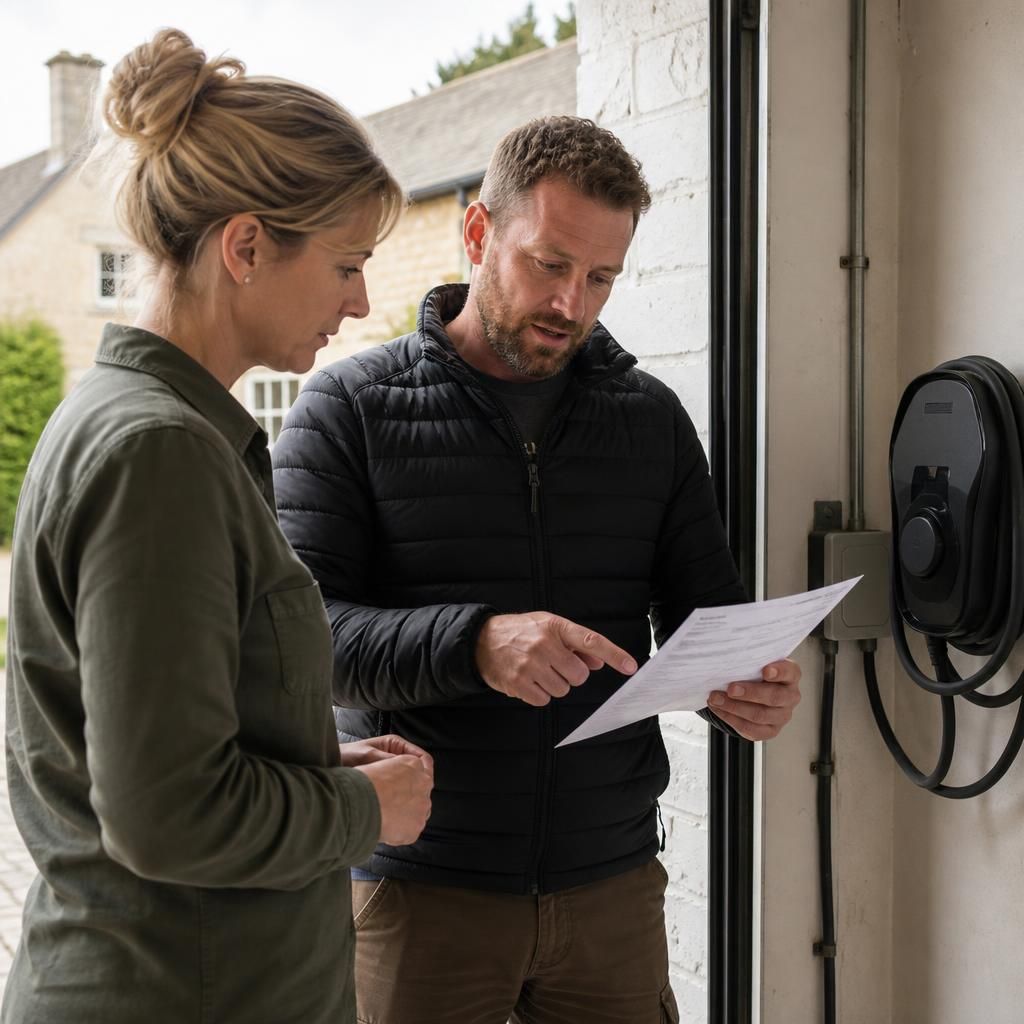
A clear Zappi or Ohme installation quotation should explain the survey findings, charger and accessories, electrical work, labour, total cost and any work excluded. It should also set out the smart charging setup, certification, and the relevant manufacturer warranty.
A useful Zappi or Ohme installation quotation should let you compare like for like. It should record the proposed charger, the findings from the site survey, the work included, the assumptions made and the full price you will pay. It should also show what could change the price before installation begins.
The charger specification
Your charging needs affect the quotation, so it should identify the exact Zappi or Ohme model and configuration proposed. The document should state whether the charger is tethered, with a permanently attached cable, or untethered, with a separate charging lead. It should also identify the charger colour or finish where relevant, the cable length and any accessories included.
If you have more than one electric vehicle, want scheduled charging or expect to use a time-of-use tariff, the quotation should explain how the proposed charger supports that arrangement. Smart features depend on the charger, the app and the available communications signal. If your parking space has weak Wi-Fi or mobile reception, we should identify that before you commit and explain any practical alternative.
What the survey has found
Your quotation should be based on an inspection of the property rather than a standard installation allowance. We look at the consumer unit, the earthing arrangement, the incoming supply and the proposed charger position. We also consider the distance between the consumer unit and the parking space.
The quotation should make the cable route clear. That includes whether the cable will run internally, externally, through a wall, under a floor or across an outbuilding. If the route needs trunking, clips, protective conduit, drilling or reinstatement, those details should appear in the specification. A short, straightforward route and a longer route to a detached garage are not equivalent installations.
Your parking position may be on a driveway, beside a garage or away from the house. The quotation should state where the charger will be mounted and whether the wall or other fixing surface is suitable. It should also identify any access equipment, excavation or additional protection that the proposed route needs.
Electrical work and protection
If the existing consumer unit has enough capacity and suitable space, the quotation should say what circuit and protective devices we will use. If it needs upgrading, the document should set out that work separately. This might include a new consumer unit, additional circuit protection, earthing work or changes to the arrangement at the intake position.
Where the charger needs current monitoring or load management, the quotation should explain what equipment is being installed and where it will sit. This matters when the property has other substantial electrical loads, such as an electric heating system, solar panels, a battery or another vehicle charger. The proposed arrangement should account for how those loads operate together.
A quotation should not hide electrical work behind the phrase “standard installation”. That phrase can mean different things between installers. Ask for the cable length, protective equipment, mounting method and any limit on the amount of consumer-unit or cable work included.
Smart charging setup
Your quotation should explain what we will configure on the day and what you will need to do afterwards. This may include registering the charger, pairing the app, connecting the charger to the available network and setting charging preferences. If tariff integration depends on information from your electricity supplier, the quotation should distinguish that from the installation work.
If you want the charger to use surplus solar generation, the quotation should state whether the existing solar or battery system can communicate with it and what additional monitoring equipment is needed. It should not assume that every existing system can be connected without further checks.
Price, assumptions and exclusions
The price should show the installation total, VAT where applicable and each significant allowance. It should make clear whether the figure includes the charger, cable, fixings, protective devices, testing, certification and smart-charging setup. Any separate charge for a longer cable route, unusual wall construction, trenching, scaffold or consumer-unit replacement should be identified before work starts.
Your quotation should also list exclusions. For example, it may exclude remedial building work, decoration, repairs to an unsuitable consumer unit or changes requested after the survey. Exclusions are not necessarily a problem; unclear exclusions are. We provide a written quotation before work starts, so you can see the agreed scope and price before making a decision.
If the survey reveals that the proposed position or electrical supply needs further work, we should explain that before installation rather than treating it as an unexpected extra. Where the installation depends on an assumption, such as access to a particular route or a suitable internet signal, that assumption belongs in the quotation.
Workmanship, certification and notification
The quotation should state how the installation will be tested and what paperwork you will receive. That normally includes the electrical installation certificate or other relevant electrical certification for the work completed. It should also explain any notification or registration that applies to the installation.
Electrical work carried out by our NICEIC-registered electricians and ECA members is assessed against the relevant requirements. For you, that means the quotation should lead to a documented installation rather than a charger simply being fixed to the wall and connected.
It should also say who will carry out the work and whether any part is being passed to another contractor. Our electricians are directly employed, so the survey, installation and associated electrical paperwork remain with the same team.
Warranty and aftercare
Your quotation should separate the manufacturer’s warranty for the charger from any workmanship cover offered for the installation. It should state the warranty period, what it covers and who you contact if the charger develops a fault. Keep the quotation, installation certificate, manuals and commissioning details together after the work is complete.
Finally, the document should identify the next step if the charger will not communicate with the app, the protective device trips or the vehicle will not start charging. A clear quotation does not promise that every fault will have the same cause. It tells you who handles the installation and what information will be available when something needs investigating.
When comparing quotations, check that each installer has priced the same charger, route, electrical protection, smart features and paperwork. The lowest figure may leave out the work that makes the installation suitable for your home.
Check the quotation’s date, validity period and payment terms before accepting it. It should also explain how any variation is handled. If site conditions require extra work, we should tell you what has changed and obtain your agreement before carrying it out. That keeps the agreed charger installation and final bill aligned.