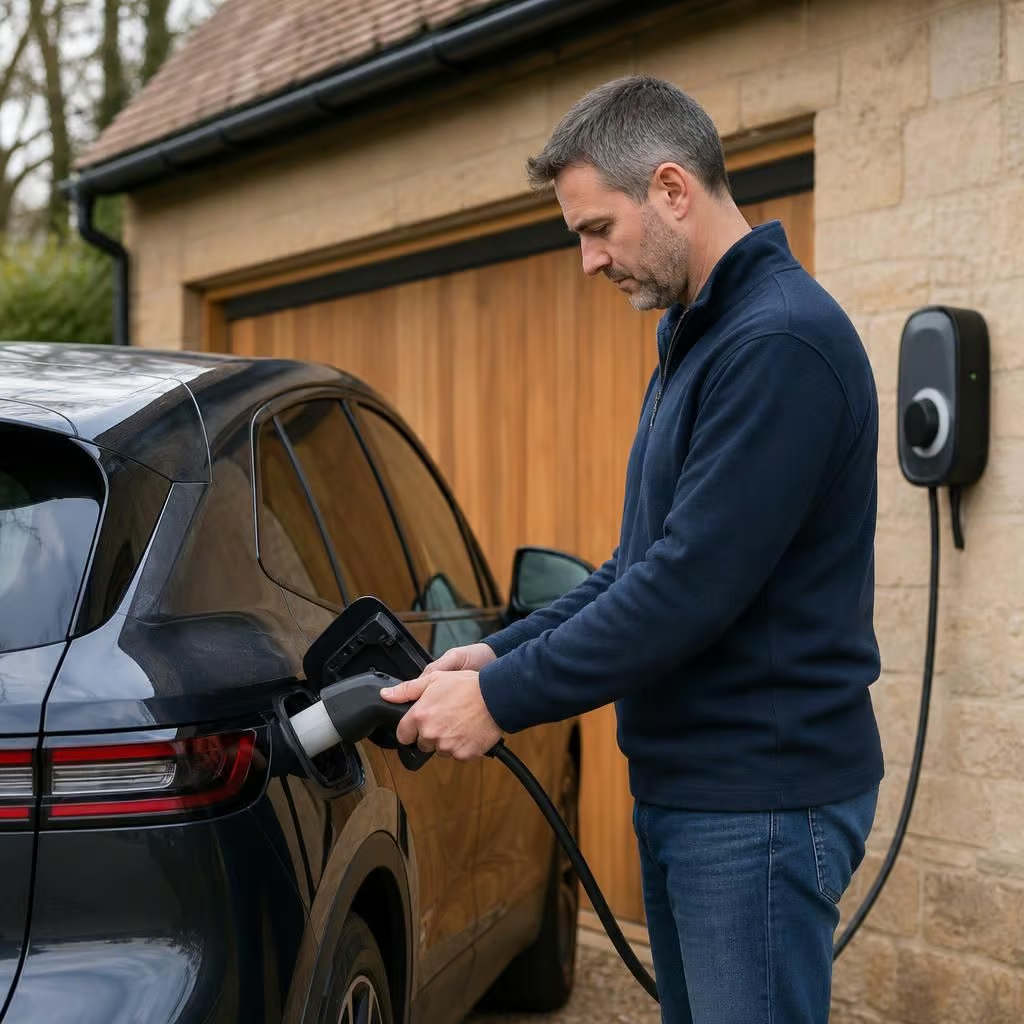
Is the proposed home charger compatible with my electric car?
Most electric cars can use a home charger, but compatibility depends on the car’s charging connector, the lead or socket type, and its maximum charging rate. We check the proposed charger against your vehicle before installation, including any Type 1 or Type 2 connection requirements.
Compatibility depends on more than whether the plug fits. The car, charging cable, home unit and available charging rate must all work together. A charger can be physically compatible but still charge more slowly than expected if the car accepts less power.
The connector on the car
Most electric cars and plug-in hybrids sold for the UK market use a Type 2 connection for home AC charging. Some older or imported vehicles use Type 1 instead. The charging inlet on the car determines which cable arrangement is suitable.
A tethered charger has its own permanently attached cable. That cable must match the vehicle inlet, or an approved adapter may be needed. An untethered charger has a socket, so you use a separate cable that matches both the car and the charger. We won’t assume that a cable supplied with the car is suitable for every home charging unit.
Some cars have separate connections for everyday AC charging and rapid DC charging. A home charger normally uses the AC connection. The rapid-charging connector does not automatically mean that the car needs a rapid charger at home.
The car’s charging capability
Your car has an onboard charger that controls how much AC power it can accept. If the proposed home unit can provide more than the car’s onboard charger, the car will normally limit the charge to its own maximum. A higher-rated charger therefore does not necessarily make that particular vehicle charge faster.
The reverse can also matter. A vehicle may support a faster AC rate than a basic home unit can provide. In that case, the car is compatible, but the charger becomes the limiting part of the arrangement. We compare the vehicle’s stated AC charging rate with the output of the proposed unit before recommending it.
Plug-in hybrids often have different charging requirements from fully electric cars. Their battery may accept a lower AC rate, and some models have unusual cable or scheduling requirements. We use the exact vehicle model and year rather than relying on a general description such as “Type 2 car”.
Car, cable and charger combinations
- Tethered charging: the fixed cable is always ready to plug into the vehicle, but its connector must suit the car.
- Untethered charging: the charger has a socket, giving you flexibility to use a suitable cable for the vehicle.
- Separate charging cables: a cable may be rated for a different charging speed from the car or home unit, so its specification matters too.
- Adapters: these should only be used where the vehicle and charger manufacturers permit them. A plug that can be made to fit is not proof of safe compatibility.
We also distinguish between the physical connection and the charger’s additional functions. An app, scheduled charging, solar-linked charging or automatic load control may depend on the charger and its controls, not just the car’s socket. Your car may still charge without every smart function being available, but the intended operation should be clear before installation.
What we need to confirm it properly
Send us the vehicle make, model, model year and whether it is fully electric or a plug-in hybrid. A photograph of the charging inlet, the vehicle handbook specification or the manufacturer’s charging information can resolve uncertainty, particularly with imported and older vehicles.
We then match the connector, cable arrangement and AC charging rate to the proposed home unit. If the car has a charging feature that affects installation, such as scheduled charging or a requirement for a particular cable, we explain how that will work in practice.
The charger may be compatible with the car but unsuitable for the property without further electrical work. That is a separate installation question, covering the existing supply, consumer unit and cable route. We assess those points as part of planning the installation, rather than treating a matching plug as the only requirement.
After installation, the charger is tested with the vehicle or with the manufacturer’s commissioning procedure, depending on the equipment. You should finish with a clear cable arrangement and instructions for starting, stopping and scheduling a charge. If you change cars later, an untethered unit may offer more flexibility, while a tethered unit may need its cable arrangement reviewing.
Your car and charger can each have a charging schedule, and the two settings may conflict. If the vehicle is set to charge only overnight while the charger is waiting for a solar surplus, charging may not start when you expect.
We check how the proposed unit, car and app controls work together. You’ll know which system should manage timed charging, how to override it, and what to change if you switch tariff or vehicle later.