
Does a portable EV charger need a dedicated circuit at home?
Not always. A portable EV charger may use a suitable existing socket, but regular charging should follow a check of the socket, circuit loading, earthing and cable route by a qualified electrician; a dedicated circuit may be recommended.
A portable EV charger does not automatically need its own circuit. The right arrangement depends on the charger’s maximum current, the socket and cable supplying it, what else shares that circuit, and the condition of the consumer unit.
A portable charger used from a normal domestic socket can draw a substantial load for several hours. That is different from plugging in a phone or a small household appliance for a short period. A circuit that appears satisfactory at first may become hot at a loose terminal, worn socket or poor connection during sustained charging.
A dedicated circuit runs from the consumer unit to the charging socket without supplying other sockets or appliances along the way. It has its own protective device and is sized for the charger’s continuous load. This does not necessarily turn the portable charger into a fixed wall-mounted unit. You can still unplug it and take it with you.
A shared socket circuit may be suitable when all of the following apply:
- the charger is designed for that supply and is set to an appropriate current;
- the socket, cable and connections are in good condition;
- the circuit is not also carrying high-load appliances;
- the consumer unit provides suitable protection; and
- the charging location is dry, secure and appropriate for the charger.
Even then, the arrangement may be better for occasional charging than as the main way to charge the car. A dedicated circuit gives the charging load a known route and removes other household demand from the same cable and protective device.
We check more than the socket. The socket may be the visible part, but the circuit includes the cable back to the consumer unit, its terminations, protective devices and earthing. We check:
- the charger’s stated current and whether its setting can be adjusted;
- the cable size, route and approximate length;
- the circuit’s protective device and RCD or RCBO protection;
- the condition and rating of the socket and any outdoor connection;
- what other appliances use the circuit; and
- whether the consumer unit has capacity for an additional circuit or protective device.
Older homes can need closer attention. A property may have an older consumer unit, extensions added over time or wiring that has not been checked since the original installation. Solid-wall houses, barns and detached garages can also involve longer cable routes or exposed cable runs. We explain what needs changing before any work starts, rather than treating the nearest socket as the whole assessment.
An outdoor socket does not make a charging point suitable by itself. The enclosure, cable entry, isolation and protection must suit its position. We also consider whether the portable charger’s control box will sit on wet ground, be driven over or be exposed to rain. The car manufacturer’s instructions and the charger’s instructions still apply.
If the existing circuit is unsuitable, the answer might be a new dedicated circuit, a replacement socket, improved protection or an upgrade to the consumer unit. In some homes, the cable route is straightforward. In others, we may need to run cable through a loft, along an outbuilding or in surface trunking. We agree the route with you first and explain any effect on decoration or access.
A dedicated circuit does not remove every charging risk. The plug must be fully inserted, the cable must not be coiled tightly while carrying load, and the socket must not be shared through an extension lead or adaptor. Stop charging if you notice heat, a burning smell, buzzing, discolouration or repeated tripping. Do not replace a protective device with a higher-rated one to stop nuisance trips.
For a planned installation, we can assess the portable charger alongside the rest of the home’s electrical demand. That matters if the property also has electric heating, solar panels, battery storage or another vehicle. The result may be a dedicated portable-charger circuit, a fixed charge point, or continued use of an existing circuit with clear limits. We base that decision on the installation and how you intend to charge, not on the word “portable” alone.
Electrical changes are carried out by our NICEIC and ECA-registered electricians. You receive a written quotation before work begins, with the proposed equipment, cable route and any consumer-unit changes set out clearly.
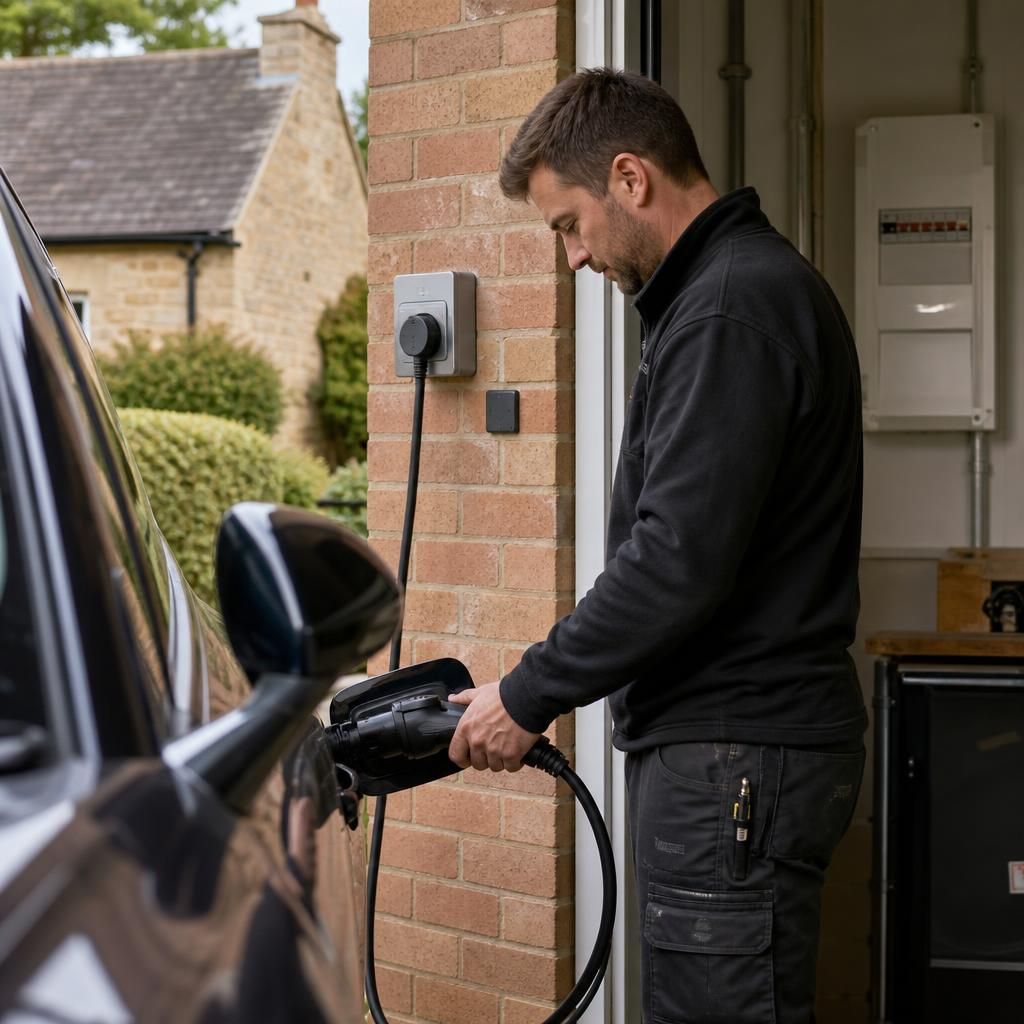
If you take the portable charger away, the dedicated circuit stays with the home socket. It simply gives you a known supply for charging at home; it does not turn the charger into a fixed unit.
When you return, store the cable and control box where they stay dry and protected from damage. Before using another socket elsewhere, check that the supply is suitable for the charger and follow its instructions. A home circuit that has been assessed for regular charging does not make every other socket suitable.