What type of EV charger is suitable for my home?
For most homes, a smart AC charger is the practical choice, with the power rating matched to your car, electricity supply and typical driving. We assess the cable route, parking position and any solar or battery system before recommending a tethered or untethered charger.
The most suitable charger depends on your car, parking arrangement and the electrical capacity available at home. For a typical property with off-street parking, a fixed AC charger connected to a dedicated circuit is usually the practical choice. The details below determine which type will work best.
Fixed or portable charging
A portable charger can use a domestic socket, so it avoids fitting a wall-mounted unit. It can help when you have no suitable parking position or need charging away from home. Charging takes longer, and the socket, wiring and extension arrangements need careful consideration. An ordinary extension lead should not be used as a substitute for a proper charging installation.
A fixed charger gives you a dedicated connection, a secure mounting point and a more convenient routine. We can position it near the parking space and route the cable so it does not cross a walkway unnecessarily. If the car is parked on a drive, this is normally the better long-term option.
Tethered or untethered
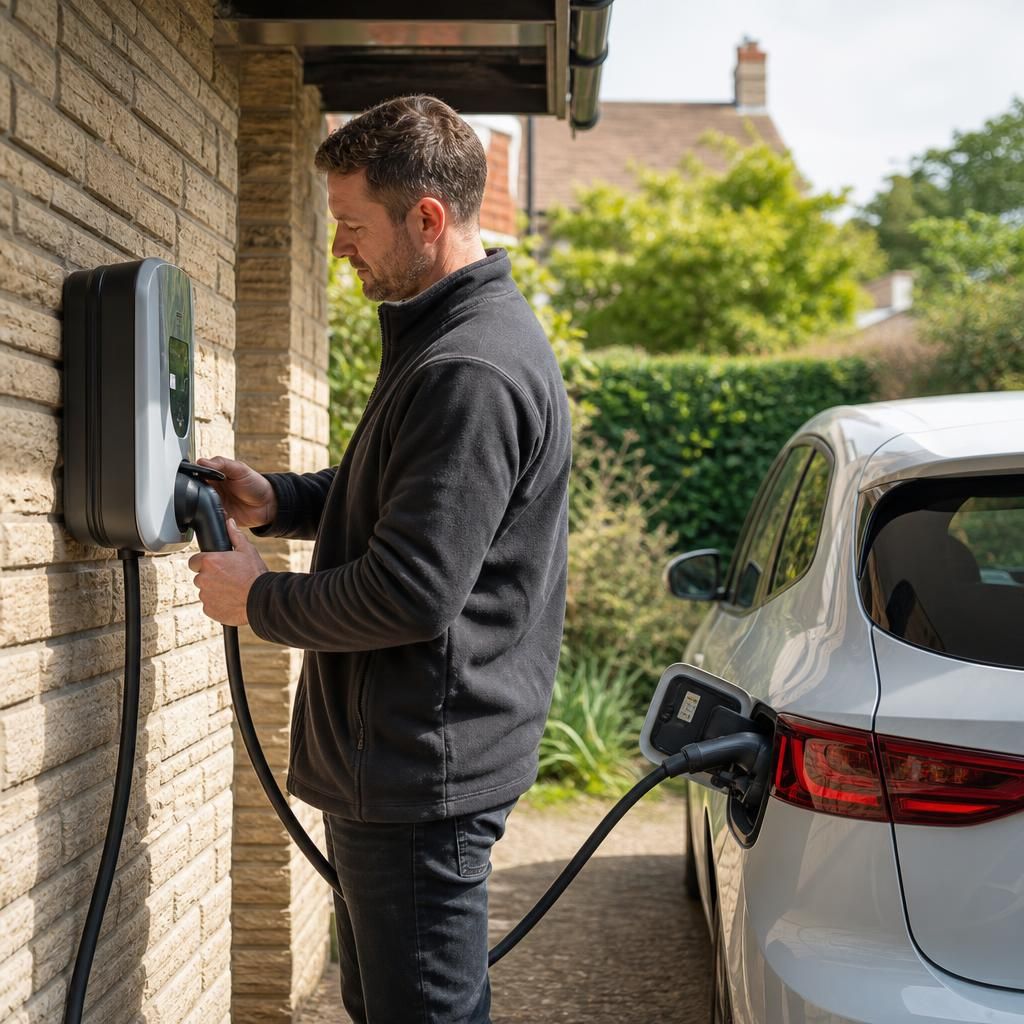
A tethered charger has its charging cable permanently attached. You can take the cable from the unit and plug straight into the car, which suits a home where one vehicle charges in the same place most of the time. The cable needs a safe storage position when it is not in use.
An untethered charger has a socket instead. You keep the charging cable in the car and connect it when needed. This looks neater and can suit a household with different cars, but you need to bring the cable to the charger each time. We consider cable length, parking direction and the position of the charging connection before recommending either type.
Standard power or a higher-powered charger
The charger’s stated power is only part of the picture. The car’s onboard charger may limit how quickly it accepts AC power, so a higher-rated unit does not always shorten the charging time. Your home’s incoming supply also needs enough capacity for the charger alongside cooking, heating and other electrical loads.
Most houses have a single-phase supply. A higher-powered installation may need a different supply arrangement, and the car must support it. We check both points rather than specifying equipment that the property or vehicle cannot use.
Smart charging
A smart charger can schedule charging for a chosen time and may adjust its demand when other large electrical loads are running. That can help if the home has an electricity tariff with different rates, or if the supply needs charging to be managed alongside other equipment.
Smart features are useful only when they work with your car, home internet connection and preferred charging routine. If you want to charge immediately without an app or scheduling, a simpler charger may be more suitable. We explain what the controls do before the installation so the finished system is straightforward to use.
Homes with solar panels or battery storage
If you already have solar panels, the choice depends on whether you want the car to use surplus generation, charge from the grid, or use both. A charger that can work with the existing electrical system may be appropriate, but the settings and energy controls need checking first.
A home battery adds another consideration. Charging the car from the battery may reduce the energy available elsewhere in the home, so we look at how the systems are connected and how you want them to operate. We do not assume that adding a charger to a renewable energy system will automatically produce the lowest-cost result.
The property matters as much as the charger
A charger may be suitable for the car but impractical for the house. The route from the consumer unit to the parking space affects the amount of cable, drilling and surface work needed. Older properties may have long routes, outbuildings, detached garages or electrical equipment that needs updating before a charger can be added.
We inspect the consumer unit, earthing arrangement, available capacity and proposed cable route. If protective equipment or other electrical work is needed, we explain why before work starts. This is particularly important where the charger will be installed on a separate building or where the cable must pass outside.
What happens when we assess the installation
- We confirm the car’s charging connection and onboard AC charging capability.
- We discuss whether a tethered or untethered cable fits the way you park and charge.
- We check the electrical supply, consumer unit and proposed charger position.
- We consider smart charging, solar generation or battery storage if they are part of the home.
- We explain the cable route, any required electrical work and the likely disruption before installation.
Electrical work is carried out by our directly employed electricians, with NICEIC and ECA registration providing the relevant assurance for the installation. You receive a written quotation before work begins, so the recommended charger type and any associated work are clear before you decide.
The best charger matches the way your car is used, rather than simply having the highest available rating. If it is normally parked at home for long periods, a straightforward fixed AC wallbox may be all you need. If it returns for only short charging periods, we look more closely at the car’s charging capability and the supply before recommending a higher-powered unit. That keeps the installation relevant to your routine, without adding features or capacity you are unlikely to use.