
How is a bidirectional charger protected from overcharging my car battery?
A bidirectional charger does not force energy into the battery continuously. It communicates with the car’s battery management system, which sets the safe charging limit; the charger then reduces or stops the flow when the battery reaches that limit.
A bidirectional charger does not rely on one control to prevent overcharging. The vehicle’s battery management system remains the final authority, while the charger and home energy controls regulate the flow around it. If the car says charging must stop, the charger stops.
The charging limit is not simply a percentage shown on the dashboard. The vehicle monitors cell voltage, battery temperature, charging current and the battery’s condition. It can reduce the requested power as the battery fills or as its temperature changes. The charger follows those instructions rather than choosing its own maximum.
A compatible bidirectional system also has its own operating limits. These can include:
- a maximum charging current and power level;
- a target state of charge set for the vehicle;
- limits set by the vehicle manufacturer for bidirectional operation;
- temperature and equipment protection controls; and
- software checks between the car, charger and energy management system.
The charger may be told to charge from the grid, solar panels or another approved source. That instruction still has to pass through the vehicle’s controls. A home energy controller cannot safely make the car accept more energy than the vehicle has permitted.
Communication failure is another important safeguard. The car and charger exchange information before and during a charging session. If that communication becomes invalid, the system should not continue sending power blindly. Depending on the vehicle and charger, it will stop the session or move into a restricted state until communication is restored. The exact response is set by the equipment manufacturer, so we confirm compatibility rather than treating every electric vehicle and charger as interchangeable.
The same principle applies when the charger is drawing energy back out of the car. During home backup or energy management, the system is not trying to fill the battery beyond its limit. It is working within a lower and upper state-of-charge range, leaving enough charge for the intended use and stopping discharge at the configured minimum. The vehicle still controls whether that request is allowed.
That means a bidirectional charger cannot compensate for an unsuitable vehicle. The car must support the relevant form of bidirectional charging, and the charger, cable, software and home electrical installation must work together. Support for ordinary AC charging does not automatically mean support for vehicle-to-home operation.
During an installation survey, we check the vehicle model and its charging capability against the proposed charger. We also look at the property’s supply, consumer unit, earthing arrangement and the route for the charging equipment. These checks help prevent a system being specified that can communicate with the car but cannot be safely connected to the home.
Commissioning matters as much as the hardware. We configure the permitted charge and discharge limits, test the stop controls and confirm that the vehicle responds correctly. We also check how the system behaves when the car is full, when the minimum charge level is reached and when communication or power is interrupted.
A sensible operating setting may leave part of the battery unused rather than charging to the highest possible level every time. The right setting depends on how you use the car, how much backup capacity you need and the limits set by the vehicle manufacturer. We can work through those choices with you instead of assuming that maximum charge is always the best setting.
Battery ageing is separate from overcharging. A correctly controlled charger can prevent the battery being charged beyond its permitted limits, but every battery gradually changes with use, temperature and time. Following the vehicle manufacturer’s charging guidance and keeping the charger software current helps the controls continue to match the vehicle’s requirements.
Before choosing equipment, ask whether the proposed system supports your exact vehicle, which device has final control of the charging session, what happens if communication fails and which state-of-charge limits can be configured. Those answers are more useful than choosing a charger by its maximum power rating alone.
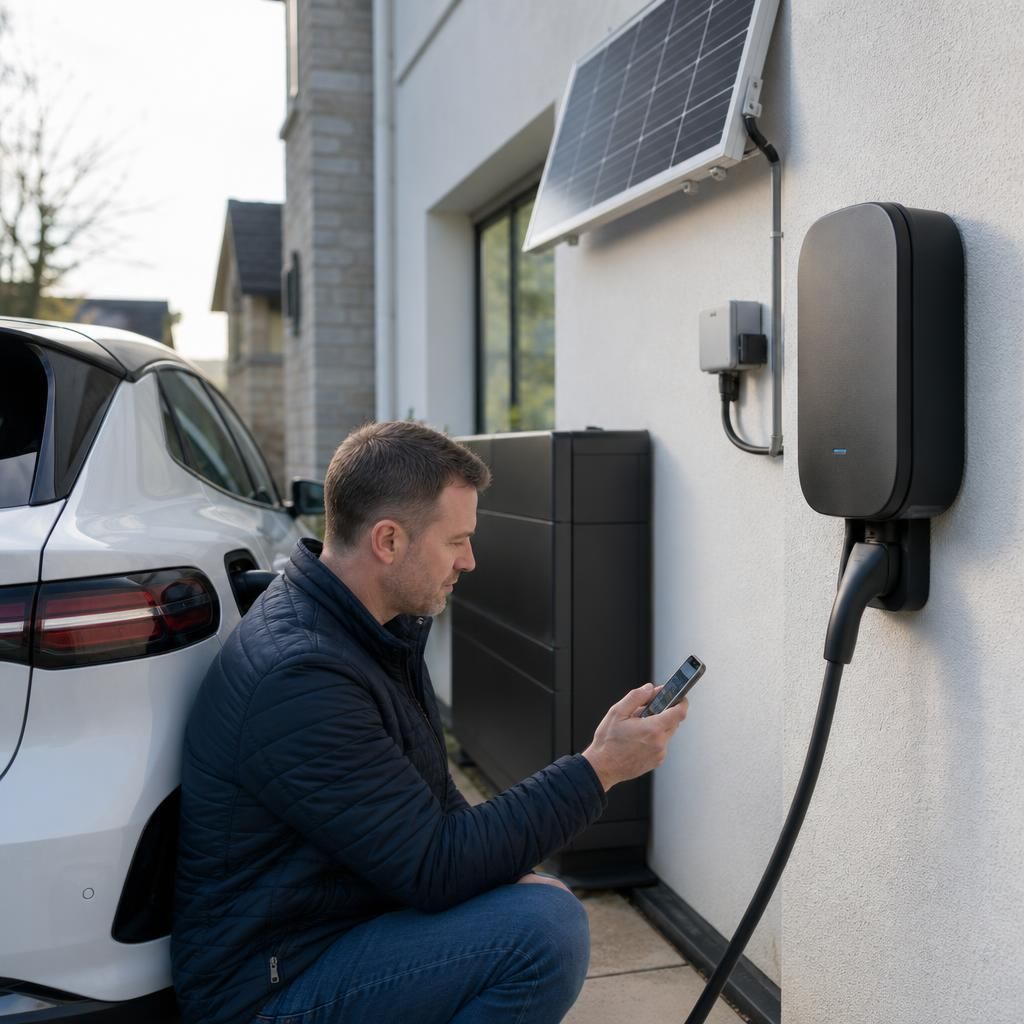
Solar generation and household demand can change from one minute to the next. A compatible energy controller adjusts the charging instruction as those conditions change, rather than sending a fixed output to the car. If available energy falls, charging can reduce or stop without bypassing the vehicle’s own limits.
That means surplus solar can be directed towards the car without treating every sunny spell as permission to keep charging. We check how the charger responds to changing generation, household load and the vehicle’s charge setting during commissioning, so the controls behave as expected in normal use.