How long does underfloor heating take to warm up?
Underfloor heating warms up gradually rather than instantly, with the timing depending on the system, floor covering, insulation and room temperature. A well-designed system will maintain an even warmth once it reaches temperature, but thicker floors and stone or tiled finishes usually take longer to respond.
Underfloor heating is designed to bring a room up to temperature gradually, not to deliver an instant burst of heat. A shallow electric system usually responds sooner than pipes buried in a thick screed, while a heavy floor construction may continue warming after the heating is switched on.
The time you notice depends on what “warm” means. You may feel heat underfoot before the air reaches the thermostat setting, particularly with tile or stone flooring. In other rooms, the air can feel comfortable while the floor itself feels only gently warm. Underfloor heating is not meant to make the floor hot to touch.
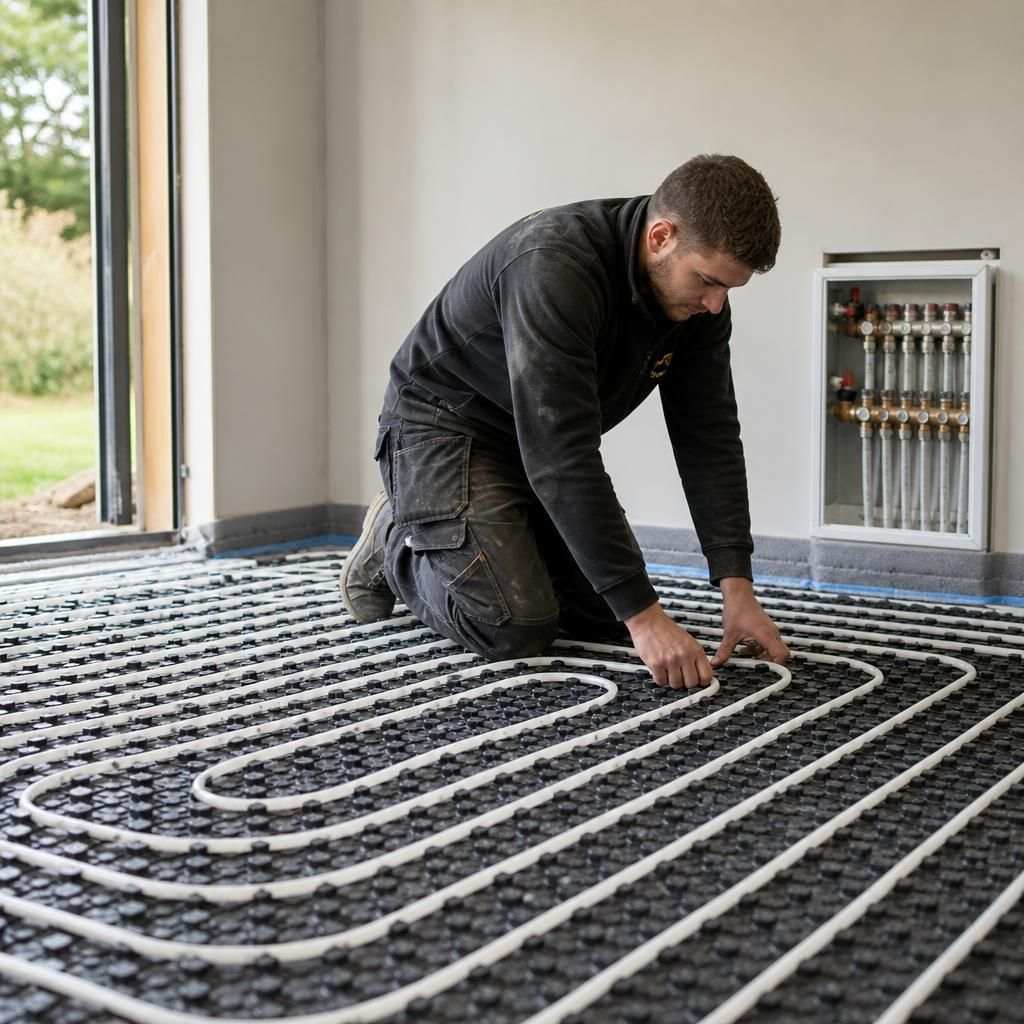
Floor construction makes the biggest practical difference. Pipes close to the finished surface respond more readily. Pipes covered by a substantial screed have more material to heat, so the system needs to start earlier. That stored heat can then keep the room comfortable after the boiler or heat pump has stopped running.
The floor covering affects heat transfer. Ceramic tiles and stone pass heat into the room efficiently. Timber, laminate, vinyl and carpet can also work, but the product must be suitable for underfloor heating. A dense underlay or an unsuitable covering slows the heat reaching the room and may limit the temperature we can run safely.
Insulation affects both the warm-up and the result. If heat can escape into an uninsulated floor or void, more of the system’s output goes downwards instead of into the room. During an installation, we look at the floor build-up and the available insulation before deciding how much heating the room needs. This matters particularly in older houses, where the original floor may not have been designed for a low-temperature heating system.
Controls should follow the way the room is used. Switching a slow-response system on only when the room feels cold often leads to disappointing results. A programmed schedule, modest temperature setback and correctly placed room sensor usually work better. We set the controls so the floor can begin warming before the room is needed, rather than asking it to recover all at once.
Individual zones also affect the experience. A large open-plan area may take longer to feel evenly comfortable than a small room. Furniture and rugs can restrict heat from reaching the air, although fixed cupboards and other obstructions should already have been considered when the pipe layout was designed.
The heat source matters too. Wet underfloor heating works well with a heat pump because both operate efficiently at lower flow temperatures. It can also work with a boiler, provided the system has the correct mixing controls and the output has been designed properly. If the boiler, pump or controls are not delivering the required flow temperature, the floor may remain cool even when the thermostat is calling for heat.
At commissioning, we check that each zone responds, the actuator opens, the pump runs correctly and the heat source delivers the required temperature. We also balance the circuits so one area does not take most of the available flow. These checks help prevent a room staying cold because of a control or circulation fault rather than a problem with the floor itself.
If the system has worked well before but now takes much longer to warm up, check the programmed times and thermostat first. A tripped electrical supply, closed valve, failed actuator, air in the circuit or a boiler fault can also stop one zone from heating. If only one room is affected, note whether the floor is cold throughout or warm in patches. That information helps us identify whether the problem is likely to be control-related, hydraulic or beneath the floor.
For a planned installation, we assess the floor construction, insulation, covering, room use and heat source together. That gives you a realistic warm-up pattern and a control strategy suited to the property, rather than treating underfloor heating like a set of radiators.
A newly installed wet system may take longer to settle than an established one. The screed must cure before we bring the heating up gradually, following the floor manufacturer’s requirements.
During commissioning, we record how each zone responds and adjust the flow and controls as the floor reaches its normal operating pattern. That avoids judging the system’s warm-up time from its first few heating cycles.