
How is a commercial gas boiler commissioned after installation?
After installation, we commission the commercial gas boiler by checking the gas supply, flue, controls, safety devices and system operation. We then test it under working conditions, record the results and provide the commissioning paperwork and instructions for its ongoing use.
Commercial gas boiler commissioning is the final proving stage after the physical installation is complete. We confirm that the appliance operates safely, delivers the required output and works correctly with the rest of the heating system before the building relies on it.
We start with the installation records. The boiler model, flue arrangement, gas pipework, controls and system design are checked against the manufacturer’s instructions and the agreed installation. This can identify a problem before the appliance is fired, such as an unsuitable flue route, incorrect control wiring or a system component that does not match the boiler.
The gas installation is assessed by engineers with the appropriate Gas Safe competence. The gas pipework is checked for soundness, the supply pressure is confirmed at the appliance and the gas rate is checked against the boiler’s requirements. If the supply cannot provide the pressure or volume needed under load, the boiler may not produce its stated output or may lock out during demand.
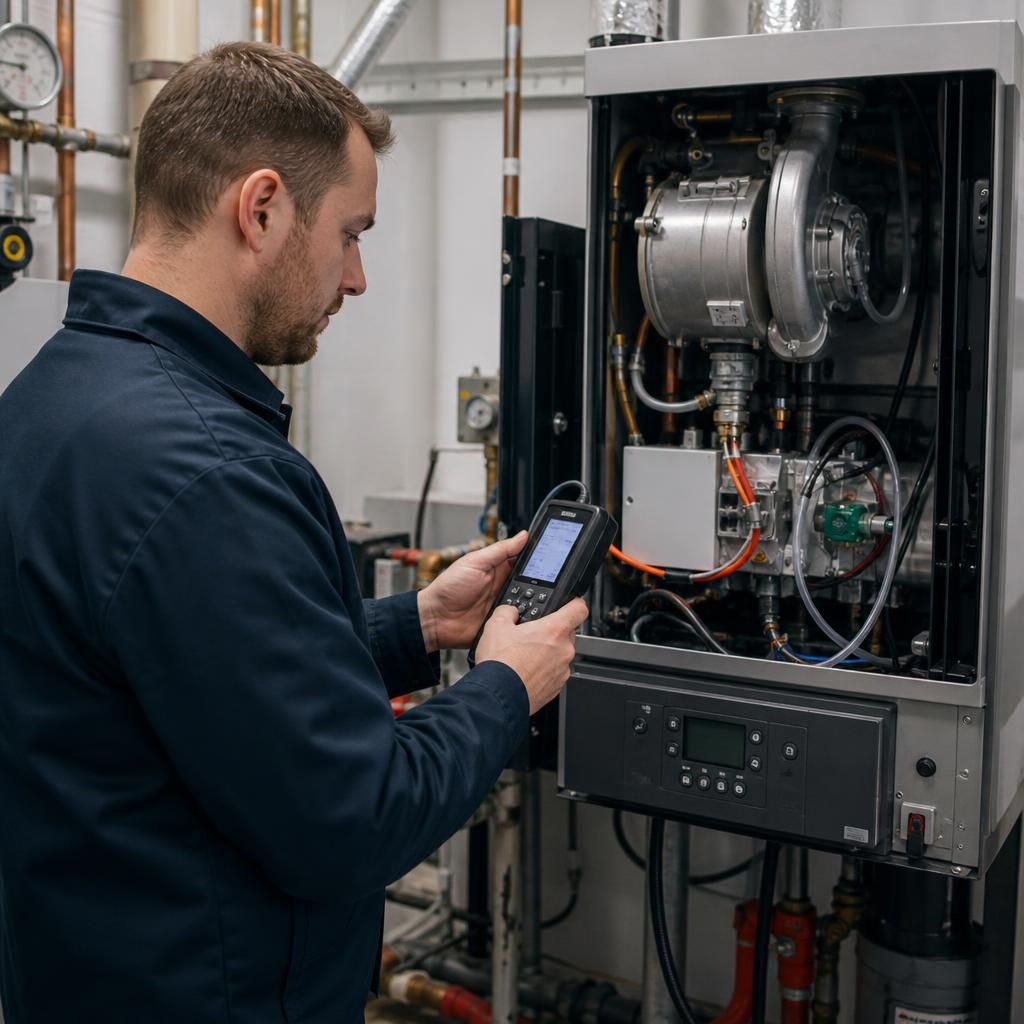
Combustion testing is a key part of the process. We use a calibrated analyser to check the products of combustion while the boiler runs through its operating range. The readings are compared with the manufacturer’s limits. We also check that the flue system is correctly assembled, supported and terminated, with no sign of leakage or recirculation.
A commercial boiler can appear to run normally while still having an unsafe combustion fault. Testing gives us evidence of how it is actually burning gas, rather than relying on the display or the sound of the appliance. We record the relevant readings with the commissioning information.
The heating circuit is tested as a working system. We check circulation, pump operation, flow and return temperatures, system pressure and the operation of valves and safety components. Where the installation includes a low-loss header, buffer vessel, plate heat exchanger or more than one boiler, each part must work in the correct sequence.
For a cascade system, we check that the boilers stage up and down as demand changes. This prevents one appliance from doing all the work while the others remain unused. It also confirms that the lead-and-lag sequence, isolation valves and associated pumps respond as intended.
Controls are commissioned for the way the building is used. Time schedules, room or zone controls, frost protection, hot water priority and heating curves are checked where they form part of the installation. If the system connects to a building management system, we test the available signals and confirm what the building operator can see and control.
Settings are not simply left at factory defaults. A school, office, workshop, rented property or agricultural building can have different heating patterns. We explain the operating settings and show the responsible person how to alter normal schedules without changing safety-critical parameters.
Safety devices are tested rather than assumed to work. Depending on the system, this can include high-limit protection, pressure protection, flame-failure response, automatic isolation, low-water protection and carbon monoxide monitoring. We make sure a fault causes the correct response and that the boiler does not continue operating when a safety condition has been breached.
If commissioning reveals a fault, we explain what has been found and what needs correcting. We do not treat a boiler as ready for normal use until the relevant defect has been resolved and the affected tests have been repeated. A failed reading can point to the appliance, the gas supply, the flue, the controls or the wider system, so the cause needs to be identified rather than masked by changing a setting.
The handover gives the operator a usable record. The commissioning information normally includes the appliance details, test results, operating settings and any relevant readings or adjustments. We provide the available manufacturer and installation documents, explain the controls and identify any maintenance requirements that the building operator needs to plan for.
The final paperwork should be kept with the building’s gas and heating records. It can be needed by a facilities manager, landlord, insurer or future engineer who has to understand what was installed and how it was set up. Where other compliance documents apply to the installation, we explain which records have been completed and which may be issued separately.
Commissioning is complete when the boiler, safety arrangements, controls and connected heating equipment have been tested together, the results have been recorded and the responsible person understands normal operation. That gives the building a documented starting point for servicing and future fault-finding.
A commissioning record gives the building a clear baseline for future checks. If occupancy, heating zones or operating schedules change, the original settings may no longer suit the way the premises are used.
When that happens, we can review the control strategy and system operation before anyone assumes the boiler has developed a fault. This helps separate a change in building demand from a problem with the appliance or installation.
Discuss your commercial gas boiler commissioning
If a commercial gas boiler installation is ready for handover, contact us to discuss the commissioning visit and the records the building operator will need. We can review the installation details first and explain what needs to be ready before testing begins.