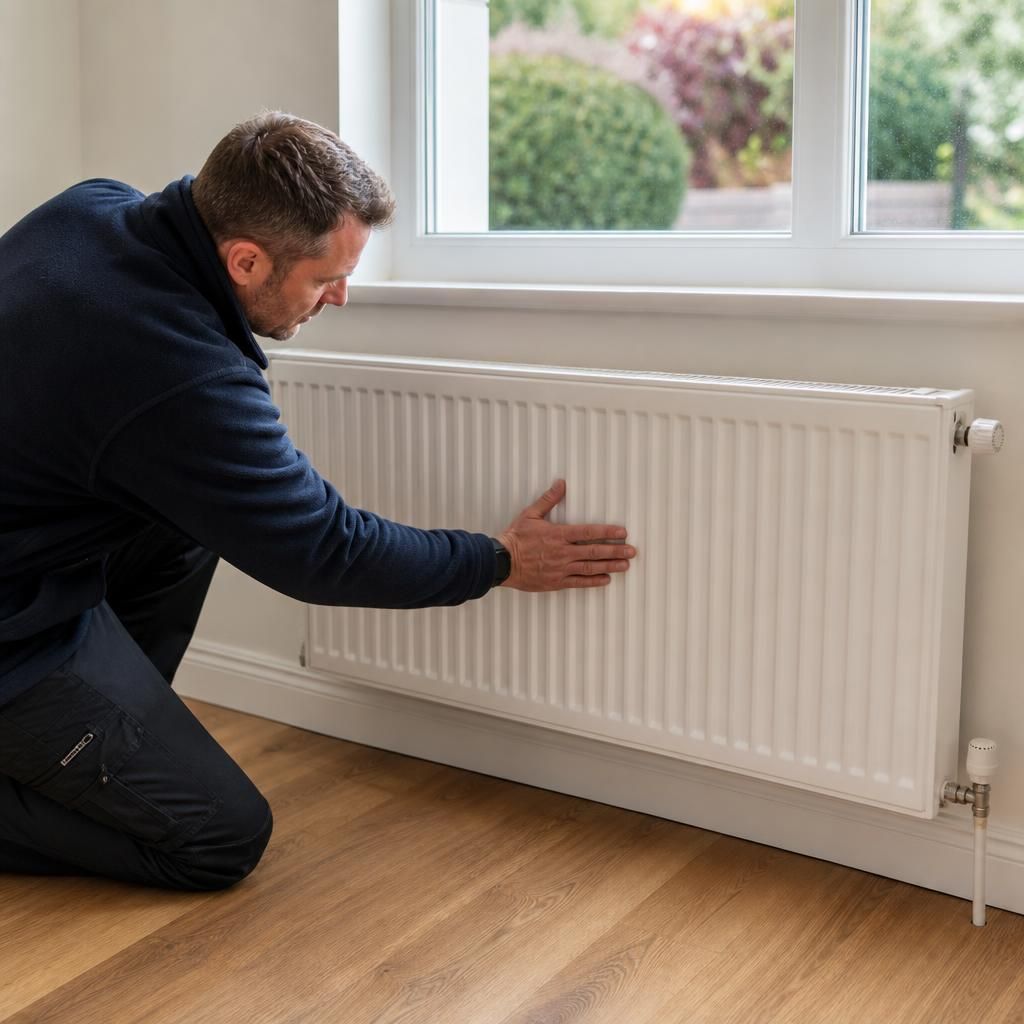
Will I need to change my radiators for a heat pump?
Not always. We assess each radiator against the heat loss in its room; some will work as they are, while others may need replacing with larger radiators so the heat pump can keep your home warm efficiently.
The key issue is not the radiator’s age, but how much heat it can deliver at the lower water temperature used by a heat pump. A radiator that worked well with a gas or oil boiler may need more surface area when the system runs at a lower temperature.
Why heat pumps can need larger radiators
A conventional boiler often sends much hotter water through the heating circuit. A heat pump works most efficiently when it provides steady heat at a lower flow temperature. The radiator must then transfer enough heat into the room without relying on very hot metal.
Radiator output depends on its size, design and operating temperature. A small single-panel radiator may not provide enough heat in a large or poorly insulated room. A deeper double-panel radiator with convector fins may provide more output in the same wall space. The correct choice depends on the room rather than on a general rule for the whole house.
What we check before recommending a change
Your room may have more or less heat demand than its size suggests. We calculate the heat loss for each room, taking account of the walls, windows, roof, floor, ventilation and the temperature we need to maintain inside. Older solid-wall homes, barn conversions and rooms with several external walls need particularly careful assessment.
We also record the radiators already fitted, including their dimensions, panel type and position. That tells us which emitters can meet the room’s heat demand and which may need more output. We look at the pipework and controls at the same time, because a suitable radiator still needs the correct water flow and control.
- Some radiators can stay. A radiator with enough output at the planned flow temperature does not need replacing simply because the heat source is changing.
- Some need a larger model. A longer or deeper radiator can provide the required heat without changing the room’s purpose.
- Some need a different type. A higher-output panel radiator may be more practical where wall space is limited.
- Some rooms need wider changes. If heat loss is high, improving insulation or reducing draughts may be more sensible than adding a very large radiator.
Older and off-gas-grid homes need a room-by-room approach
A property heated by oil or LPG may already have radiators that were sized for a boiler running at a higher temperature. That does not mean the whole system is unsuitable for a heat pump. It means we need to check what each room can achieve at the lower design temperature.
Solid walls, high ceilings, older windows and exposed positions can increase heat loss. In a listed building or barn conversion, there may also be limits on where a radiator can go. We take those restrictions into account rather than assuming that every room can accept the same standard replacement.
Insulation improvements can affect the radiator calculation. If roof insulation, draught reduction or window upgrades are planned, we need to understand the intended finished condition. Otherwise, the radiators may be selected for the wrong heat demand.
Will all the radiators need changing at once?
Not always. The survey may show that only particular rooms need larger emitters. We can identify those before work starts, so the quotation separates necessary radiator changes from optional improvements. Where replacement is needed, it can normally be coordinated with the heat pump and heating work rather than treated as an unrelated project.
Changing a radiator usually involves draining the relevant part of the heating circuit, removing the old unit, fitting the new one and reconnecting the pipework. We then refill, vent and balance the system. The work may be more involved if pipe positions need altering, walls need repairing or the existing pipework cannot provide the required flow.
Radiator size is only one part of the design
A heat pump needs the system designed and commissioned as a whole. The heat pump, cylinder, controls, pipework and radiators must work at compatible temperatures. We set the controls to provide steady heat rather than treating the system like a boiler that is switched on for short, hot bursts.
Balancing matters too. Without it, nearby radiators can take too much flow while rooms further away remain cool. We check the circuit and adjust it during commissioning so the available heat reaches the rooms that need it.
For a heat pump installation, our MCS-certified renewable energy installers use the completed design when preparing the paperwork. MCS certification also allows us to apply for a Boiler Upgrade Scheme grant on your behalf where the property and installation meet the scheme rules.
The sensible answer comes from the heat-loss calculation, not from replacing every radiator automatically. If the existing radiators can deliver the required heat at the planned flow temperature, we leave them in place. If they cannot, we explain which ones need changing, why, and what other work could reduce the heat demand.
A heat pump radiator may feel warm rather than hot when you touch it. That is normal. The system aims to maintain the room temperature steadily, instead of heating the radiator quickly and then switching off.
If a room still falls short of its target temperature, we investigate the heat loss, radiator output, water flow and controls. That shows whether the answer is a larger radiator or an adjustment elsewhere, rather than replacing equipment unnecessarily.