
Can you repair a boiler that keeps losing pressure?
Usually, yes. We can identify whether the pressure loss comes from a leak, expansion vessel, pressure relief valve or another fault, then repair the cause rather than repeatedly topping up the boiler.
Repeated pressure loss is usually repairable, but the repair depends on where the water is going or which component is allowing the pressure to change. A sealed heating system should not need regular topping up. If it does, the underlying fault needs investigating rather than simply resetting the gauge.
Your pressure may fall because of a visible leak from a radiator valve, pipe joint, boiler connection or heated towel rail. We inspect accessible pipework, valves and the boiler casing for signs of water, staining or corrosion. A small leak can evaporate before it forms a puddle, particularly around a hot boiler or pipe.
If the pressure drops while the heating is switched off, a leak somewhere in the heating circuit becomes more likely. Pipework under floors, behind walls or below a concrete floor can be harder to find. We use the pressure behaviour and the condition of accessible components to decide whether further leak tracing is needed.
A pressure relief valve can also discharge water outside through its copper outlet pipe. If that valve has opened, it may continue to pass water after the original pressure problem has gone. We check the discharge route and the valve, rather than assuming the gauge itself is faulty.
If the gauge rises when the heating warms up and then falls sharply as the system cools, the expansion vessel may have lost its charge or developed a fault. This vessel allows the water to expand safely as it heats. When it cannot do that properly, the pressure can climb high enough to open the relief valve.
We check the expansion vessel and pressure relief valve as part of the diagnosis. Depending on their condition, the repair may involve recharging the vessel, replacing a failed valve or replacing another defective component. We explain which part has failed and why it would cause the pressure loss before carrying out chargeable work.
Bleeding radiators can cause a small drop in pressure because air is released from the system. That may be normal after maintenance, but repeated pressure loss after bleeding points to another issue. Topping up the system each time can hide a leak and introduce fresh water, which may increase corrosion inside the heating circuit.
Do not keep refilling the boiler indefinitely or leave the filling loop open. An open filling loop can raise the pressure continuously and may cause the relief valve to discharge. If the boiler is losing pressure quickly, leaking water or repeatedly locking out, switch it off and arrange an inspection. If water is reaching electrical equipment, isolate the power safely if you can and avoid touching wet components.
Some boilers stop working when pressure falls below their operating limit. Resetting the boiler may restore heating briefly, but it will not correct the leak, expansion vessel fault or valve problem. We test the system after the repair to check that the pressure remains stable as the heating warms and cools.
A replacement boiler is not automatically needed. A leaking valve, failed expansion vessel or pressure relief valve can often be repaired without changing the boiler. Replacement becomes a consideration when the fault is part of wider deterioration, compatible parts are no longer practical to source, or the repair cost does not make sense for the boiler’s age and condition. We separate that decision from the initial diagnosis.
Before booking, note how often you need to top up the pressure, whether it falls when the heating is on or off, and whether you have seen water near a radiator, boiler or outside discharge pipe. Tell us the boiler make and model if you have it, along with any fault code. Those details help us bring the right parts and begin with the most likely causes.
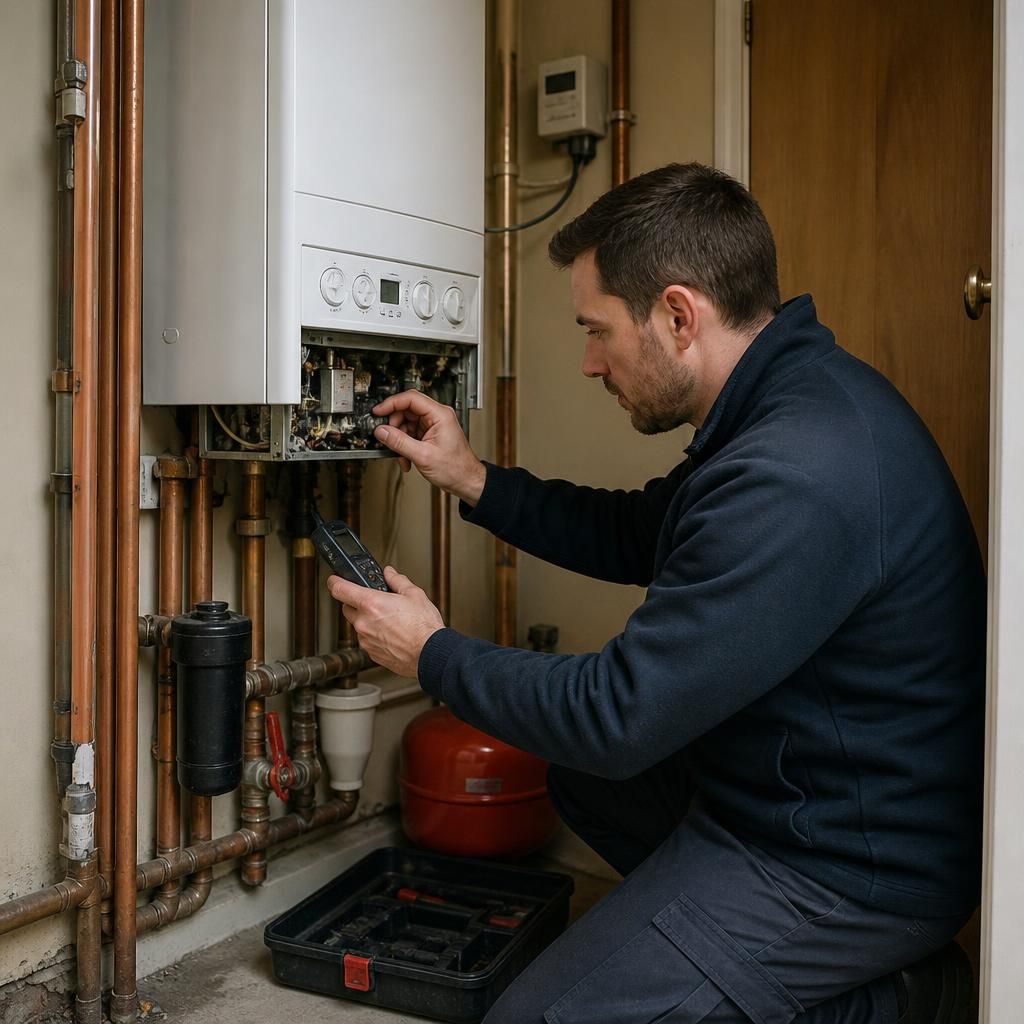
If the pressure keeps falling but there’s no visible water, the fault may be in concealed pipework rather than the boiler itself. We can separate the boiler from the heating circuit and test each part to narrow down where pressure is being lost.
That helps avoid replacing a working boiler for a problem beneath a floor or behind a wall. If access is needed, we explain the likely disruption and repair options before any opening-up work begins.