
How much heating oil should I order?
Base the order on your recent oil use, the level in the tank and the heating you expect before the next delivery, while leaving a sensible reserve so the boiler does not run dry. If you’re unsure, we can help estimate the amount from your usage and tank capacity before you place the order.
A sensible heating oil order is the amount needed to bring the tank back to a safe working level, based on its actual capacity and the fuel already inside. Start with the tank’s capacity, estimate the remaining litres, then allow for the period before the next delivery and colder weather.
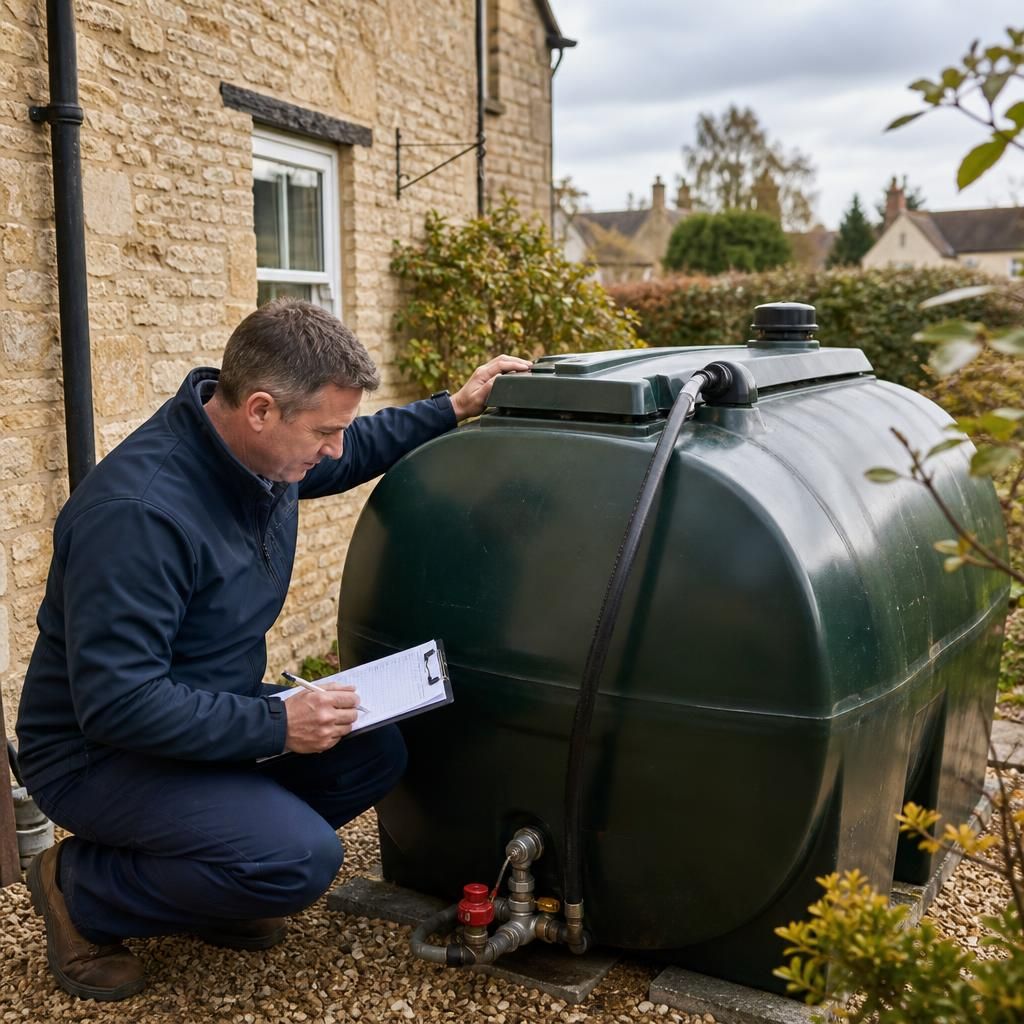
Use the tank capacity, not the gauge reading alone. The capacity may be shown on the tank label, installation paperwork or previous delivery records. A gauge marked in quarters or percentages gives an approximate level, but the shape of the tank means that a halfway reading does not always represent half its capacity.
If the capacity is 1,200 litres and the gauge suggests that roughly a quarter remains, the tank may contain about 300 litres. That is only an estimate. A supplier or engineer can give a more reliable assessment where the gauge is damaged, difficult to read or known to be inaccurate.
Work out the likely annual use from your own records. Add the quantities from previous deliveries and compare them with the dates between orders. Keep heating, hot water, occupancy and weather in mind when comparing one year with another. A winter spent in a mostly empty house will not provide a useful guide to a winter with full-time occupancy.
- Older boilers and poorly insulated homes usually need more fuel than a modern, well-insulated property.
- A colder winter can increase consumption without any change to the heating controls.
- Guests, working from home and longer hot-water use can raise demand.
- A boiler replacement, insulation work or changed thermostat settings can make older delivery records less relevant.
For a rough planning figure, divide the fuel used over a complete year into monthly amounts, then allow more for the colder part of the year. A simple monthly average can understate winter demand because oil heating use is seasonal. It is safer to compare the same months from previous years where those records exist.
Then calculate the order quantity: tank capacity minus the estimated fuel remaining, with enough room left to avoid overfilling. Do not order more than the tank can safely hold. The delivery company will need to know the tank size and the estimated level before confirming the quantity.
Do not rely on the gauge if it has stopped moving, stays at one reading or shows empty immediately after a delivery. Water or sludge in the tank can also make the remaining fuel difficult to judge. We can assess the tank and help work out a practical order when the records and gauge do not agree.
Try not to let the tank run completely dry. An empty tank can allow the boiler to draw air or sediment into the fuel line, and the boiler may need attention before it will run again. If the boiler has stopped after the tank emptied, avoid repeated reset attempts. Check the fuel level and contact a suitably registered heating engineer.
The tank’s condition matters as much as the quantity being ordered. A damaged tank, leaking connection or heavily corroded base should be dealt with before delivery. The delivery driver may refuse to fill a tank that appears unsafe, and ordering extra fuel will not solve that problem.
For an older or off-gas-grid property, delivery planning is also a useful point to review the boiler and tank together. If fuel use has risen without a clear change in occupancy or weather, we can investigate the boiler, controls, pipework and tank rather than simply ordering more oil. Our OFTEC-registered heating engineers work on oil-fired systems, so the check can focus on the equipment already serving the property.
Keep a note of each delivery date, quantity and tank reading. After several deliveries, those records give a much better basis for the next order than a single gauge reading. We can use them with the tank capacity and household circumstances to help plan an order that leaves a sensible reserve without paying for fuel the tank cannot hold.
If the property will be empty for part of the winter, include frost-protection heating in the estimate. A vacant house can still use oil, particularly during cold spells, so a normal holiday-period allowance may not be enough.
Tell us about any planned changes before we help calculate the order. A new boiler, altered heating controls or insulation work can change consumption, making older delivery records less useful. That gives you an order based on how the property is likely to operate next, rather than simply repeating its previous pattern.