What maintenance does a replacement boiler need?
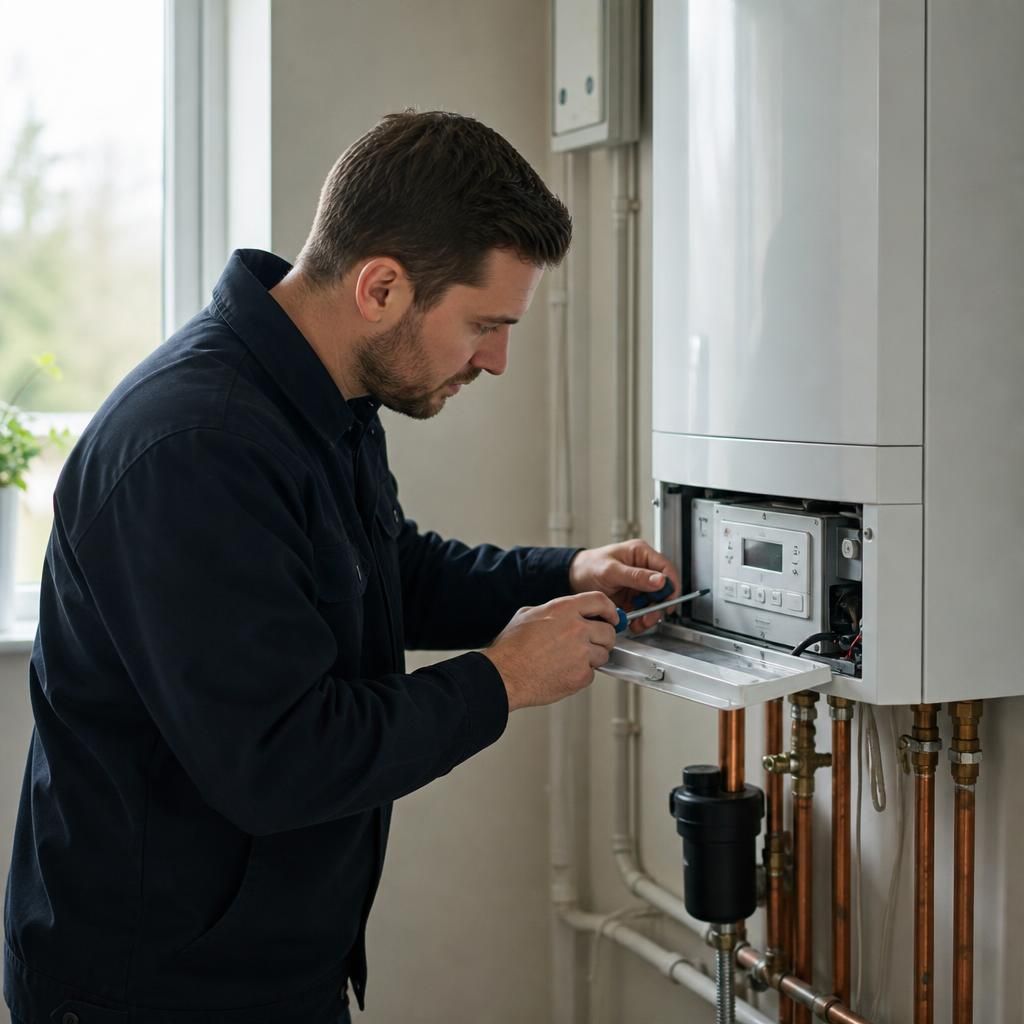
Your replacement boiler should be serviced at the interval set by its manufacturer, with the flue, combustion, safety controls, condensate route and heating performance checked. Between services, keep the boiler area clear, watch for pressure changes or unusual noises, and report faults rather than removing covers or attempting repairs yourself.
Most ongoing care happens between engineer visits. Keep the boiler accessible, avoid covering vents or controls, and report changes before they become a breakdown. Good maintenance also protects the warranty position and helps us identify whether a fault is minor or points to a wider heating problem.
Keep the boiler area clear. Do not use the cupboard around the boiler for storage unless the installation instructions allow it. Air vents, service panels, the flue route and pipework must remain accessible. Avoid hanging clothes or placing boxes against exposed pipes. If building work, insulation or decorating changes the area around the boiler, check that nothing has restricted ventilation or access.
Use the controls rather than switching the system off at the electrical supply. A programmer, room thermostat or smart control can manage heating periods more effectively than repeatedly turning the boiler off at the fused switch. If the home is empty during cold weather, use an appropriate frost-protection setting where the system has one. Ask us to explain the controls if the settings are unclear after installation.
Watch for small changes. A new rattle, whistling sound, smell, stain, drop in heating performance or increase in pressure fluctuations is worth reporting. A fault code can help identify the problem, so make a note of it before resetting the boiler. Repeatedly resetting it can hide a developing fault and may leave the cause unresolved.
Never remove the boiler casing or attempt to repair gas components yourself. Gas work must be carried out by a Gas Safe registered engineer. For an oil-fired replacement, use an OFTEC-registered engineer. This protects the safety of the installation and gives you the correct service record for the fuel type.
What happens during a proper service? The engineer checks the boiler against its installation and manufacturer requirements, examines the combustion and safety controls, and looks for signs of wear or leakage. We also consider how the boiler is operating as part of the wider system, including the controls, radiators, pump and visible pipework. The findings should be explained clearly, with any repair or improvement kept separate from routine servicing.
For an oil boiler, the service includes attention to the burner, oil supply and combustion arrangements. Oil tanks, filters and external pipework can also affect reliability, so they should not be ignored simply because the boiler itself appears sound. On a gas system, the engineer records the relevant safety results and explains any issue that needs further work.
Keep the paperwork. Store the service record, commissioning information, installation certificate and any repair invoices together. Some boiler warranties require servicing in line with the manufacturer’s instructions. The exact conditions vary, so the paperwork matters if you need to make a warranty claim later.
If we find a component that needs replacing, we explain what has failed and why it matters before carrying out additional work. A written quotation sets out planned work before it starts, so routine maintenance does not turn into an unexpected repair bill without discussion.
The heating system may need care beyond the boiler. Older radiators, dirty system water, air in the circuit or poor balancing can make a new boiler appear less effective than it should. Cold spots, noisy radiators and slow warm-up may come from the distribution system rather than the boiler. We can investigate those symptoms instead of treating the boiler as the automatic cause.
Bleeding a radiator can be reasonable when it contains air, but frequent bleeding or repeated loss of system pressure needs investigation. Topping up the system regularly is not a maintenance strategy; it can indicate a leak, an expansion-vessel problem or another fault. Do not keep adding water without finding out why the system needs it.
Arrange a review after changes to the property. An extension, loft conversion, insulation work or room alteration can change heat demand and airflow around the installation. If rooms are being added or radiators moved, ask an engineer to check the system rather than assuming the replacement boiler will continue to suit the altered home.
For a rural or off-gas-grid property, fuel storage and delivery arrangements also form part of reliable heating maintenance. An oil boiler cannot run when the tank is empty, and a problem with the tank, filter or supply line can be mistaken for a boiler fault. Keeping those parts accessible makes diagnosis simpler and reduces unnecessary disruption.
Before a service, make a note of any unusual behaviour, recent fault codes and rooms that are not heating properly. Clear access to the boiler and controls, and have the installation records available if you hold them. That gives the engineer a better picture of how the system has been performing and helps separate normal adjustment from work that needs a quotation.
If the replacement is a regular or system boiler, maintenance includes more than the boiler itself. The hot water cylinder, pump, valves and any feed-and-expansion tank can affect heating and hot water performance. We check these parts as part of the wider system, so a boiler service does not overlook a fault elsewhere.
Tell us if hot water takes longer to heat, the cylinder makes unusual noises or the heating loses temperature unexpectedly. Those symptoms can point to a control, circulation or storage problem rather than a boiler fault. Finding the cause early helps you decide whether the system needs an adjustment, repair or separate improvement.