Does panel orientation change commercial solar panel cost?
Yes. Roof orientation can change commercial solar panel cost because it affects the available layout, shading, cable runs and whether extra mounting equipment is needed, as well as the electricity the system can produce.
The direction a commercial roof faces changes the balance between installation cost and usable generation. A roof with a less favourable aspect may still be financially sound, but the design can need more panels, more mounting equipment or a different electrical layout.
Roof direction affects how much electricity each panel produces. In the UK, a broadly south-facing roof often gives the strongest output across the year. East- and west-facing roofs produce less at the daily peak, but they spread generation across more of the morning and afternoon. That pattern may suit a business using electricity throughout the working day better than a shorter generation peak.
A north-facing roof usually needs closer assessment. The roof pitch, local shading and available area all affect the result. We model the roof rather than rejecting it from its compass direction alone. The calculation shows whether the expected output justifies the extra panel area or mounting work.
Orientation can change the number of panels needed. If each panel produces less electricity in its proposed position, we may need more panels to reach the required annual generation. That increases the cost of panels, mounting rails, roof fixings, cabling and installation time. A larger array also needs enough usable roof area and may require a different inverter arrangement.
Roof layout can matter as much as compass direction. Plant, rooflights, vents, parapets and adjoining buildings can reduce the area available for panels. A roof with several orientations may need separate electrical strings or multiple maximum power point trackers. Those components help different roof sections operate effectively, but they can add to the equipment and design cost.
Shading makes the orientation calculation more important. Trees, chimneys, taller buildings and roof structures can affect panels at different times of day. A west-facing section shaded in the afternoon may perform differently from an east-facing section shaded in the morning. We assess the obstruction, model its effect and consider panel placement and inverter design before pricing the installation.
The roof structure and access can outweigh the effect of direction on the final price. A straightforward roof with good access may cost less to work on than a well-oriented roof that needs additional access equipment, strengthening or complex fixings. The roof covering, its condition and the position of the electrical intake also affect the installation method and cable route.
An east-west layout can sometimes reduce the cost per usable square metre. Panels can be arranged on both roof slopes, often with a lower profile than a single-direction arrangement. This can make better use of a large commercial roof and match a business whose electricity demand is spread through the day. The final design still depends on roof pitch, spacing, maintenance access, wind loading and the required output.
Orientation also affects the value of the electricity rather than just the installation price. If the business uses most of its power during the hours when the panels generate, more of the electricity may be used on site. If generation regularly exceeds demand, the design may need to consider export arrangements, battery storage or a different panel capacity. We compare the predicted generation with the site’s demand profile instead of judging the roof on annual output alone.
The cheapest installation is not always the lowest-cost option over its working life. Fitting fewer panels on a favourable roof section may reduce the initial price, but it might leave useful roof space unused. Filling a less favourable section may increase the installation cost without producing enough additional value. We set out the design assumptions so the business can compare the capital cost with the electricity it is expected to produce and use.
Our survey considers the roof direction, pitch, shading, usable area, structure, access, cable route and electricity demand. We then model suitable layouts and explain any cost difference between them. Where solar panels and battery storage are included, the design also considers when electricity is generated, stored and used. MCS certification means the finished renewable installation can be considered for the Smart Export Guarantee, subject to the scheme and supplier requirements.
As a result, panel orientation is one part of the commercial solar price rather than a fixed surcharge. A suitable roof may need little adjustment. A divided, shaded or less productive roof may need more panels, extra electrical equipment or a different layout. The written quotation should show those choices clearly, so the decision is based on the expected use of the system as well as the installation cost.
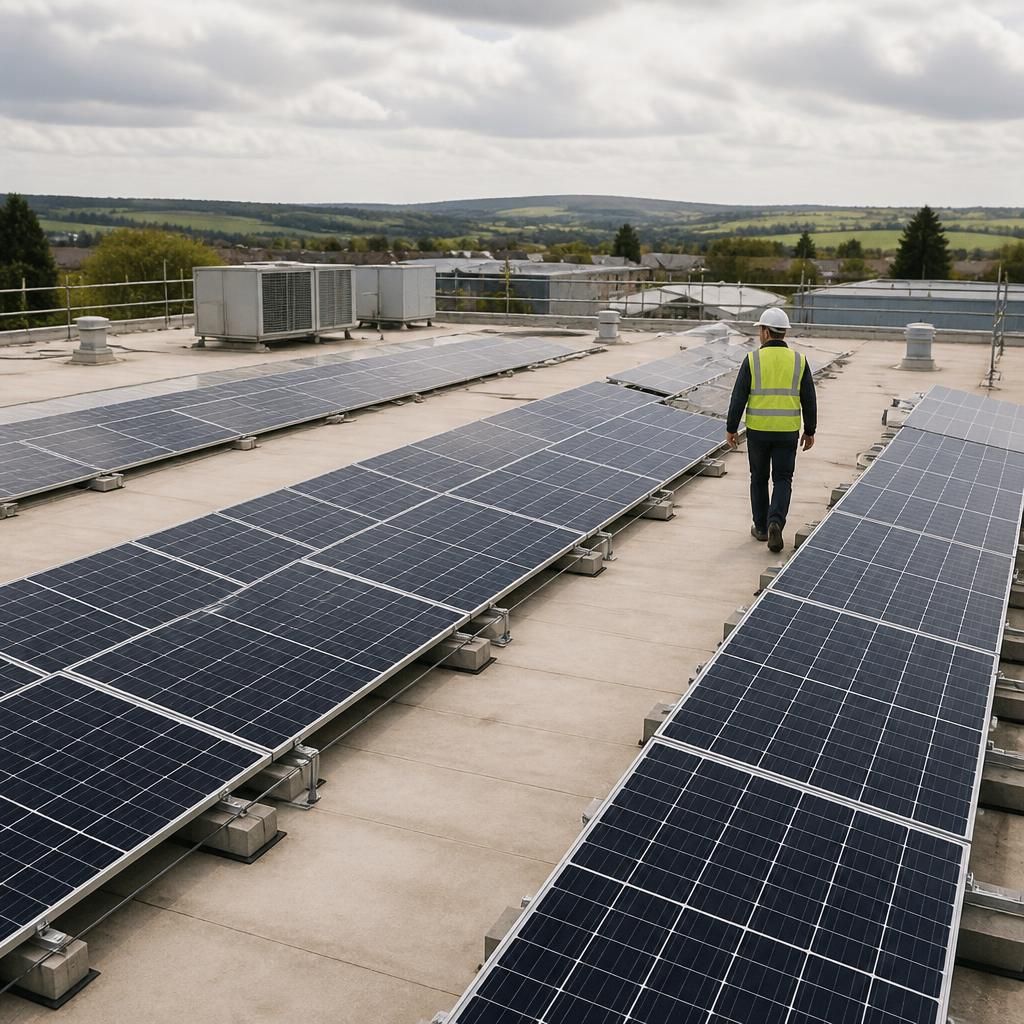
A flat commercial roof has no fixed panel direction, so the mounting design becomes part of the cost. Panels can be angled towards the strongest available sun, or arranged in east–west rows to use the roof more evenly.
Row spacing must prevent one row shading another. That spacing, along with walkways for maintenance, can reduce the area available for panels. The mounting system may also need ballast or structural fixings, depending on the roof and wind loading.
We compare the usable panel area with the mounting and access requirements before pricing the array. This shows whether a different orientation increases the panel count, the mounting cost or both.