
How does commercial solar PV perform in cloudy weather?
Commercial solar PV still generates electricity in cloudy weather because panels use diffuse daylight, although output is lower than on a clear day. We assess expected generation across the year and can include monitoring or battery storage where it helps your business use more of its solar power.
Cloudy weather usually reduces solar PV output rather than stopping it. The practical question for a business is how much electricity the system produces across the year, and how closely that production matches the building’s demand.
Not all cloud has the same effect. Bright or broken cloud can leave useful daylight available, while thick, dark cloud and heavy rain reduce the available energy much further. Short periods of poor weather may have little effect on annual performance, but a run of dull winter days can produce noticeably less electricity than the same roof would produce in spring or summer.
The panels’ rated capacity is not a promise of constant output. The rating describes the system under standard test conditions. Actual production changes with daylight, roof orientation, shading, temperature and the condition of the electrical equipment. We use these factors when estimating performance, rather than presenting the rated capacity as an expected daily figure.
Your roof may receive good daylight even when the sky looks grey. A roof with a clear outlook can perform better than one with a nominally favourable orientation but nearby trees, buildings or plant casting shade. We assess the roof and surrounding obstructions before we model the likely generation.
For a commercial building, daytime electricity use often matters more than the weather alone. Lighting, refrigeration, machinery, pumps, office equipment and ventilation may all be operating while the panels are producing power. That allows the business to use part of the generation directly instead of buying the same electricity from the grid.
Where the building uses most of its electricity at different times, we look at how the demand changes through the day and across the year. A system that produces useful daytime energy can still be worthwhile in cloudy conditions, but the financial case depends on the amount used on site, the amount exported and the price paid for each.
A battery can help move some generated electricity from one part of the day to another. It cannot create extra energy during a prolonged period of heavy cloud. We therefore size storage against the building’s consumption and the expected generation, rather than treating it as a way to remove the effect of bad weather.
Export is another part of the calculation. When generation exceeds the building’s immediate demand and the battery is full, surplus electricity may be exported to the grid. An MCS-certified installation can support an application for the Smart Export Guarantee, subject to the relevant supplier and scheme requirements. We explain the paperwork and model export as part of the overall assessment, rather than assuming every unit will have the same value.
Seasonal differences are important. A commercial solar PV system will normally produce more during longer, brighter days and less during short winter days. The business may still have a steady winter load, so we compare the expected generation profile with actual consumption throughout the year. Looking only at a summer electricity bill can give an unrealistic view of performance.
We use the site survey and electricity data to examine:
- the roof’s orientation, pitch and usable area;
- shading from trees, neighbouring buildings, roof structures and equipment;
- the building’s half-hourly or interval electricity demand, where available;
- the expected generation in different seasons and weather conditions;
- how much electricity may be used directly, stored or exported; and
- the location of the inverter, cabling routes and connection equipment.
This process also helps distinguish normal low production from a fault. Cloudy weather should lower the output in a way that broadly follows the available daylight. If the monitoring shows no generation on a bright day, or one section of the array behaves differently from the rest, the cause may be shading, a connection problem, an inverter fault or a monitoring issue. We can investigate the system rather than attributing every low reading to the weather.
Online monitoring makes these changes easier to understand. It can show generation, site consumption, battery charge and export, depending on the equipment installed. A single dull day is not a useful test of the system. Comparing production with the expected seasonal pattern gives a more reliable indication of whether the array is performing properly.
Cloudy weather should therefore be included in the design, not treated as an exception. We work out the likely annual and seasonal generation for the particular roof, then compare it with the building’s electricity use and the proposed export arrangements. That gives the business a clearer view of what the system can contribute on ordinary working days, including the grey ones.
A cloudy day may still reduce the electricity your business buys from the grid, even when the panels are not producing at their peak. The benefit appears through lower site imports rather than a separate line marked “solar saving” on every bill.
We can compare the building’s electricity use with the PV generation profile, including periods of bright overcast weather. That helps show how much power the site uses directly and how much remains dependent on grid electricity. It also keeps the financial assessment grounded in the way the business actually operates, rather than in the appearance of the sky on one particular day.
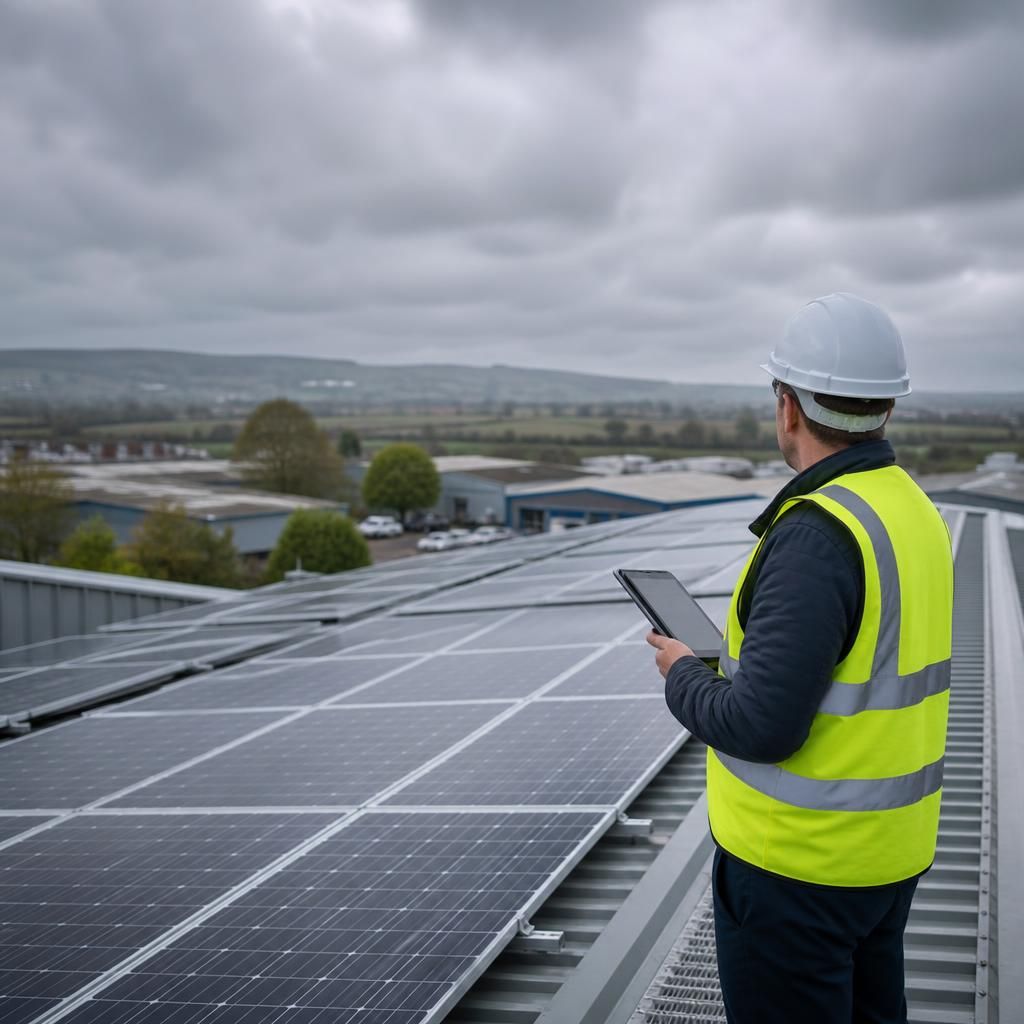
Assess how commercial solar PV could perform on your site
Ask us to assess how commercial solar PV could perform on your site, using the roof, electricity demand and expected cloudy-weather generation.
We’ll explain the likely balance between on-site use, battery storage and export before you decide whether to proceed.