
What does commercial solar installation cost?
Commercial solar installation cost depends on the system size, roof condition, access, electrical work and whether battery storage is included. We assess those factors at survey and provide a written quotation showing what the installation involves and what you can expect to pay.
There is no reliable standard price for commercial solar installation. The cost depends mainly on how much electricity the building uses, how much suitable roof space is available, the condition of the roof and electrical system, and whether battery storage is included. A proper quotation should show each part of the work separately, rather than giving a price based only on panel numbers.
What makes up the installation cost?
The panels are only one part of a commercial solar installation. The quotation may also include the inverter, mounting system, cabling, isolators, monitoring equipment, access equipment, design work, testing and commissioning. Larger systems can need additional distribution-board work or changes to the building’s electrical infrastructure.
Your electricity use affects the design more than the roof area alone. A business using power during daylight hours may use a greater proportion of its solar generation directly. A building that is empty during the day may need a different design, with battery storage or export arrangements considered alongside the panels.
Roof condition can change the price
A roof with suitable space and straightforward access usually needs less installation work than a roof with multiple levels, rooflights, fragile coverings or restricted access. We check the roof covering, fixing points and layout before confirming the system design. If the roof needs repair or replacement, that work should normally happen before the panels are fitted.
Older commercial buildings may also need closer attention to their structure. We consider the additional loading, wind exposure and fixing method rather than assuming that every roof can take the same system. This avoids pricing a panel array that cannot be installed safely.
Electrical work and grid requirements
The existing supply determines how the solar system connects to the building. A small installation may connect to existing equipment, while a larger array can require changes to switchgear, protection or the connection with the electricity network. The network operator may also need to approve the connection before installation.
That work can be a significant part of the total cost on an industrial or agricultural property. We identify it during the survey and include the required electrical work in the quotation. This is more useful than presenting a low panel-only price that later grows when the supply is assessed.
Does battery storage add much to the cost?
A battery adds the cost of the battery itself, its control equipment, installation and any changes needed to connect it safely. It can be useful where the building has low daytime demand but uses electricity later, or where stored energy forms part of a wider energy plan.
It is not automatically the right financial choice. We compare the expected solar generation with the site’s half-hourly or interval electricity use where that information is available. The resulting calculation shows how much energy may be used on site, how much may be exported and whether storage changes the position for that building.
How we work out the likely return
A commercial solar quotation should be judged against the site’s actual electricity use, not against a generic annual saving. We look at the roof orientation and shading, the proposed system size, the building’s operating pattern and the current electricity costs available to the business.
The assessment can then show the expected generation, the proportion likely to be used on site, the amount that may be exported and the effect of battery storage if included. From those figures, we can discuss the likely payback period for the proposed installation. We do not treat a roof’s maximum panel capacity as proof that a larger system will be more cost-effective.
Export income also needs careful treatment. An MCS-certified installation can support an application for the Smart Export Guarantee, subject to the relevant supplier and scheme requirements. Tariffs and eligibility can change, so we set out the assumptions used rather than treating export payments as a fixed part of the return.
Are grants available for commercial solar?
Commercial funding depends on the business, the property, the type of installation and the schemes available at the time. There is no single grant that applies to every commercial solar project. We can identify the information needed for a funding or financial assessment, but current grant, tax and tariff rules should be checked before the investment decision is made.
What should a commercial quotation include?
- the proposed panel capacity and estimated annual generation;
- the roof areas and mounting method used in the design;
- the inverter, monitoring equipment and protection arrangements;
- any structural, access or roof-related work;
- electrical alterations and network-connection requirements;
- the cost of battery storage, if it is being considered;
- testing, commissioning and the handover information;
- the assumptions used for on-site use, export and payback calculations; and
- any exclusions, such as roof repairs or changes to the building’s supply.
We provide a written quotation before work starts, so the business can see what is included and where a separate decision may be needed. If the survey finds that a larger system would need expensive electrical alterations, we can compare that with a smaller array rather than assuming the largest possible installation is best.
What about disruption?
Most of the work takes place on the roof and around the electrical equipment, but the installation can still affect access, parking, loading areas and parts of the building. The extent depends on the roof layout, cable routes and the position of the connection equipment. We plan the work around the building’s practical constraints and explain any areas that need to be kept clear.
The final cost should therefore be compared on more than the headline figure. A suitable system, clear electrical scope, accurate generation estimate and complete paperwork are all part of the value of the installation. For a commercial property in Warwickshire, Oxfordshire, Gloucestershire or the North Cotswolds, we can assess the site and prepare a quotation based on its roof and electricity use.
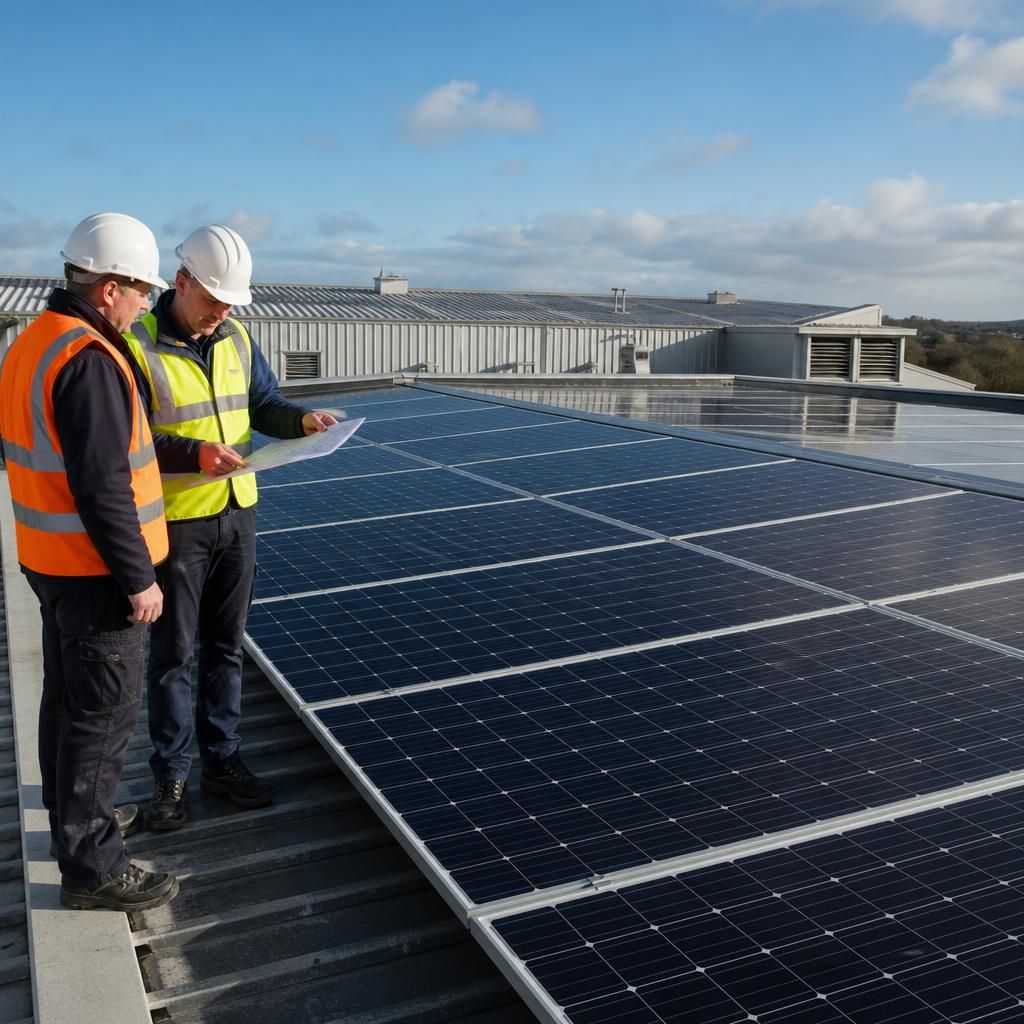
If the building is leased, the installation cost may include work that is not visible from the roof. The landlord may need to approve the mounting method, cable routes and any roof penetrations before the design can proceed.
Separate electricity meters can also affect the design. We establish which meter supplies the solar installation and how generation will be allocated across the site. That prevents the quotation from being based on savings the occupying business cannot actually use.
Request a commercial solar installation quotation
If you’re assessing commercial solar for a building in Warwickshire, Oxfordshire, Gloucestershire or the North Cotswolds, contact us to arrange a site assessment. We’ll use the roof, electrical system and electricity use to prepare a clear quotation for the proposed installation.