
What safety standards should renewable energy storage installers meet?
Renewable energy storage installers should work to BS 7671, the IET Code of Practice for Electrical Energy Storage Systems and relevant battery fire-safety requirements. We assess the battery location, isolation, protection and existing consumer unit before installation, then test and explain the system so you receive clear commissioning and handover paperwork.
The installer should meet electrical, battery-storage, building and grid-connection requirements, not simply fit the battery and switch it on. A safe installation starts with a site assessment, follows the relevant standards and manufacturer instructions, and ends with testing, commissioning and clear paperwork.
Battery storage is part of the electrical installation, so the design must comply with BS 7671, the IET Wiring Regulations. That covers matters such as cable sizing, earthing, isolation, overcurrent protection, fault protection and the arrangement of the consumer unit. The battery and inverter also need protection that matches their electrical characteristics and the way the system will operate.
The installation should also follow current guidance for domestic energy storage, including PAS 63100 where it applies. This guidance addresses the risks associated with battery systems, including their location, access, separation from living areas and measures to limit the consequences of a fault. We consider the building as well as the equipment before recommending a position.
The battery location matters. A garage, utility room, outbuilding or plant area may be suitable, but not every space is. We look at the room’s construction, access, ventilation, exposure to heat or water, escape routes and proximity to combustible materials. We also consider whether the equipment could obstruct access or make future maintenance difficult.
A loft, cupboard or external wall may appear convenient but can introduce additional risks. Heat build-up, limited access, roof loading, fire separation and the route for cables all need checking. An older house may need improvements to the mounting surface, consumer unit or cable routes before the battery can be installed safely.
The battery system itself must be suitable for the installation. We check the inverter, battery modules, protection equipment and monitoring controls as one system. The equipment must be installed to the manufacturer’s instructions, including clearances, mounting, environmental limits and approved combinations of components. Mixing incompatible equipment can affect both safety and the manufacturer’s warranty.
Electrical safety is not limited to the battery. We check the existing installation for faults, inadequate earthing, overloaded circuits and equipment that may not cope with the new system. A battery can expose weaknesses in an older installation because it can charge and discharge at significant power. Where remedial work is needed, we explain it before the installation proceeds.
The connection to the electricity network has its own requirements. The inverter must meet the relevant technical requirements for connecting generation and storage to the grid. Depending on the system, the network operator may require notification, approval or an application before the work starts. We deal with the connection requirements applicable to the design rather than assuming every battery follows the same process.
Export control also needs to be considered. If solar panels and a battery can send electricity to the grid, the inverter settings and any export-limiting equipment must be configured correctly. An installer should record those settings and provide the relevant confirmation for the network operator.
Fire safety forms part of the design. We assess the battery’s position, nearby materials, access for isolation and the route occupants would use to leave the building. The appropriate detection, separation or protection measures depend on the property and equipment. A battery should not be placed where a fault could block an escape route or expose occupants to avoidable risk.
Good practice also includes keeping manufacturer instructions, isolation points and warning labels clear. Everyone in the property should be able to identify how the system is isolated in an emergency. We explain the controls and provide information about what to do if the battery displays a fault, becomes damaged or has been exposed to water.
The installer needs the right competence for both the electrical work and the storage system. An electrician who can wire a consumer unit may not have the experience needed to assess battery placement, inverter behaviour, export control and commissioning. Ask who will design the system, who will install it and who will test it. The people carrying out the work should be trained for the equipment being fitted and able to show the relevant certification.
For installations involving solar generation and battery storage, MCS certification has a practical benefit. It provides the route for an eligible installation to be registered for the Smart Export Guarantee, subject to the scheme’s current rules. It also supports applications for grants where the particular renewable installation qualifies. Certification does not remove the need for a proper electrical design or site assessment.
Testing and commissioning should be documented. Once the work is complete, we test the protective devices, earthing, isolation, polarity, cable installation and system operation. We check that the inverter and battery communicate correctly, that charging and discharging behave as intended, and that monitoring information is available to the owner.
You should receive the electrical test results, commissioning records, equipment instructions, warranty information and details of any network notification or approval. The paperwork should identify the installed equipment and explain the isolation points. If a future electrician needs to work on the property, these records help them understand the system before touching it.
A safe installation is also one that can be maintained safely. We leave access to the battery, inverter, isolators and protective devices. The owner should know what routine checks are appropriate and which warnings need professional attention. Battery systems should not be opened, modified or repaired by someone who is not qualified to work on them.
Before accepting a quotation, ask the installer to explain:
- which electrical and battery-storage requirements the design follows;
- why the proposed location is suitable for the building;
- how the system will connect to the grid and whether the network operator must approve it;
- what checks will be made to the existing consumer unit, earthing and cable routes;
- who will install and commission the equipment;
- what testing certificates and commissioning paperwork you will receive; and
- how faults, isolation and future maintenance will be handled.
We provide a written quotation before work starts, including any electrical improvements the survey identifies. That gives you a clear distinction between the battery equipment, required safety work and optional additions, with no surprise charges added after installation.
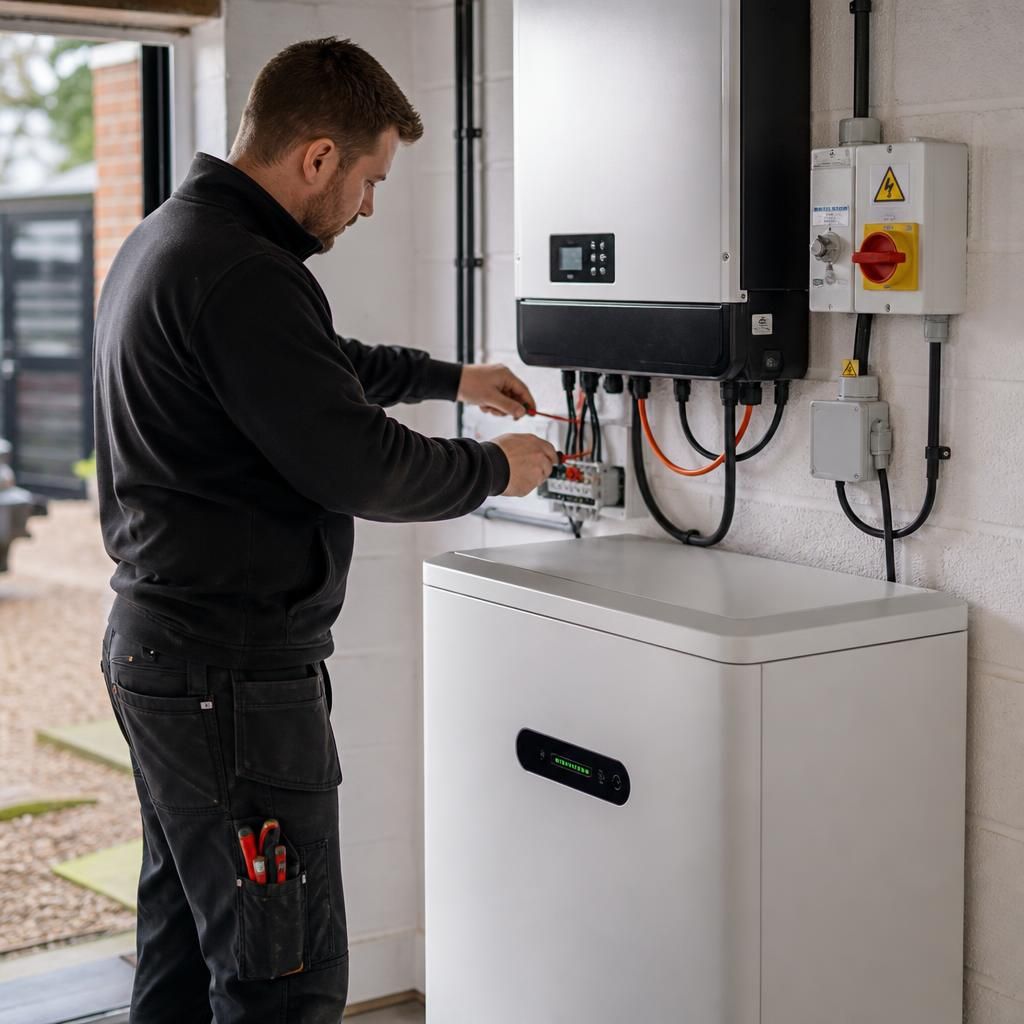
A certificate on its own does not show that a battery installation is safe. We explain which parts of the design relate to the property, the equipment and the electricity connection, so you can see what has been checked rather than relying on a generic compliance statement.
If the survey identifies a conflict between the proposed system and the building, we change the design or explain the work needed before installation. That matters particularly in older homes, where the existing electrical arrangement may not match the demands of modern storage equipment.