
What certifications should a renewable energy installer provide?
For solar panels, batteries and heat pumps, look for MCS certification, which confirms the installer meets recognised standards and supports eligibility for schemes such as the Smart Export Guarantee. Check that electrical work is covered by an appropriate registration, and ask whether the installer can provide TrustMark approval, insurance details and clear handover paperwork.
The certificate must match the technology being installed, the type of work involved and the business named on your quotation. For a domestic solar PV, battery or heat pump installation, current MCS certification is the main evidence that the installer follows recognised design and installation standards. TrustMark membership adds checks on business practice and customer service, but it does not replace technology-specific certification.
Check the installer’s current MCS scope
MCS certification applies to an installer’s approved activities, not simply to a company name on a website. Ask to see the current certificate and check that it covers the system you are considering. A business may be certified for solar PV but not for heat pumps, or for installation but not every related activity.
The certificate should show:
- the legal name of the certified business;
- the technologies it is approved to install;
- whether its scope covers domestic work, commercial work or both;
- the certificate number and current expiry date; and
- the certification body that issued it.
This matters when funding or export payments are involved. The correct MCS installation paperwork supports an application to the Boiler Upgrade Scheme where the heat pump and property meet the scheme rules. For eligible solar installations, it also provides the evidence commonly needed for the Smart Export Guarantee. Neither certification nor a quotation guarantees that a grant or export tariff will be available, so the property and proposed system still need checking.
Understand what TrustMark adds
TrustMark is a government-endorsed quality scheme covering business standards, customer service, technical competence and trading practice. It can give you another way to check how a firm handles quotations, complaints and customer protection.
It is not a substitute for MCS certification. An installer can have good business processes without being certified for the renewable technology you need. Check both points separately, and make sure the business on the TrustMark record is the same legal business named in the contract.
Check the electrical work separately
Solar panels, batteries and heat pumps all involve electrical work. The renewable installer should explain who designs the electrical connection, who carries out the work and what testing you will receive afterwards.
Ask whether the quotation includes the electrical installation certificate, test results and any required notification to the network operator. A battery may need changes to the consumer unit, protective devices or cable routes. The certificate for the panels or battery does not automatically prove that every alteration inside the property has been designed and tested correctly.
For an installation that includes a new circuit, consumer unit work or other changes to the fixed wiring, check that the electrical work is covered by the appropriate electrical registration. We provide the relevant test and handover paperwork alongside the renewable installation, so you can see which documents relate to the generation equipment and which relate to the property’s wiring.
Check the qualifications behind a heat pump installation
A heat pump is not only an outdoor unit. Its performance depends on heat-loss calculations, emitter sizing, pipework, controls, hot-water arrangements and electrical capacity. MCS certification helps you assess the renewable installation, but you should also ask who is responsible for the heating and plumbing work.
If the design retains a gas boiler, anyone working on that boiler must hold the legal registration required for gas work. If an oil-fired boiler or oil storage system is altered, ask whether the engineer’s registration covers oil-fired equipment. This is particularly relevant on properties that are off the gas grid, where an existing oil or LPG system may remain part of the design.
For an older house, ask the installer to explain the survey findings rather than relying on a certificate as proof of suitability. A listed building, solid-wall house or barn conversion may need a different pipe route, radiator changes, control strategy or planning check. Certification shows that the installer works to a recognised standard; it does not mean every property will suit the same design.
Ask what paperwork you will receive
A properly documented installation should leave you with more than a certificate displayed on a website. Before work starts, ask for the following items to be identified in the quotation or handover pack:
- a written system design and the main assumptions behind it;
- the MCS installation certificate, where applicable;
- electrical installation and testing documents;
- evidence of any required building control or network notifications;
- commissioning records and settings for the inverter, battery, heat pump and controls;
- product warranties and details of who handles a fault;
- maintenance instructions and recommended service checks; and
- the final price, including any remedial work or changes identified during installation.
These documents help if you sell the property, make a grant or export application, need a warranty claim or want another engineer to understand the system later. They also show whether the installer has considered the complete job rather than only the equipment being fitted.
Check who will actually carry out the work
Some businesses use a certified company to design or sign off a project while another team carries out the installation. That arrangement is not automatically unsuitable, but you should know who is responsible for the design, physical installation, testing and aftercare.
Ask whether the engineers are directly employed or subcontracted, and which business holds responsibility if something goes wrong. We keep the electrical, heating and renewable work with our own team, so the person assessing the system can account for the wiring, pipework and renewable equipment together.
What should make you cautious?
- A badge appears on the website but no current certificate can be provided.
- The certificate belongs to a different company name.
- The installer cannot state which technology or work scope the certification covers.
- The quotation promises a grant or income without checking the property and system.
- The design contains no information about heat loss, electrical changes, roof constraints or equipment location.
- You are offered a low headline price but no clear list of certificates, notifications and commissioning documents.
Certification is an important starting check, not a replacement for a proper survey. The right installer can show current credentials, explain which parts of the work each credential covers and put the design, price and handover paperwork in writing before installation begins.
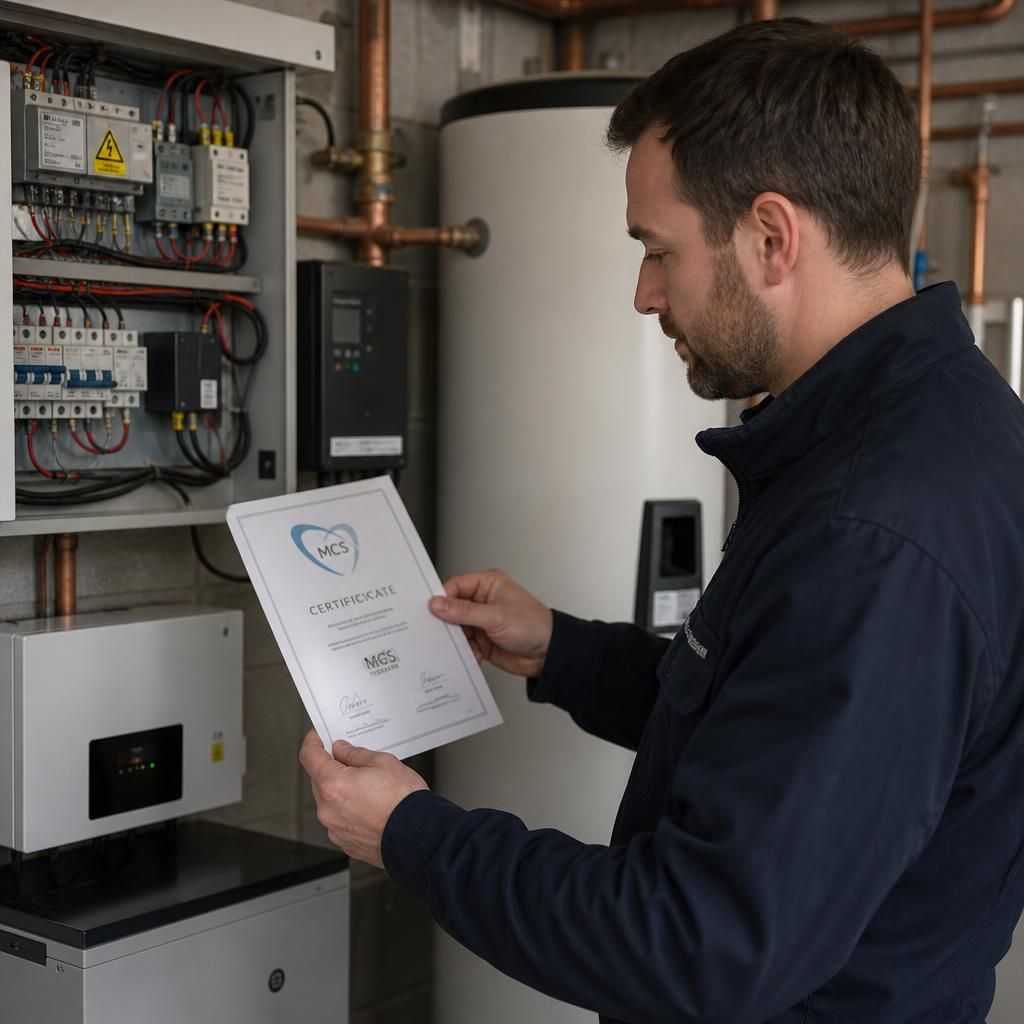
A manufacturer’s training certificate can show that an engineer knows a particular inverter, battery or heat pump. It doesn’t replace certification for the installation itself. When you compare quotations, treat product training as an extra rather than the main qualification. The important question is whether the installer’s recognised certification covers the complete work being proposed, including design, electrical connections, commissioning and handover. That distinction helps you avoid choosing a firm that knows the equipment but cannot demonstrate responsibility for the finished renewable energy system.