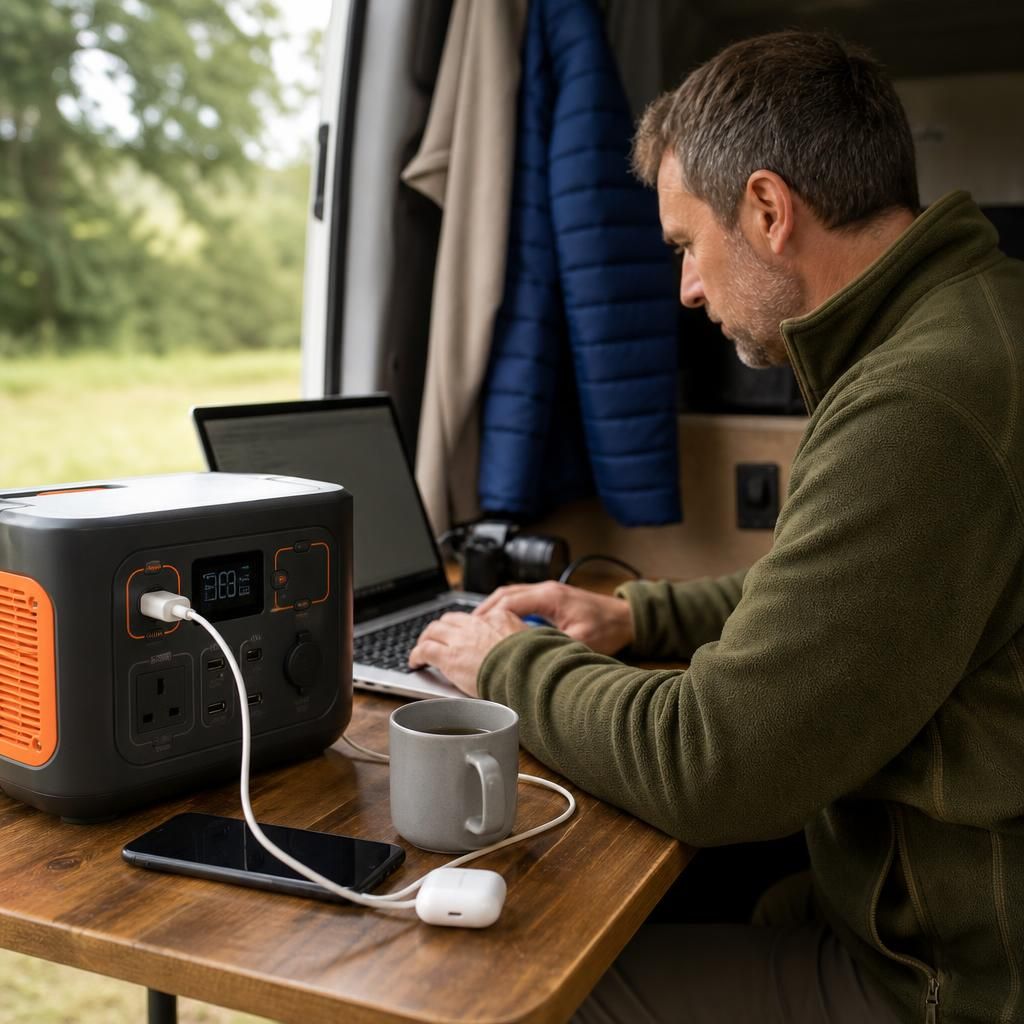
How long will a portable solar generator run my equipment?
A portable solar generator will run your equipment for roughly its usable battery capacity in watt-hours divided by the equipment’s total wattage, allowing for conversion losses. Add the running wattages of everything connected, then compare that figure with the generator’s usable capacity rather than its headline capacity.
The runtime shown by a portable solar generator is a guide rather than a fixed promise. The same battery may run a router for many hours but power a kettle, heater or power tool for only a short period. The result depends on the battery’s usable capacity, the equipment’s actual demand and the way the generator delivers power.
Start with the equipment rating. Look for the wattage on the appliance label, charger or power supply. A laptop charger marked 65W does not necessarily mean the laptop draws 65W continuously. Its demand may fall once the battery is charged. A fridge, freezer, pump or power tool can also switch on and off, so its average demand differs from its starting demand.
Make a list of the equipment you expect to use. Record the wattage of each item and how long you expect it to run. For equipment that cycles, such as a fridge, use its average consumption if the manufacturer provides it. If you cannot find a reliable figure, allow for the higher demand when comparing generators.
Check usable capacity, not just the headline battery size. A generator may state its capacity in watt-hours, but the full figure is not normally available at the socket. Some energy is retained by the battery management system, and the inverter uses some when converting battery power into mains electricity. The usable figure in the technical specification gives a more realistic starting point.
AC equipment normally loses more energy than USB or 12-volt equipment because it passes through an inverter. A phone charged directly from a USB outlet can therefore use less stored energy than a similar charger connected through the mains sockets. The difference matters when you are trying to keep low-power equipment running for a long period.
Check two different output ratings. Continuous output is the power the generator can supply steadily. Peak or surge output is the higher short-term power available when some motors and compressors start. A generator can have enough battery capacity for a fridge, yet still fail to start it if its inverter cannot handle the starting surge.
Motors, compressors and pumps are the main concern. Fridges, freezers, boilers with pumps and some power tools can briefly demand considerably more than their normal running wattage. A kettle, fan heater or immersion heater may not have a starting surge, but its high continuous demand will deplete the battery quickly.
Running several items together adds their demands. A router, lamp and laptop may be within the continuous output rating individually but exceed it when used at the same time. Leave headroom below the generator’s maximum rating, particularly when one of the loads contains a motor or compressor.
Solar input changes the calculation. In good conditions, a panel can replenish some of the energy while equipment is running. Cloud, shading, panel position, low winter sun and the generator’s maximum solar-input rating all reduce the contribution. Treat solar charging as assistance unless you have checked the expected generation for that location and season.
Charging from a vehicle or mains supply also takes time, and the charging input is separate from the output available to your equipment. A generator may be able to accept a high charging rate but still have a lower AC output limit. Check both figures before planning to run equipment while charging.
Temperature and battery condition affect the result too. Cold conditions can reduce available performance, while an ageing or heavily used battery may not deliver the same capacity as when new. Cables, extension leads and additional adapters create small losses and can also introduce a safety concern if they are not rated for the load.
For a useful estimate, compare the generator’s usable watt-hours with the total watt-hours your equipment is expected to consume. Allow for inverter losses when using AC sockets, and allow extra capacity for starting surges. The estimate becomes less reliable when the appliance has a compressor, heater or motor, so a real-world test is preferable where the equipment is important.
A sensible test involves charging the generator fully, connecting the intended equipment and recording the battery level over a known period. Keep the load within the continuous and peak ratings. Do not test a critical medical device or other essential equipment by trial and error; use the manufacturer’s stated requirements and seek professional advice if the figures are unclear.
For planned use, choose the generator after deciding which equipment is essential. Keeping a router, phone, laptop, lights or monitoring equipment running requires a different capacity from powering refrigeration, pumps or cooking appliances. Separating essential loads also prevents a high-demand appliance from using the stored energy needed by lower-power devices.
If we are helping assess electrical equipment for a property, we can check the stated loads, starting characteristics and connection method before you rely on a portable generator. That is particularly important where a generator may be connected to fixed wiring. It must not be plugged into a wall socket to energise the building, as back-feeding can endanger anyone working on the supply. A suitable changeover arrangement and correct earthing are needed for a fixed electrical connection.
A manufacturer’s runtime figure only makes sense alongside its test conditions. It may be based on a light, steady load, so it won’t predict performance with a fridge, pump or heater. Check whether the figure was measured from a full charge to automatic shut-off, and whether it assumes AC output.
If the generator has a display showing live demand or estimated runtime, treat it as a moving calculation. The estimate may fall sharply when a high-load appliance starts, then rise again when a cycling appliance switches off. Use the reading to see how your equipment behaves, but base an important backup plan on the appliance requirements and the generator’s usable capacity.