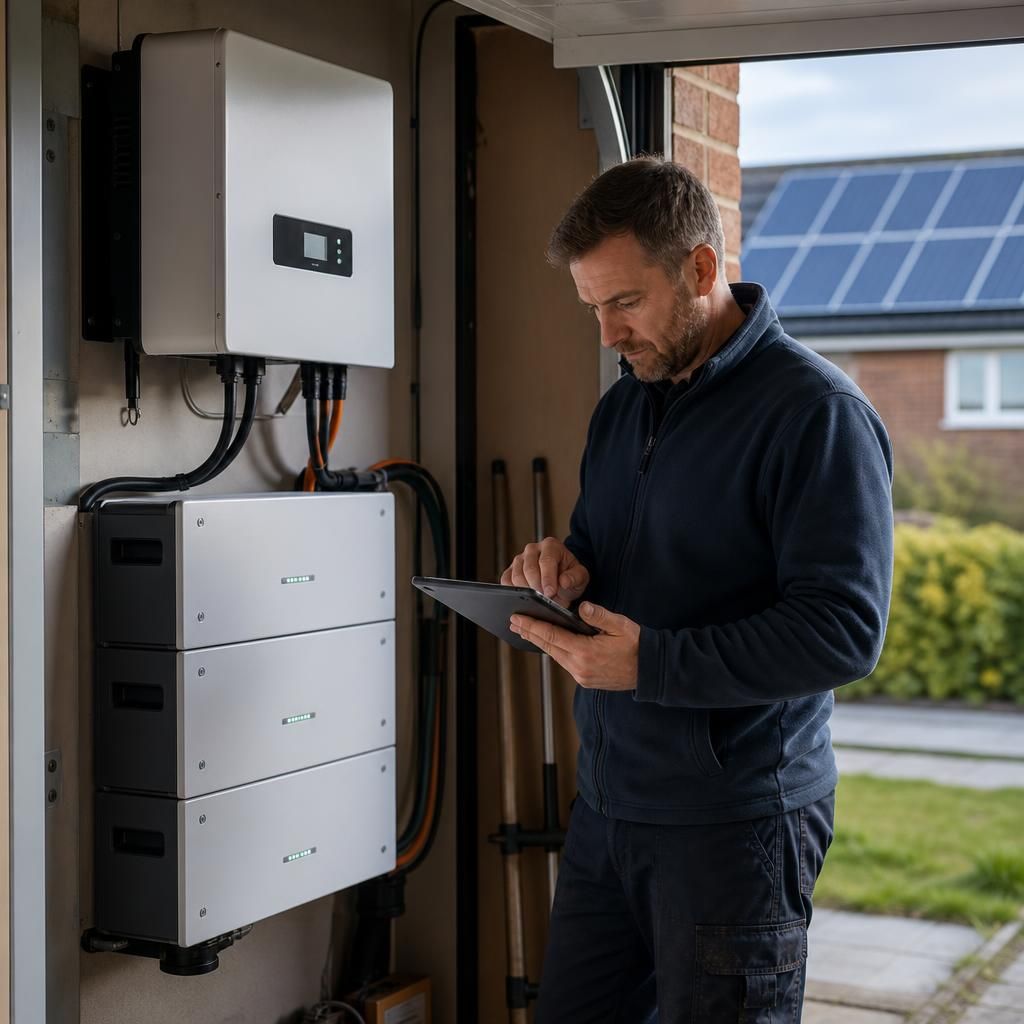
How long can a solar battery provide backup power?
A solar battery may power essential circuits for several hours, but the actual backup time depends on its usable capacity, household demand and whether your solar panels are still generating. We size the battery around the appliances you need to keep running, rather than treating its headline capacity as a guaranteed runtime.
There is no fixed backup duration for a solar battery. We work it out from the battery’s usable capacity, the power being drawn and the circuits connected to the backup supply. A lightly loaded essential-circuits system can last much longer than a whole-home system running electric heating and cooking appliances.
Usable capacity matters more than the headline capacity. A battery has a nominal capacity, but the control system keeps a reserve and limits how far the cells discharge. The inverter also uses some energy. The figure available during a power cut is therefore lower than the number printed on the battery specification.
We use the usable capacity in a simple calculation:
- usable battery energy, measured in kilowatt-hours
- divided by the average load, measured in kilowatts
- with allowance for inverter losses and the battery’s minimum reserve
The result is an estimate rather than a guaranteed running time. A fridge does not draw its full rated power continuously, while a kettle or electric shower draws a high load for a short period. Your actual usage pattern can therefore change the result considerably.
The appliances you run make the biggest difference. Lighting, broadband equipment, a television, refrigeration and small appliances are relatively manageable loads. Electric showers, immersion heaters, ovens, hobs, tumble dryers, heat pumps and EV chargers use much more energy. Running several of them together can reduce the available backup period and may exceed the inverter’s maximum output.
For this reason, many backup systems supply selected essential circuits rather than every circuit in the consumer unit. We can discuss which circuits matter most to you, such as refrigeration, lighting, communications equipment, security systems or heating controls. High-demand appliances can remain on the normal supply and be excluded from the backup circuits.
A whole-home backup system needs careful load planning. Connecting every circuit does not mean the battery can run everything at once. The inverter must be able to handle the starting current from motors and the combined demand from appliances. If the property has electric heating, an electric hot-water cylinder or an EV charger, we check how those loads would affect both the duration and the system’s maximum output.
Battery settings also affect the time available. A reserve may be kept for later use, and the system may reduce output when the battery reaches a low state of charge. This protects the battery and ensures the controls can shut down safely. We explain those settings so you know what the displayed charge level means during an outage.
Solar panels can extend the backup period, but only if the system is designed for it. Standard grid-connected solar panels switch off when the grid fails. They must not continue exporting electricity onto a damaged network. A compatible battery inverter can create a safe local supply and allow the panels to generate again during the outage. The battery may then recharge from the panels while the sun is producing enough energy.
Solar generation is not constant. Roof orientation, shading, season, cloud cover and the time of the outage all affect how much energy reaches the battery. A system that continues through a daytime outage in good weather may behave differently during a dark winter evening. We include those conditions when discussing what the system can realistically support.
An outage lasting longer than the battery’s stored energy requires careful energy management. Keeping non-essential circuits off, avoiding high-power appliances and using solar generation when available can preserve the remaining charge. Once the grid supply returns, the system can resume its normal operating pattern and recharge according to its settings.
At survey stage, we look at your existing solar installation, the battery’s usable capacity, the inverter output and the circuits that need protection. We also consider how you heat the property and whether you want backup for individual appliances or a wider part of the home. That gives you an expected duration based on your actual equipment and normal usage, rather than a figure taken from a battery brochure.
Backup time can gradually change as the battery ages. The cells normally hold less energy after repeated use than they did when new, so the original runtime estimate isn’t permanent. We allow for the battery’s expected condition when discussing how much of the home it should support, rather than sizing the system around an ideal figure on day one.